| Read in browser | ||||||||||||||
 The world is getting hotter, and the consequences could be deadly. New research quantifies the risks if the world fails to curb emissions and adapt to warming in the pipeline. Today's newsletter looks at the locations most vulnerable to rising temperatures. Plus, exclusive details about the prominent researcher who left NASA, citing US attacks on science, and a look at India's new climate targets. Did someone forward you this newsletter? Subscribe to the Green Daily to get free climate news in your inbox six days a week. Danger zonesPoor countries may lose 10 times more people to deaths from high temperatures than rich ones, according to an analysis by Climate Impact Lab. The research, published Wednesday, is designed to help cities and communities understand and respond to the dangers they face from rising temperatures. It comes as a record-breaking heat wave grips much of the US and as more evidence emerges that global warming is accelerating. While the rising heat is global, its consequences for health vary dramatically depending on affluence. "I continue to be shaken by the inequality of climate change," said Michael Greenstone, a University of Chicago economist who co-authored the report and who co-directs Climate Impact Lab, a collaboration among researchers focused on emerging risks. "The extra deaths are all going to occur in places that contributed very little" to greenhouse gas emissions that are warming the atmosphere. 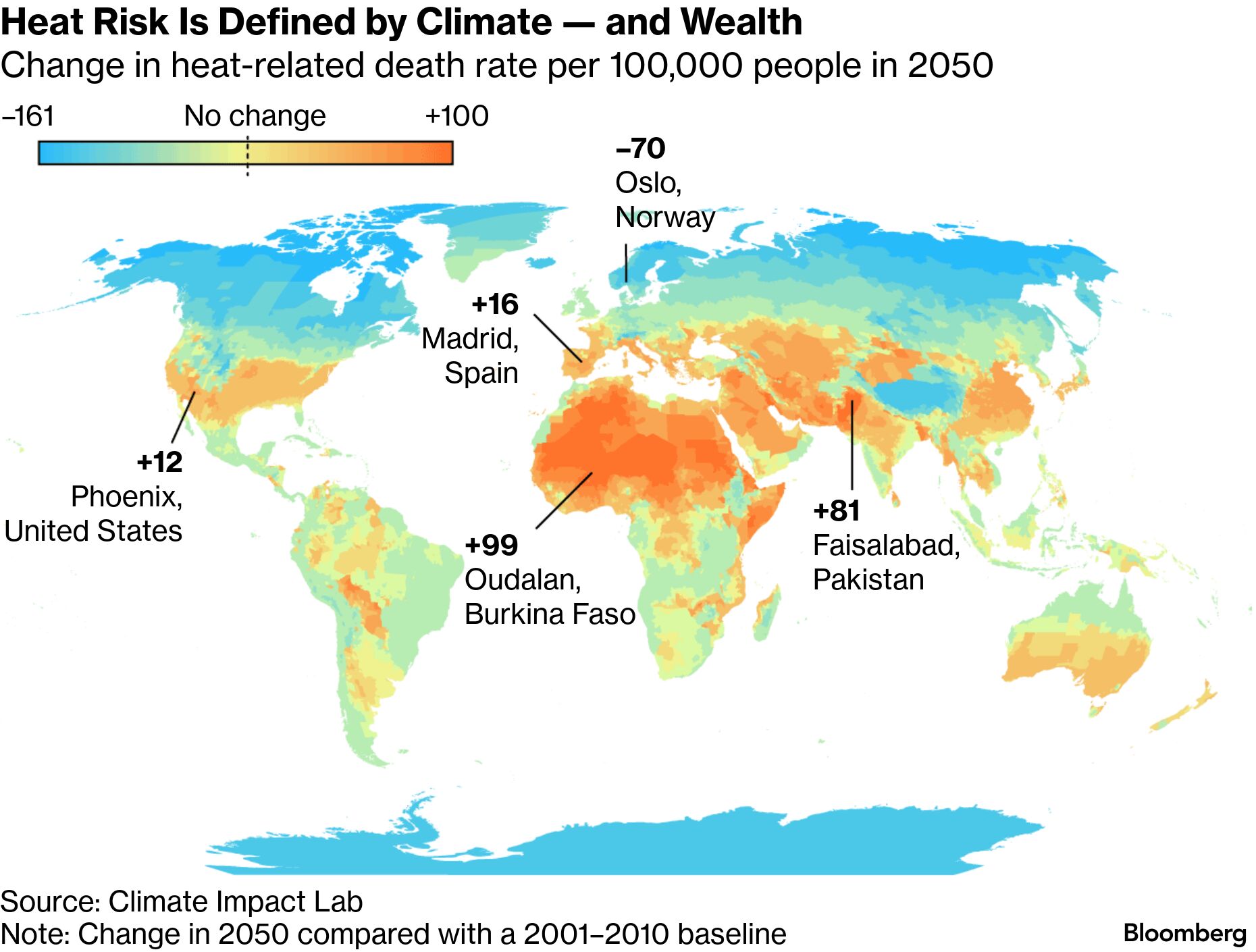 The new report projects that by 2050, vulnerable countries will see an increase in heat-related deaths equivalent to current fatalities from common diseases. Niger, Burkina Faso and other countries in Africa's Sahel region could see 60 more deaths a year per 100,000 people — more people than currently die from malaria in Africa. About 55 people per 100,000 die of HIV/AIDS in Djibouti; it might experience a commensurate rise in heat-related mortality. In southeastern Bolivia, the death rate could rise by 30 people per 100,000, or about the current rate from diabetes. Some cold climates will see a drop in heat-related deaths. Northeastern Russia's New Siberia Islands could register the biggest decline in the mortality rate — 161 fewer per 100,000 people — although not many people actually live there. Other places in rich countries also benefit, including the North Slope of Alaska, Banff, Canada, and Oslo. All but two of the 20 countries with the biggest net improvements are high-income, and 16 of the 20 countries facing the most new deaths are lower-income. "Alarm bells are ringing," said Cascade Tuholske, a geographer at Montana State University who works on climate risk. "Mortality rates will continue to rise due to extreme heat that is being driven by carbon emissions, by fossil fuels. The burden is falling on those who have the fewest resources to adapt and the people who are not causing this problem, by and large." Read the full story on Bloomberg and subscribe for unlimited access to all our climate coverage. A matter of degrees0.35 The average annual rate of warming in degrees Celsius from 2015 to 2025. That's faster than previous periods, indicating that global warming may be accelerating. Risks already here"These numbers represent real people who have lost their lives." Friederike Otto Professor, Imperial College London Otto led a study that found 16,500 people in Europe died due to heat last summer. It's a reminder that while future climate change poses grave risks, deadly impacts are already here. India's long-awaited planBy Ishika Mookerjee and Lou Del Bello India set a modest target to cut a key emissions metric 47% by 2035, as the world's third-largest polluter attempts to balance growing energy demand and action on global warming. 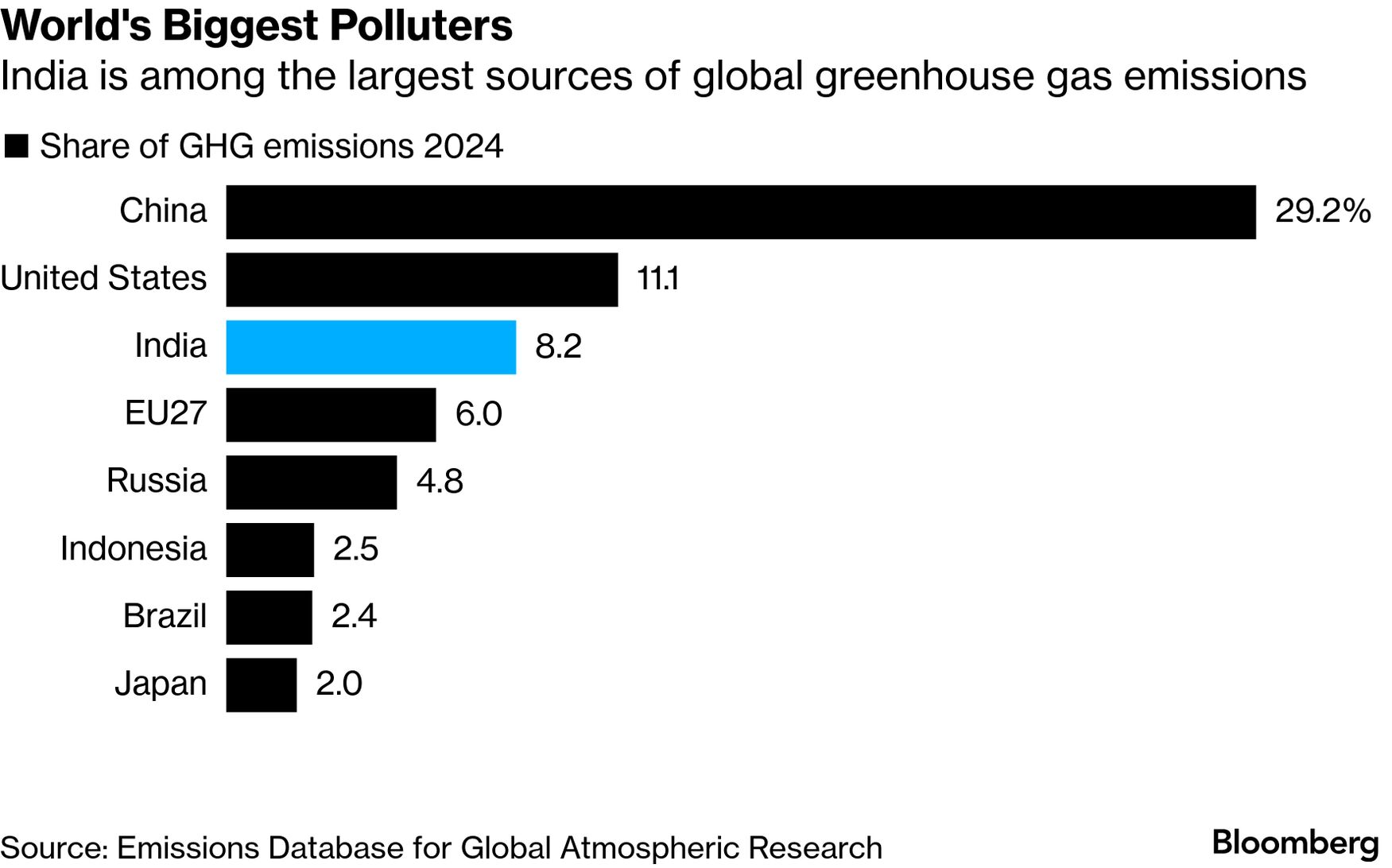 The new goal to reduce emissions intensity — the amount of pollution generated per unit of gross domestic product — is calculated against a baseline year of 2005, and makes only an incremental advance on the nation's prior commitments. India set an earlier pledge in 2022 to cut the metric 45% below 2005 levels by 2030. The long-delayed strategy, which had originally been due by February 2025 under the terms of the Paris Agreement, was outlined at a cabinet briefing Wednesday. New plans also include a target to raise the share of non-fossil electricity capacity to 60% by 2035 from a prior goal of 50% by 2030, which India said it has achieved ahead of schedule. India's fresh targets follow a series of underwhelming climate strategies from dozens of other countries that the United Nations has warned will leave the world far off track to limit global warming this century to 1.5C. The new goals "underestimate the country's potential for transformative clean energy growth," said Lauri Myllyvirta, lead analyst at the Centre for Research on Energy and Clean Air. "India's booming clean energy industry is highly likely to deliver much faster progress than policymakers were prepared to commit to today." Read the full story about India's new climate plan. A prominent NASA exitBy Eric Roston and Lorelei Smillie Kate Marvel, a high-profile NASA climate scientist, resigned from the space agency's Earth research division on Tuesday, citing in a resignation letter the Trump administration's attacks on science and "upheavals of the past year."  Kate Marvel Source: NASA "I never expected that science itself would come under attack, simply because it — like journalism, history, and even the best kind of art — is a way of seeking truth," she wrote in the letter, seen by Bloomberg and addressed to Gavin Schmidt, director of NASA's Goddard Institute of Space Studies, and Ron Miller, the institute's deputy director. A NASA spokesperson said it would be inappropriate for the agency to comment on personnel matters. Marvel, who published a book last year called Human Nature, was an author of the Fifth National Climate Assessment, released in 2023. The sixth edition of the US government's major climate research initiative was effectively canceled by the Trump administration last spring. Read the full story, including the administration's priorities for NASA. Your Big Take listen Bloomberg reporter Todd Woody and Zero podcast host Akshat Rathi join Sarah Holder to discuss early signs that the high cost of oil is reigniting consumer interest in electric vehicles and how companies and countries are beginning to respond. Listen wherever you get your podcasts. More from GreenSingapore is delaying a sustainable aviation fuel levy that airline customers were meant to start paying next month, due to the surge in fuel costs spurred by the Iran war. The extra charges will now begin Oct. 1, Singapore's civil aviation authority said on Wednesday. The new levy will depend on the class of travel or length of flight, and could total as much as S$41.60 ($32.54) for passengers. Customers will pay an additional S$1 for trips to Southeast Asia, and S$10.40 for flights to the Americas, the Civil Aviation Authority of Singapore said in November.  Passenger aircraft at the JetQuay CIP Terminal of Changi Airport in Singapore. Photo: Bloomberg Chevron warned that California is heading toward an energy crisis due to the state's reliance on imported fuel. A spokesman for Governor Gavin Newsom's office said oil companies are "cashing in" on the war in Iran and running a "coordinated campaign" to attack California. The Asian Infrastructure Investment Bank aims to help the region accelerate the adoption of cleaner power as nations respond to energy shocks from the Iran war by seeking greater self-sufficiency. Domestic gas supply in several European cities contains high levels of benzene, an odorless substance that can cause cancer, according to research released on Wednesday. Ninety-one US-based ESG funds shut down last year, compared with the launch of just nine new offerings, according to data compiled by Morningstar. More from Bloomberg
Explore all Bloomberg newsletters. We're improving your newsletter experience and we'd love your feedback. If something looks off, help us fine-tune your experience by reporting it here. Follow us
You received this message because you are subscribed to Bloomberg's Green Daily newsletter. If a friend forwarded you this message, sign up here to get it in your inbox.
|




AI isn’t ready for trading
Testing showed models lost money. ...