| Read in browser | ||||||||||||||
 The war in Iran has sent gas prices spiraling well above where they were a month ago. To avoid pain at the pump, drivers are taking a second look at EVs, which have seen sales crater after the Trump administration ended federal incentives last year. Today's newsletter looks at electric cars' new lease on life. Plus, how Asian countries are coping with the surge in gas prices. Subscribe to Bloomberg for unlimited access to more stories on how the conflict in the Middle East is impacting auto and gas markets across the world. Consider the electronBy Kyle Stock One would be hard-pressed to find a bigger petrol-head than Michael Prichinello, cofounder of the Manhattan Classic Car Club. And yet, after years of driving the world's most precious (and thirstiest) sports cars, Prichinello is shopping for an electric pickup truck – "begrudgingly" – because his gas bill has stretched to $50 a day. "My commute is 220 round-trip, and I drive a full-sized Silverado," he explained. "She's a gem, and I'll never get rid of her, but it feels irresponsible."  Zac Moseley, left, and Michael Prichinello, right, of the Classic Car Club in New York. Photographer: Michael Nagle/Bloomberg The war in Iran and the surging gas prices that followed are reinvigorating interest in electric vehicles after months of slowing sales. This week alone, US drivers will pay an additional $1.65 billion at the pump, according to BloombergNEF. Not surprisingly, EV holdouts are starting to go electric for the first time or are crunching the mileage numbers on the growing batch of hybrid vehicles. Somewhere around $4 a gallon is where car shoppers will start going electric en masse, according to Steven Cegelka, chief operating officer of Ignition Dealer Services, a consultancy for car dealerships. "It's all going to boil down to the question: Is EV the solution or is it really the hybrid?" he said. "It is what it is, it happens every time." 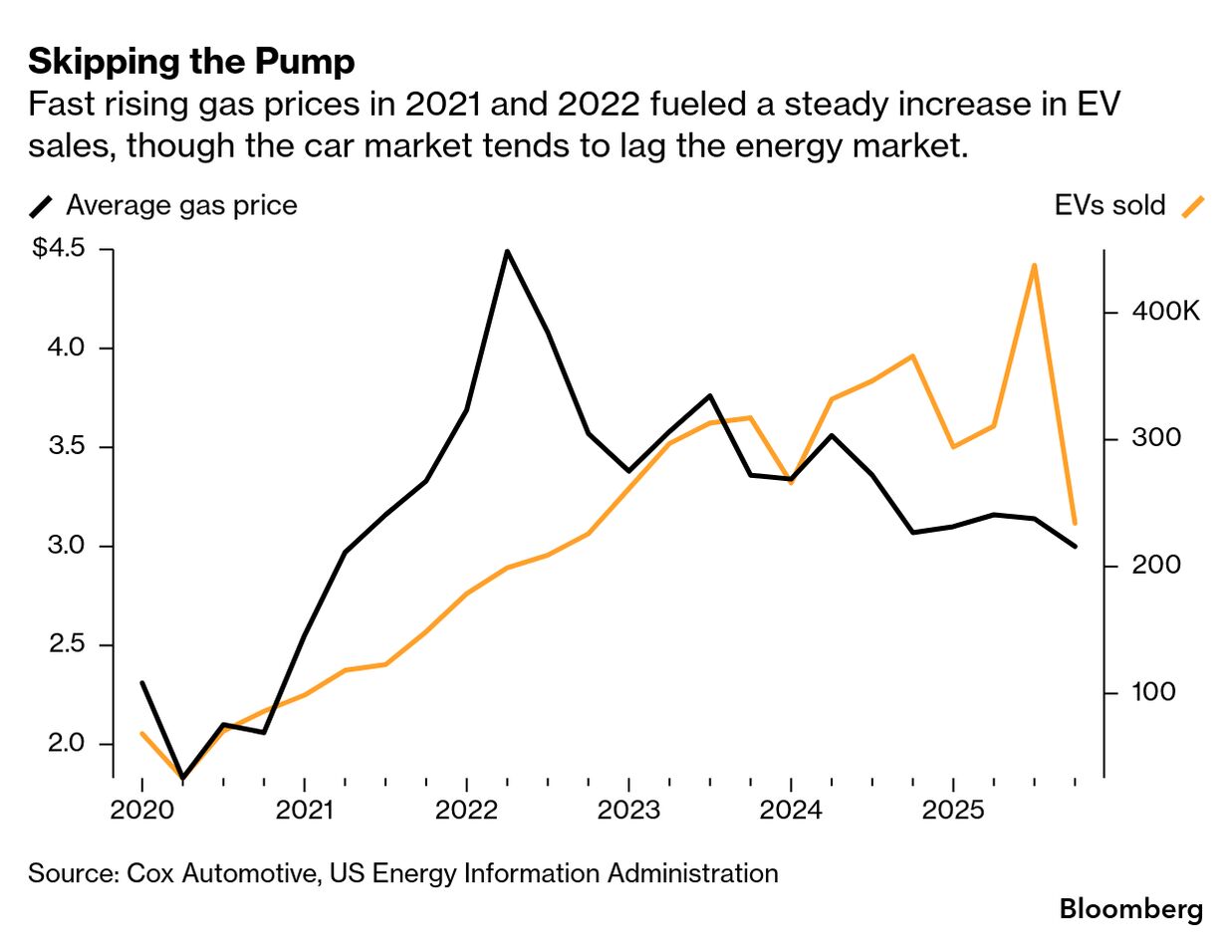 CarEdge, an AI-driven platform that helps car shoppers negotiate with dealerships, said search traffic for electric vehicles was up 20% in the week following the initial attack on Iran, compared with the prior week. For the most popular EVs, such as the Tesla Model Y and Chevrolet Equinox, traffic nearly doubled. Since the initial barrage Feb. 28, the price of a gallon of regular gas in the US has climbed by about 21% to $4.26 a gallon, a level not seen in almost three years. For the average American driver, that equates roughly to an extra $32 a month in fuel costs, though the financial pain will be greater for those driving luxury cars, which require more expensive gas, and drivers in less efficient vehicles; there are about 50 million Americans like Prichinello who pilot pickup trucks and another 10 million or so households with a large SUV. The EV-curious will be spoiled for choice, at least for the time being. Once federal purchase incentives of up to $7,500 per vehicle expired at the end of September, sales of electric cars and trucks swooned by 36% in the recent quarter, compared to the year-earlier period. Though carmakers have been trimming EV production and culling future models, inventory levels for electric cars and trucks are nearly double that of internal-combustion vehicles. 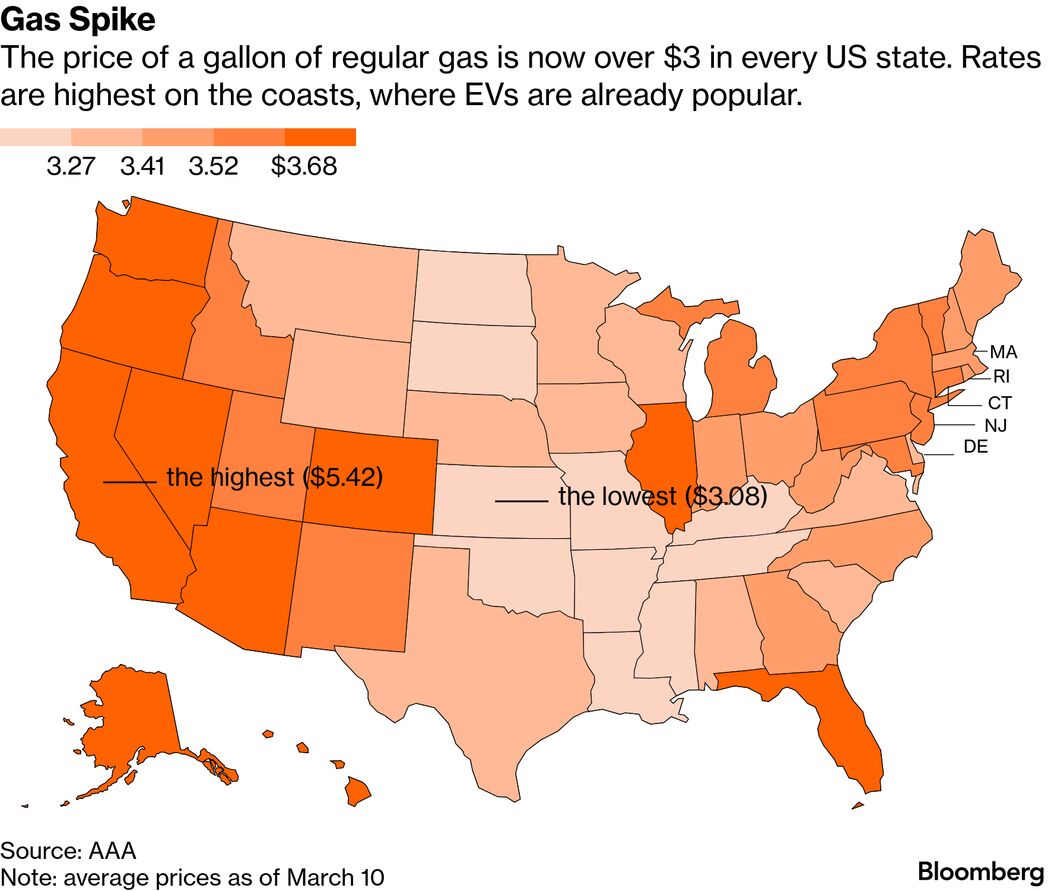 In the five or so years that EVs have been in the mass market, gas prices have largely been both low and stable. However, the one outlier was a spike to $5.36 per gallon in the summer of 2022 after Russia invaded Ukraine. Sales of battery-powered machines surged by 66% that year, a period that predated federal purchase incentives. Drivers don't forget that kind of thing, particularly when inflation is running hot. At the end of 2024, long after gas prices had cooled, car shoppers said saving on fuel was their No. 1 incentive to go electric, according to a study by Carvana, a predominantly online used-car vendor. Harvard economist Elaine Buckberg, formerly of General Motors, said the duration of the inflated fuel prices may prove more telling than the initial spike. At the moment, high gas prices are likely only influencing people who are currently shopping for a car, she explained. But if gas prices stay high for three months or more, even folks who weren't in the market for a new vehicle may get the EV itch. "A second incident of major gasoline price volatility in under five years may make consumers more sensitive to this one," she added. Read the full story to see how volatility will weigh on drivers. Subscribe to the weekly Hyperdrive newsletter for a global view of the future of cars. Cost cutting$30,000 The price target for an electric pickup that Ford is planning to release next year. That would be $20,000 cheaper than the average car in the US. Lightly used"It was just a matter of time until people sort of started trusting used EVs." Liz Najman Director of market insights, Recurrent More and more used models are popping up. Will they experience an uptick in prices as interest increases? Asia on the frontlineBy Alisha Sachdev, Nicholas Lua, and Will Kubzansky 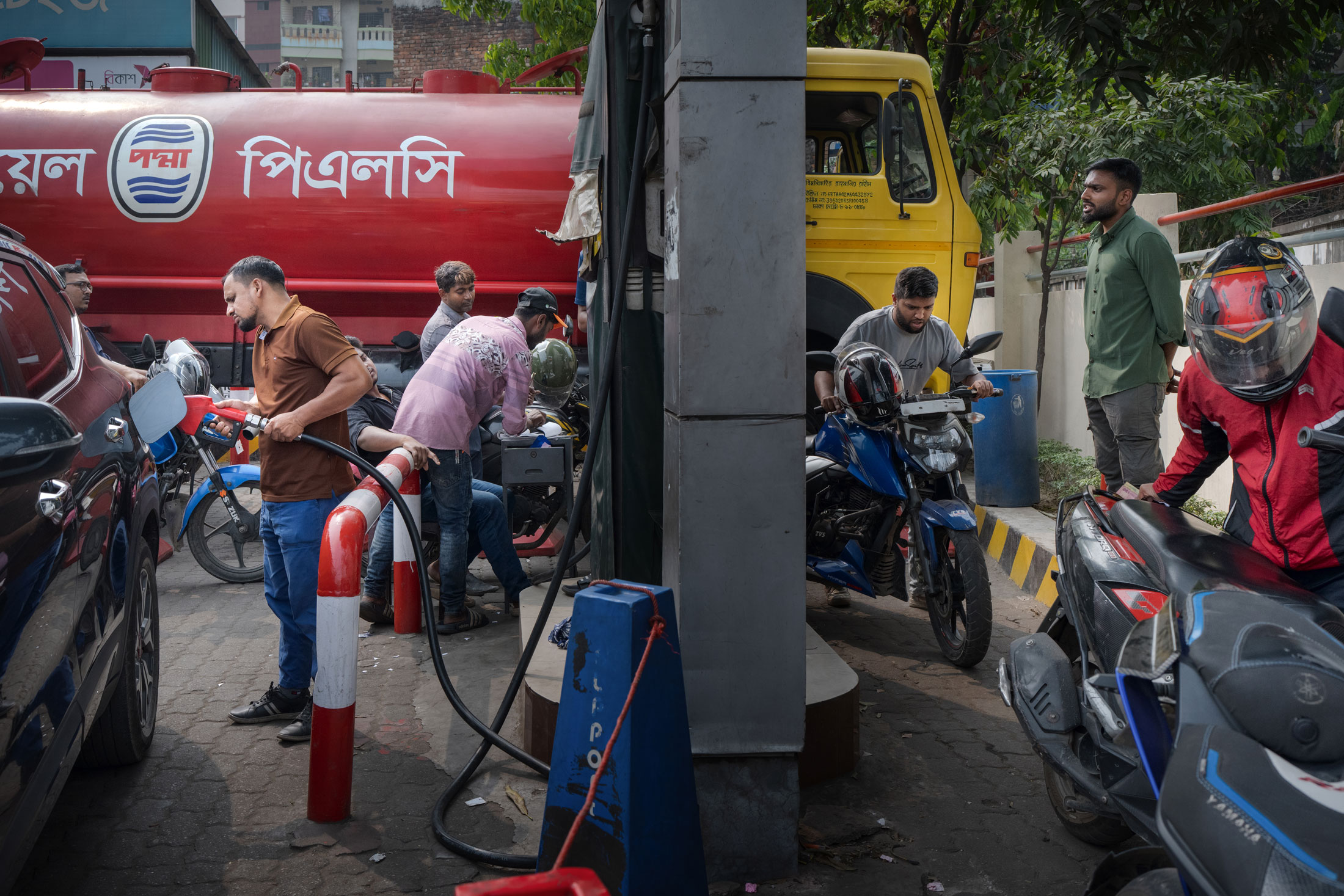 Drivers refuel vehicles and motorcycles at a petrol station in Dhaka, Bangladesh, on March 9. From metal furnaces in western India to rice paddies in Southeast Asia, billions of people are dealing with gas outages, drawing up "crisis menus" and preparing for fuel rationing at the pump. As the war in the Persian Gulf enters its third week, Asia is caught in an energy emergency — a regional crunch that is rapidly turning into a global one as disruption widens and prices spike. The Iran conflict has effectively halted trade through the Strait of Hormuz, a vital maritime waterway through which — in normal times — a fifth of global oil production flows, along with a multitude of other commodities from fertilizer to aluminum and helium for chip production. Aluminium Bahrain BSC announced a phased production shutdown at the world's largest single-site smelter on Sunday, deepening the disruption to the industry, which has seen prices soar. The impact, now rippling across the globe, is for now most acute in Asia. The narrow chokepoint in the Strait of Hormuz is a key transit route for tankers ferrying liquefied petroleum gas, used in kitchens and some industrial processes, to Asian markets. India takes 90% of its LPG imports from the Middle East — alternatives from the US would take at least 40 days to arrive, and cost a lot more. Read today's Big Take on how the war in Iran is impacting Asian nations. California's insurance strugglesBy Todd Woody As another wildfire season looms, insurance companies have abandoned some California neighborhoods at lower risk of burning, forcing tens of thousands of homeowners to obtain bare-bones coverage from the state's insurer of last resort. California intended the insurer, called the FAIR Plan, as a backstop for homeowners unable to secure insurance on the private market because they live in areas of the state classifies as at high risk for wildfire due to vegetation, terrain and weather. Between September 2024 and December 2025, enrollment in FAIR surged 43% as insurers pull back from California following a series of catastrophic wildfires, including last year's $40 billion Los Angeles inferno. 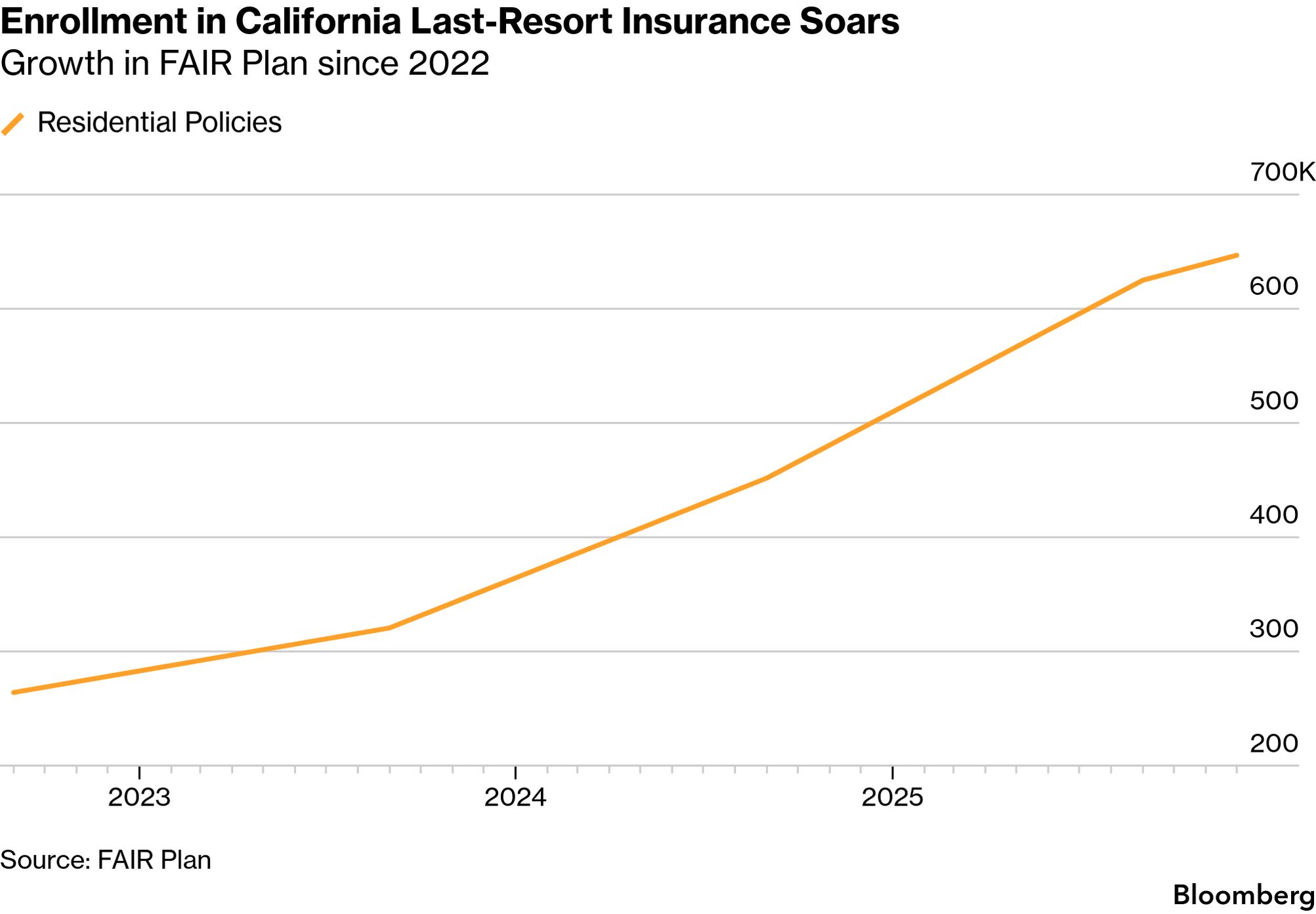 But in a sign insurers have curtailed coverage even in places less likely to face wildfires, 14% of current FAIR policies are for properties largely in urban zones with low fire risk, according to a Bloomberg News analysis of FAIR plan data, with 28% of the cash-strapped plan's exposure now in those areas. "What we're seeing is that the infection of the market that existed in the high-fire-risk areas has spread into the normal parts of the market," said Michael Wara, director of the climate and energy policy program at Stanford University. There are tentative signs, though, that access to the private market is improving. After breakneck growth in the FAIR Plan since 2024, enrollment increased by less than 4% in the final three months of last year. The California Department of Insurance has recently approved or is currently considering rate increase requests from six major insurers that promise quicker reviews of proposals in exchange for commitments to expand coverage in high-risk areas. "We are not out of the woods," California Insurance Commissioner Ricardo Lara told lawmakers in February. "A structurally healthier market is a 3–5-year project." Read the full story to see how private insurers are responding to fire risks. This week's Zero listen In the latest episode of Zero's Imagine series, Akshat Rathi is joined by Abi Daré, winner of the inaugural Climate Fiction Prize. Abi is the bestselling author of And So I Roar, which tells the story of the teenager Adunni as she confronts superstition, lack of education and the impacts of climate change on the rural communities of Nigeria. Abi joins Zero to talk about the role climate change plays in her storytelling, and how she has seen Nigeria adopt climate solutions as it develops rapidly. Listen now, and subscribe on Apple, Spotify or YouTube to get new episodes of Zero every Thursday. More from Green Ophelie Mortier Source: Degroof Petercam Asset Management To many, the strategy would be unthinkable. But for almost two decades, a $60 billion wealth manager in Belgium has been shunning US Treasuries. Degroof Petercam Asset Management says Treasuries aren't good enough for its flagship sustainable government bond fund because the US doesn't score well enough on metrics like equality and democracy. More recently, however, what started as a niche strategy in a single fund has spilled into other parts of DPAM. And this time the concern isn't sustainability, it's the fear of financial losses. The decision to cut US Treasuries from other parts of the wealth manager's portfolio was based "more on valuation than anything else," says Ophelie Mortier, DPAM's chief sustainability officer. Read the full story on Bloomberg.com EU nations are discussing ways to curb energy prices, as concerns mount over their economic impact and increasing risks to supplies. More from Bloomberg
Explore all Bloomberg newsletters. We're improving your newsletter experience and we'd love your feedback. If something looks off, help us fine-tune your experience by reporting it here. Follow us
You received this message because you are subscribed to Bloomberg's Green Daily newsletter. If a friend forwarded you this message, sign up here to get it in your inbox.
|




Highlights from Bloomberg CityLab 2026 in Madrid
The conference kicked off with remarks from the mayors of Madrid, London and more. ...