| Read in browser | ||||||||||||||
 /> />
Inflation worries, meet home insurance worries. Policy costs are on the rise across the US, with particularly extreme increases in hurricane- and fire-prone regions. Today's newsletter looks at just how much the cost of insurance has ballooned since 2021 and where the steepest increases will be this year. Plus, EV displaced millions of barrels of daily oil use last year, a trend set to accelerate, and major weather events threaten to shatter temperature records in the US and disrupt mining operations in Australia. Paying a premiumUS home insurance premiums are set to rise for a fifth straight year in 2026 as insurers grapple with losses from extreme weather and high rebuilding costs. The average annual premium is projected to increase 4% to about $3,057 this year, after jumping 12% in 2025, according to Insurify, an online insurance comparison site. The expected gain follows several years of steep growth in rates. Since 2021, premiums have climbed 46%, roughly three times as much as inflation, Insurify said. 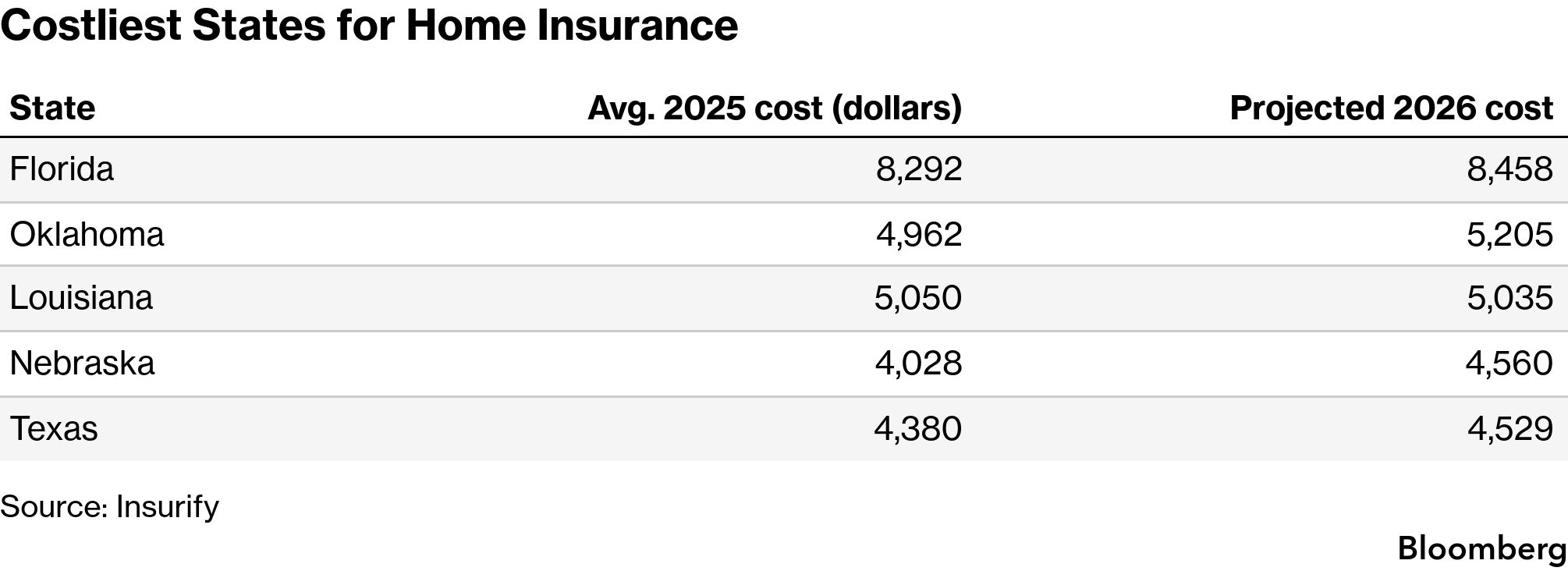 /> />
The forecasts are in line with other recent estimates. A report released Tuesday by Lending Tree, an online mortgage comparison site, found home insurance price increases were outpacing both inflation and income growth. In a separate analysis last year, the Consumer Federation of America said premiums rose in 95% of ZIP codes between 2021 and 2024. Over that period, the cost of coverage for a typical homeowner increased by $648 on average. There is a growing body of research connecting extreme weather, exacerbated by climate change, to insurance price increases. A US Treasury Department analysis of more than 243 million home policies, released in January 2025, concluded that communities routinely affected by severe weather were paying substantially more than those that were not. No hurricane made landfall in the US in 2025, but Matt Brannon of Insurify pointed to the toll from severe convective storms, which can produce tornadoes, hail and destructive winds. Insured losses from such storms have exceeded $42 billion for three years running, an amount significantly higher than the 10-year average, according to reinsurer Munich Re. Those events have hit the middle of the country especially hard. In 2025, premiums jumped by more than 20% in six states, including Minnesota (+34%), Colorado (+33%), Nebraska (+25%) and Oklahoma (+24%). Florida remains by far the most expensive state to buy homeowners insurance, with the average premium set to approach $8,500, more than double the national average. Read the full story on Bloomberg.com and subscribe for all the latest on the insurance crisis.
Big risk, big money$622,000 The quoted price of a policy to insure one of the ultraluxe mansions on Star Island, an exclusive Miami enclave. Obsolete data"They've got 250 years of data, but that data looks very different now." Penni Chambers Senior vice president, Hillwood, a Perot Company Insurers are increasingly finding that the historic weather data they rely on to set rates is out of step with today's climate. Missing oilBy Akshat Rathi and Laura Millan Growing global adoption of electric vehicles helped avoid the consumption of 2.3 million barrels of oil per day last year, according to a modeled scenario from BloombergNEF. Those fossil fuel savings are expected to increase every year for the rest of the decade as more drivers turn to battery-powered vehicles, said Claudio Lubis, BNEF's oil analyst. The research group projects that by 2030, avoided daily consumption could more than double to 5.25 million barrels under the economic transition scenario, where governments deploy technologies that are economical rather than implement policies primarily driven by climate goals. 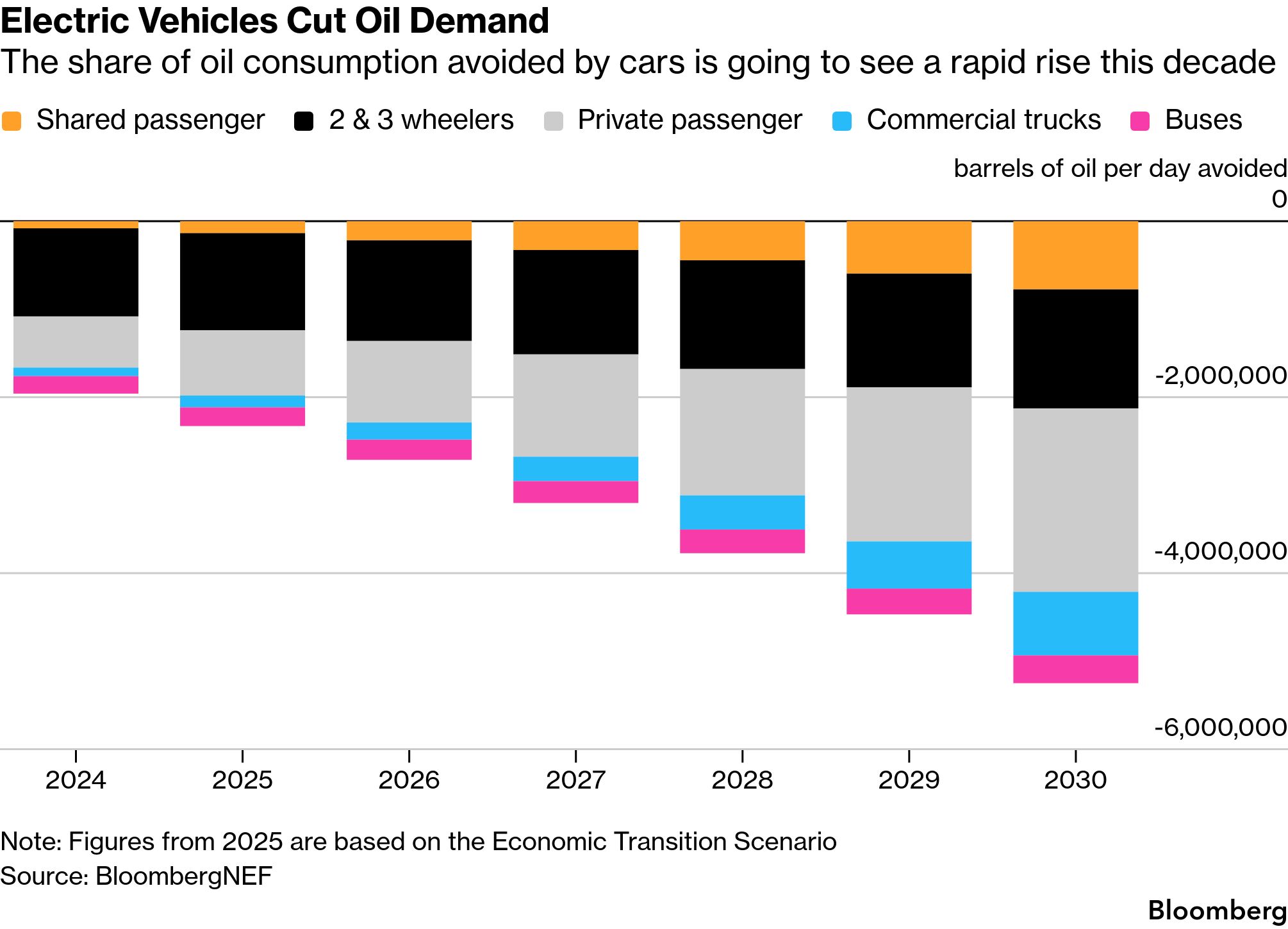 /> />
Two- and three-wheeler vehicles now make up the bulk of avoided road fuel use due to the fast rise of electric motorbikes, especially in developing nations. As electric cars become more common, they are forecast to cut more oil demand later this decade. Growth in global EV sales was expected to slow this year, with China winding down some subsidies, Europe abandoning plans to phase out combustion engines by 2035 and the US making a U-turn on clean tech policies. But surging fuel prices driven by the conflict in the Middle East has reignited interest in EVs. Read the full story. Weather watchBy Brian K. Sullivan and Mary Hui Los Angeles and the US Southwest are set for a second record heat wave in two weeks as temperatures soar, potentially straining electric grids, melting snowpack and raising health risks. Extreme heat advisories blanket the region this week. Temperatures are forecast to be 15F to 30F (8C to 16 C) above normal, reaching the triple digits in parts of California, Arizona and Nevada. Through next Monday, 450 daily high-temperature records may be broken or threatened across the US, most in the West, the US Weather Prediction Center said. An additional 334 record warm overnight lows also may be set or tied.  /> />
A man cools off in Lytle Creek in California on March 12.
Photographer: Robert Gauthier/Los Angeles Times/Getty Images
Meanwhile, a major storm is strengthening off the northern coast of Australia, threatening to bring destructive winds and heavy rains as it heads for landfall in the North Queensland mining region later this week. Tropical Cyclone Narelle was about 1,100 kilometers (684 miles) northeast of Cairns as of Wednesday morning local time, packing top sustained winds of 110 kilometers per hour, according to the Australian Bureau of Meteorology. It is expected to intensify as it moves west and feeds off warm ocean waters, making landfall on Friday as a Category 4 storm in Australia's five-step system, the bureau said. Read the full stories on the US and Australia, and subscribe to Weather Watch to get weekly updates on how extreme weather impacts the global economy. More from Green /> />
President Donald Trump in the Oval Office on Tuesday.
Photographer: Yuri Gripas/Abaca/Bloomberg
US President Donald Trump said he wanted to have no wind turbines built during his presidency, reiterating his distaste for the renewable energy source after his administration has made multiple moves to thwart its development. "I'm proudly telling you that we're going to try and have no windmills built in the United States during my" administration, Trump said in remarks from the Oval Office on Tuesday. "They're very bad environmentally." The remarks came after the New York Times reported that the Trump administration is weighing a $1 billion deal with TotalEnergies SE, the French energy company spearheading two US offshore wind farms, to cancel leases in federal waters. A representative for Total declined to comment when contacted by Bloomberg News, and the Interior Department didn't respond to a request for comment. Read the full story. Senator Markwayne Mullin doesn't support abolishing the Federal Emergency Management Agency, instead favoring a restructure. The Republican has been nominated to lead the Department of Homeland Security, which oversees FEMA. He also said he would end "micromanaging" the agency's finances. The US already has enough capacity to build all the energy storage it needs. The country's manufacturing capacity for fully-assembled battery systems jumped from seven gigawatt hours in 2023 to about 70 gigawatt hours today. Don't throw out that plastic bottle. The Singapore government wants empty beverage containers in return for cash and, in a bid to boost the recycling rate, it will install over 1,000 machines from April 1. More from Bloomberg
Explore all Bloomberg newsletters. We're improving your newsletter experience and we'd love your feedback. If something looks off, help us fine-tune your experience by reporting it here. Follow us
You received this message because you are subscribed to Bloomberg's Green Daily newsletter. If a friend forwarded you this message, sign up here to get it in your inbox.
|




Beacon no more
Milei risks becoming one conservative leader among many ...