| Read in browser | ||||||||||||||
  I'm Nancy Cook, Bloomberg's senior national political correspondent, and each weekday I'll be coming to you with inside-the-room reporting and insights that reveal what's really happening in Washington — and how it impacts you. Email me with feedback and comments here. If this newsletter was forwarded to you sign up here. Multiple ChoiceDemocrats don't have a clear leader setting the party's direction and recruiting candidates, but they keep winning congressional and statewide elections. They've won important gubernatorial races in New Jersey and Virginia, while flipping state legislative seats in Arkansas, Texas, Iowa, Mississippi, Georgia, Pennsylvania and even President Donald Trump's own backyard of Palm Beach, Florida. They've done it by zeroing in on central issues on the minds of voters, the cost of buying a starter home, inflation at the grocery store and worries about AI taking white-collar and entry-level jobs. Will that be enough for the battle for control of Congress in November and the 2028 presidential race? As we reported this morning, highlighted in Jonathan Tamari's morning edition of this newsletter, Democrats are heading into the midterms with many donors sitting on their wallets, putting them well behind Republicans in fundraising. Read More:
And then there's the ongoing, angst-filled debate in the party about whether Democrats need to coalesce around a particular type of candidates. Should they be progressive stars like New York City Mayor Zohran Mamdani, or is it easier for a centrist politician with national security credentials like Governors Mikie Sherrill of New Jersey or Abigail Spanberger of Virginia, both of whom handily won their races last November? (Sherrill launched a super PAC this week to support like-minded candidates.) 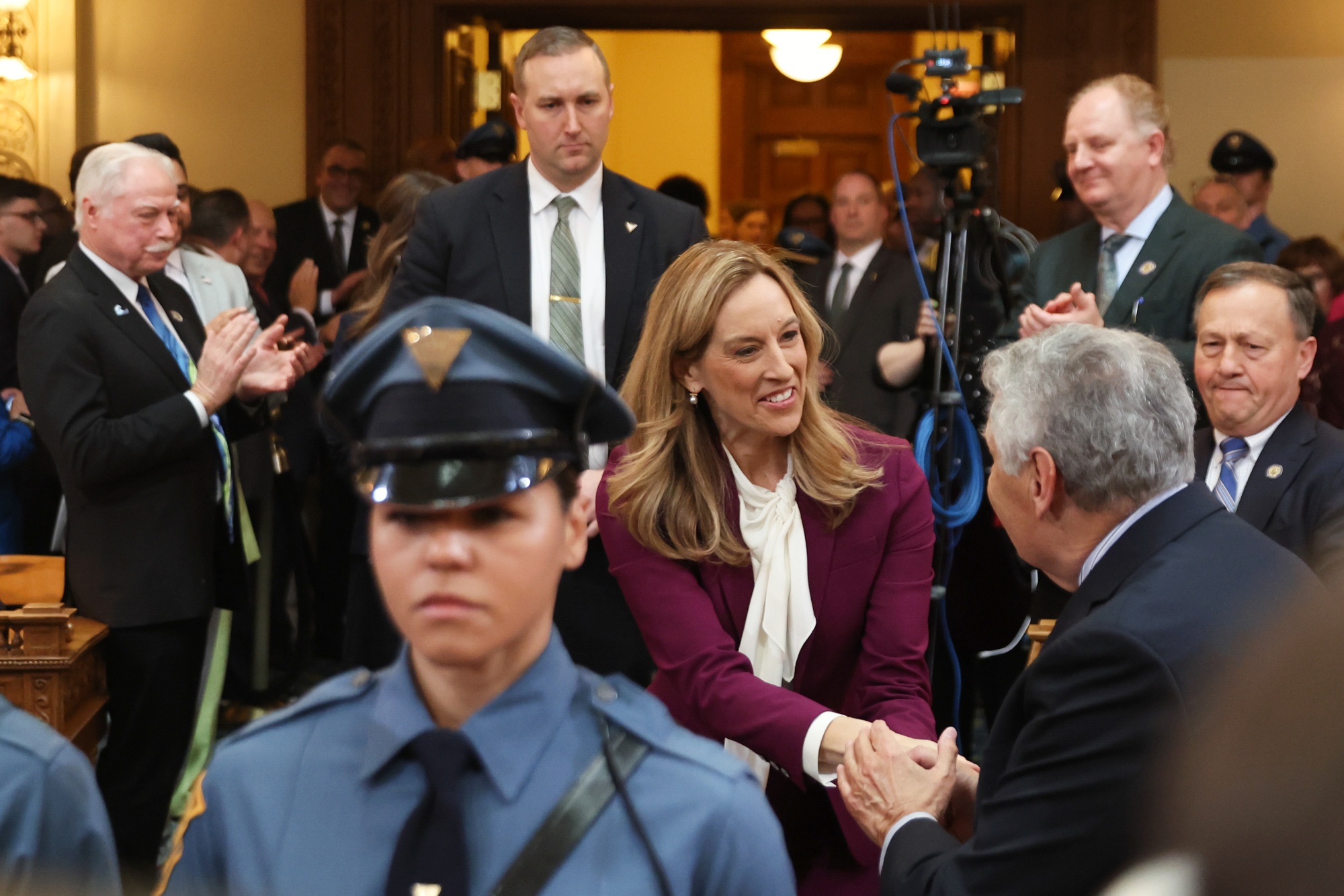 New Jersey Governor Mikie Sherrill. Photographer: Heather Khalifa/Bloomberg Or should the party take a conventional turn as exemplified by the governors eying a run in 2028 like Illinois' JB Pritzker or Josh Shapiro from Pennsylvania? In my conversations with 2028 presidential hopefuls and high-level Democratic strategists, the emerging theory is all of the above — the more the merrier, as long as they're authentic, fluent in social media and can speak to voters' economic concerns. For Republicans the answer is easy: Trump is a such a dominant, movement-like figure, and he's consolidated power so much that GOP candidates must mimic him and go along with his agenda if they want to succeed. Democrats don't necessary want that top-down approach, many tell me. The party long has been a sometimes fractious collection of centrists, pragmatists, progressives and old school type from a wide variety of ethnic and racial backgrounds. The big tent approach can work, party strategists have argued, as long as the candidates don't get sidetracked by intra-party fighting, ideological purity tests or culture war battles. Rahm Emanuel, former Chicago mayor, ambassador to Japan and potential presidential contender, said in a recent sit down with some of us at Bloomberg News and Bloomberg Government that Democrats have an opening if they can avoid "paralysis of analysis." The party, he said, needs to be aggressive in highlighting Trump's own words on the economy and then offering their own prescriptions. "Who here, raise your hand, is experiencing lower inflation at the grocery store?" Emmanuel said in his often-animated way. Trump "gave you the material, and if you want to beat them, give them a taste of their own medicine." (Programing note: I will be off next week, but the afternoon Washington Edition will continue arriving in your inbox.) War With IranTrump extended his deadline for Iran to reopen the Strait of Hormuz for the second time, until April 6, saying that "talks are ongoing" on a deal between Washington and Tehran. Treasury Secretary Scott Bessent said a US insurance program meant to boost shipping through the Strait of Hormuz will begin soon, a move that may help revive flows of much of the world's oil and gas supplies. The US warned that Iran-backed Houthi militants in Yemen could start firing on vessels in the Bab El-Mandeb Strait after Tehran raised the possibility of extending barriers to global shipping during the ongoing war. Republican Senator Lisa Murkowski said she's working on a possible authorization for the use of military force in Iran as frustration rises in the president's party with lack of detail over operations in the Middle East. Today's Top NewsSenators are pushing for a deal to end the disruptive shutdown at the Department of Homeland Security as key lawmakers from both parties negotiated immigration policy and Trump struck a hard line on the talks. Fliers across the US encountered some of the longest airport security lines since a partial government shutdown started in mid February, with travelers increasingly seeking out alternatives to planes such as rental cars and trains.  Travelers wait in a TSA checkpoint line at Atlanta Hartsfield-Jackson International Airport. Photographer: Megan Varner/Getty Images/Getty Images North America States that have legalized sports betting have seen a rise in delinquency rates on consumer credit products and a decrease in credit scores, according to a new report from the Federal Reserve Bank of New York. The Federal Reserve asked a judge to stand firm in his decision to dismiss two Justice Department subpoenas seeking information about building-renovation cost overruns tied to the administration's fight with Chair Jerome Powell. Recurring applications for unemployment benefits fell to the lowest level in almost two years, indicating ongoing stability in the labor market despite fresh economic headwinds. 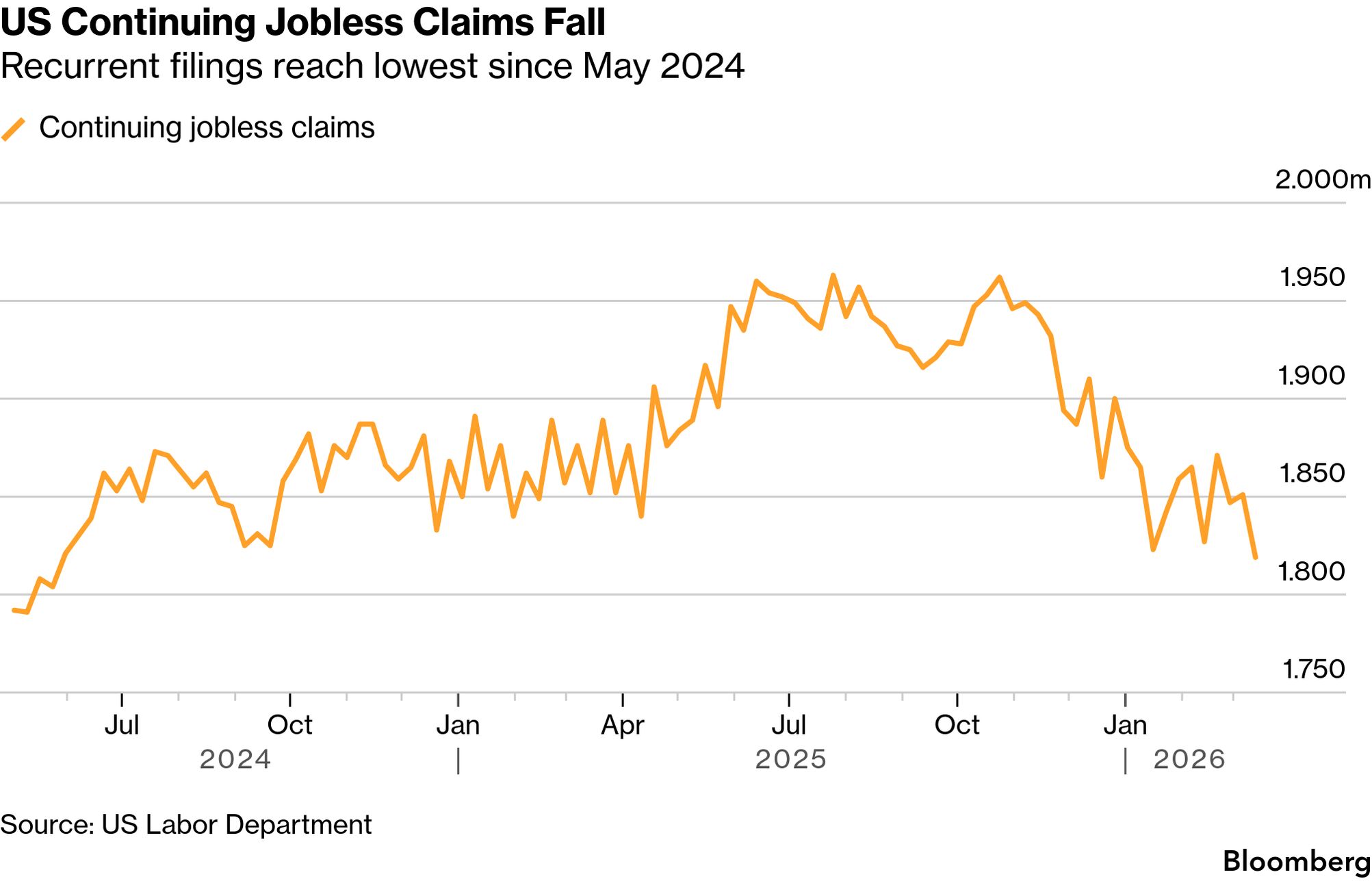 Justice Department lawyers told a federal judge that they've been relying on incorrect information in a fight over Trump administration migrant arrest tactics, blaming Immigration and Customs Enforcement for the "regrettable error." The Justice Department is investigating medical-school admissions policies at Ohio State University and University of California at San Diego over possible racial discrimination. White House adviser David Sacks said Congress could pass bipartisan artificial intelligence legislation within months, a move that would fulfill Trump's pledge to create a national playbook for regulating the emerging technology. The US Army has announced the first group of companies that will build data centers on military bases, as the armed forces address a growing need for artificial intelligence computing power. Trump will be headlining a three-day conference this week in Miami Beach showcasing the power and wealth of Saudi Arabia, an annual bash that lures titans of finance and politics for a chance to tap into the Kingdom's riches. The two air traffic controllers at LaGuardia Airport were grappling with a higher-than-anticipated workload, complicated by foul weather, when an inbound Air Canada Express jet plowed into a fire truck on Sunday evening. The Federal Emergency Management Agency said it will fund up to $1 billion in disaster-resilient infrastructure under a grant program it had previously canceled and criticized as being wasteful. A new online game called Five Nights at Epstein's is sweeping through classrooms, where players pretend to be sexual assault victims trapped on late sex offender Jeffrey Epstein's notorious island. Must Reads From Bloomberg GovernmentDeputy Attorney General Todd Blanche touted the Justice Department's efforts to fire Trump's opponents, saying it has "cleaned house" at the FBI to remove anyone associated with prosecutions against him. Senator John Cornyn is gaining support in his Republican runoff against Attorney General Ken Paxton as the brutal Texas primary deepens GOP divisions in a state where polls fuel Democratic optimism. With no new nominee for the Centers for Disease Control and Prevention named by Wednesday's deadline, acting director and current head of the NIH Jay Bhattacharya is poised to stay a top the agency with new constraints. Watch & ListenToday on Bloomberg Television's Balance of Power early edition at 1 p.m., hosts Joe Mathieu and Kailey Leinz interviewed Republican Senator Ted Budd about the war with Iran and the continued standoff over Homeland Security funding. They also talked with Representative Suzan DelBene, chair of the Democratic Congressional Campaign Committee. 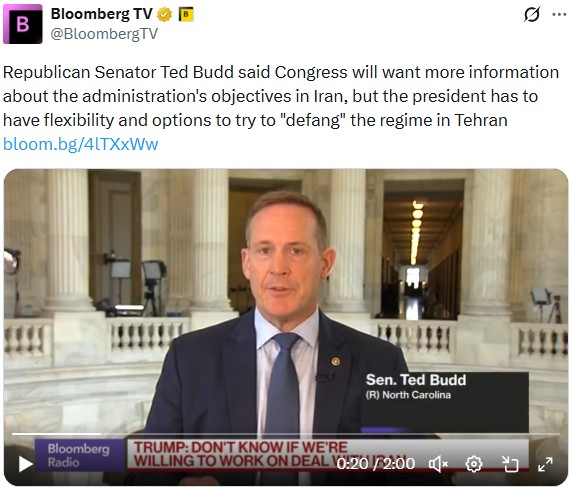 On the program at 5 p.m., they talk with Republican Senator Pete Ricketts and Democratic Representative Gabe Amo about DHS funding and the growing security lines at US airports as well as the war. On the Big Take podcast, Bloomberg legal reporter David Voreacos joins host Sarah Holder to discuss the revelation in the Epstein files that two decades ago, a federal prosecutor in Florida spent two years investigating the disgraced financier and urged her superiors to charge him and how, despite years of credible evidence, he managed to slip through the cracks. Listen on iHeart, Apple Podcasts and Spotify.  Chart of the Day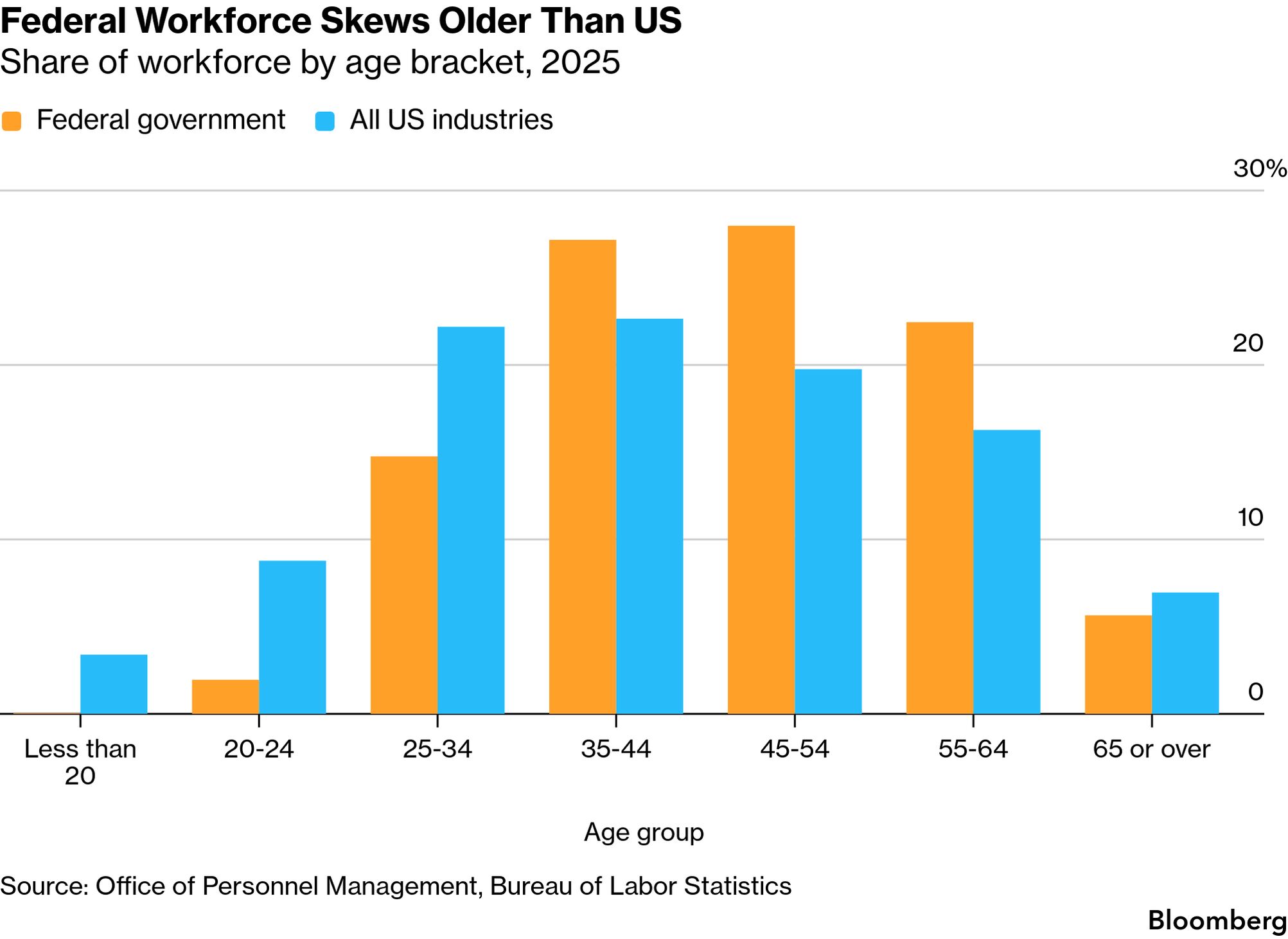 The federal government workforce is older than the private sector, with a median age of 47 — five years older than the nation's workforce overall. The gap is most pronounced among younger workers: those under 35 make up roughly one-sixth of federal employees, compared with more than one-third in the private sector. And a year of Elon Musk-inspired cuts to federal agencies has widened that imbalance, predominately affecting less-tenured staff. "We have a very, very important demographic imbalance that I believe is unsustainable," Office of Personnel Management Director Scott Kupor told Congress yesterday. "Without deliberate attention to attract and develop the next generation, we risk an existential capability gap that will undermine our ability to effectively serve the American people in the years ahead." One proposal to address it: loosening education and tenure requirements for promotions, Bloomberg Government's Ian Kullgren reports. — Gregory Korte What's NextG-7 foreign ministers meet in Paris today and tomorrow The University of Michigan's index of consumer sentiment in March will be published tomorrow. The Conference Board's measure of consumer sentiment and expectations in March will be released Tuesday. Job openings and layoffs in February will be reported Tuesday. Retail sales in February will be released on Wednesday. The jobs report for March will be released April 3. More From BloombergLike Washington Edition? Check out these newsletters:
Explore all newsletters at Bloomberg.com. We're improving your newsletter experience and we'd love your feedback. If something looks off, help us fine-tune your experience by reporting it here. Follow us
You received this message because you are subscribed to Bloomberg's Washington Edition newsletter. If a friend forwarded you this message, sign up here to get it in your inbox.
|




Rave files antitrust lawsuit against Apple over removal of video-sharing app
Software developer Rave on Thursday filed an antitrust lawsuit against Apple , alleging that the iPhone maker kicked Rave's app for shared viewing of video content off the Apple App Store after introducing a competing product called SharePlay. ...