| Read in browser | ||||||||||||||

States run by Democrats have said they’ll hold the climate line as the Trump administration dismantles federal efforts to cut carbon pollution. But with the Iran War sending oil prices skyrocketing, some lawmakers are now considering how to soften climate regulations. Today’s newsletter looks at the proposals on the table — and why efforts to roll back climate laws may be misguided. Moving targetsBy Todd Woody As countries and consumers embrace renewable energy in the wake of the Iran war, skyrocketing gasoline prices in the US are fueling efforts to weaken state climate laws. Renewable energy mandates to reduce greenhouse gas emissions generally have little impact on US gas prices, according to experts. But the growing pain at the pump has charged debates in California, Massachusetts, Michigan and New York over whether climate action is affordable as households face rising costs for electricity, groceries and housing. “The war in Iran is driving up gas prices at the pump to the breaking point for too many New Yorkers,” New York Governor Kathy Hochul said in March as she proposed to delay regulations implementing the state’s 2019 climate law, calling its emission-reduction targets “costly and unattainable.” As Michigan lawmakers debate how to respond to gas prices exceeding $4 a gallon, Republicans have introduced legislation to repeal a 2023 law that requires utilities to obtain 100% of power from emission-free sources by 2040, a goal they blame for rising electricity bills. 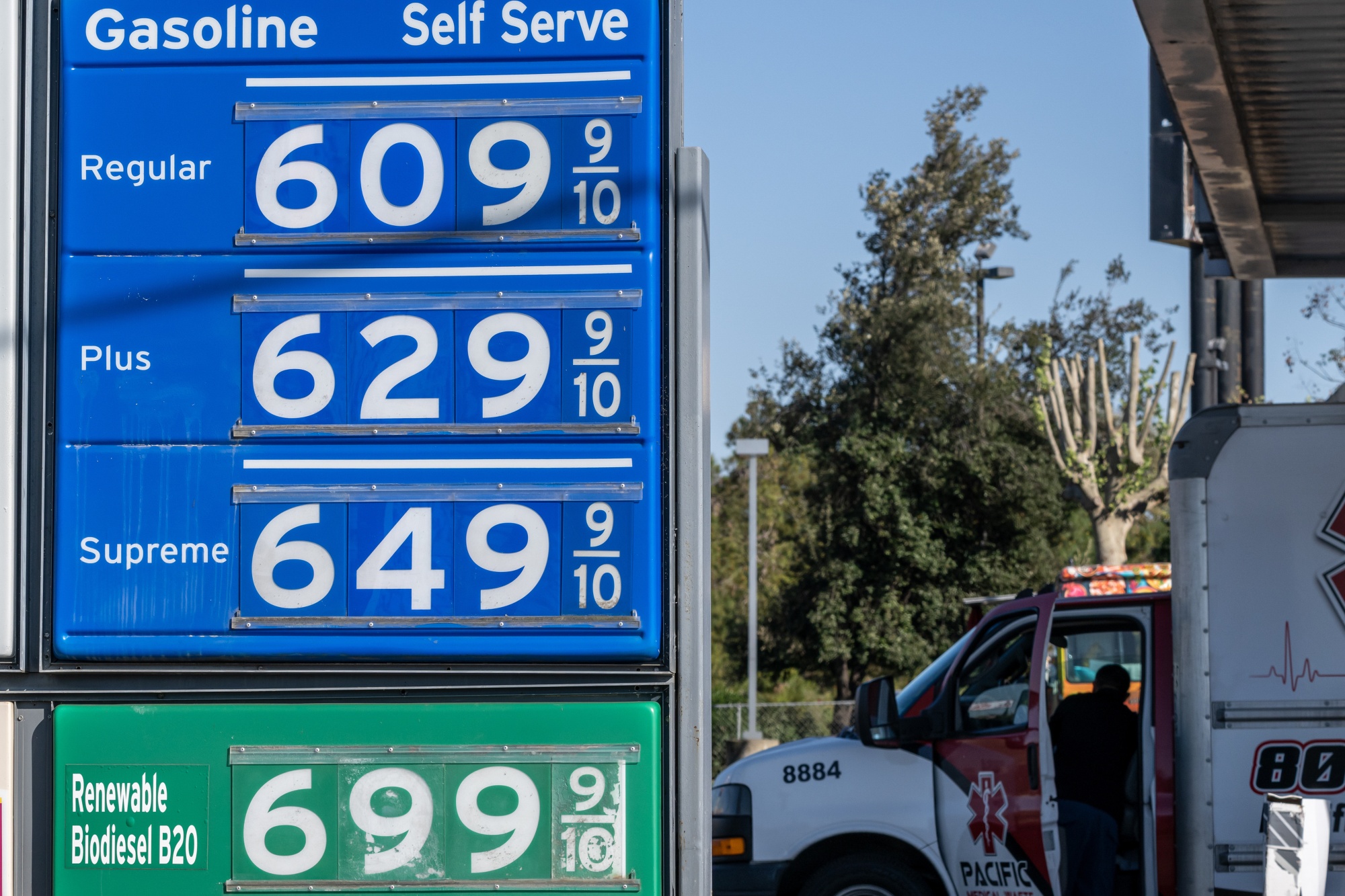
A sign displays the prices in Sacramento, California.
Photographer: David Paul Morris/Bloomberg
“Lowering the cost of daily life isn’t just an issue for Michigan families. It’s the issue,” Republican state Representative Pauline Wendzel said in an email. “There’s this effort to jump on affordability as an issue that should dissuade states from pursuing climate policies,” said Michael Burger, executive director of the Sabin Center for Climate Change Law at Columbia University. “When my [utility] bill was two or three times higher this winter it didn’t make me happy, but it’s not connected to the state’s climate goals.” Climate policy experts note that high electricity rates are in large part due to increased demand from such things as data centers and artificial intelligence, and that non-polluting solar and wind energy are cheaper than fossil fuels. “If anything, we want to be spurring the development of those resources,” said Ann Carlson, a professor of environmental law at the University of California at Los Angeles. “There are costs to fossil fuels that don’t show up directly in your electricity bill, such as dirtier air and increased greenhouse gases.” California oil refiners, though, are warning that war-triggered $6 a gallon gas prices, the nation’s highest, could rise another $1 or more if the state implements proposed changes to its “cap-and-invest” carbon market. The revisions would tighten limits on industrial emissions to help California achieve its target of carbon neutrality by 2045. “The proposed regulation will cripple the survivability of the state’s remaining refineries, which will result in California losing the entire industry to this misguided program,” wrote Chevron Corp. executive Andy Walz in a March letter to state officials. Chevron, whose refineries account for about 35% of California’s crude oil capacity, said the new emissions limits could cost it $500 million within five years. Regulators dismiss those assertions. “That does not reflect market reality,” Lindsay Buckley, a spokesperson for the California Air Resources Board (CARB), which oversees the state carbon market, said in an email. “The ongoing war further underscores why it’s important to move away from fossil fuels and reduce our dependence on oil altogether.” Still, 15 Democratic state lawmakers sent a letter to CARB Chair Lauren Sanchez in March asking the agency to reconsider changes that they said would “further destabilize California’s fuel supply, economy and working families.” Two days before the US and Israel attacked Iran on Feb. 28, the Massachusetts House of Representatives passed legislation that aimed to provide relief from escalating power costs by cutting $1 billion from an energy efficiency program funded by surcharges on utility bills. The state Senate now takes up the legislation amid soaring gas prices. Caitlin Peale Sloan, vice president for climate and energy at Boston-based nonprofit Conservation Law Foundation, said she expects gas prices to become part of the debate. “People name the energy affordability crisis and spiking fossil fuel costs in the same breath,” she said. “It just doesn’t make any sense to change long-term climate targets and mandates to address a short-term crisis.” Read the full story. You can subscribe to Bloomberg News for more on how the Iran War is affecting affordability politics. A new deadline2040 The year Kathy Hochul wants to set as a new greenhouse gas emission reduction goal for New York. New habits“The momentum of the last few weeks is among the strongest we’ve seen.” Maximilian Quertermous Cofounder and chief executive officer, Ever Some lawmakers may be looking to cut fossil energy prices, but individuals are looking to cut their bills by going electric. Europe’s climate tech momentWill the Iran War finally be the moment where countries move to renewables en masse, or will they rely more heavily on fossil fuels? This week on Zero, Akshat Rathi is joined by Aurore Belfrage, a tech investor, geopolitical risk advisor, and sustainability strategist, to look at how the energy investment landscape is changing with a fresh war in the Middle East, and how climate tech is making countries more resilient. Listen now, and subscribe on Apple, Spotify or YouTube to get new episodes of Zero every Thursday. Weather watchCritical fire weather conditions exist across parts of the Texas and Oklahoma panhandles, in southwest Kansas, southeast Colorado and a small sliver of northeast New Mexico, the US Storm Prediction Center said. There are red flag fire warnings up across the same area. There is also a fire weather watch across the Florida panhandle and into southern Georgia. Fire was also a problem in Southern California this weekend. The Springs Fire burned across nearly 4,200 acres in Riverside County. Though relatively small, it comes as the state deals with extremely low snowpack for this time of year, which raises the risk of drought and wildfire risk this summer. Elsewhere, heavy rains, wet snow and strong winds damaged some power facilities in the Russian region of Dagestan, leaving dozens of villages without electricity over the weekend, local officials said. Dagestan, which neighbors Georgia and Azerbaijan in the North Caucasus region, declared a state of emergency a week ago after heavy rain triggered widespread flooding, described by local media as the worst in more than a century. More from Bloomberg
Explore all Bloomberg newsletters. We’re improving your newsletter experience and we’d love your feedback. If something looks off, help us fine-tune your experience by reporting it here. Follow us
You received this message because you are subscribed to Bloomberg’s Green Daily newsletter. If a friend forwarded you this message, sign up here to get it in your inbox.
|