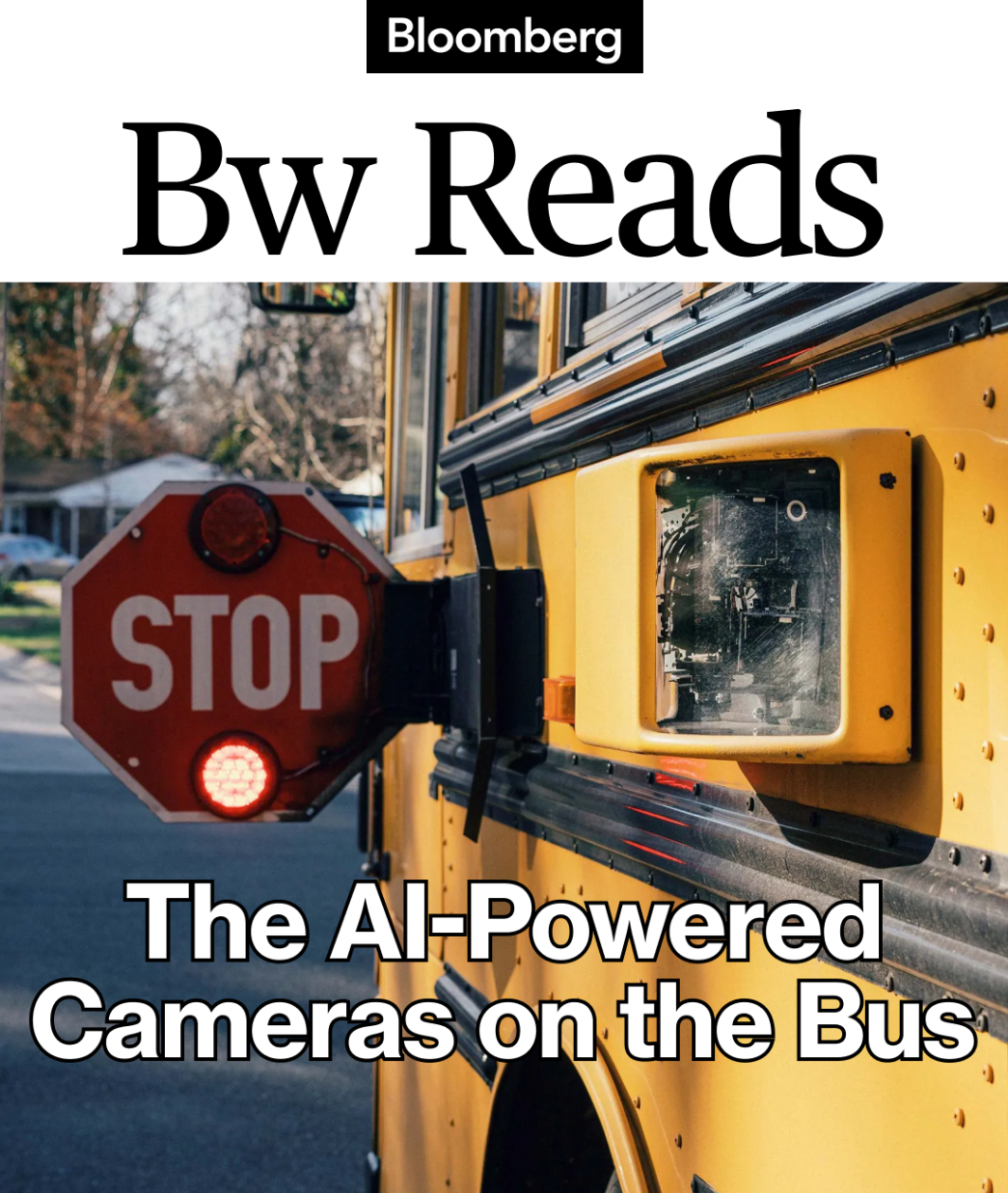
Welcome to Bw Reads, our weekend newsletter featuring one great magazine story from Bloomberg Businessweek. Today Byard Duncan writes about BusPatrol, a company that says its technology helps curb dangerous driving at no cost to cities. Public records from across the US often tell a different tale. You can find the whole story online here (free!). If you like what you see, tell your friends! Sign up here. Every weekday morning outside the 16-story apartment complex at 1400 East-West Highway in Silver Spring, Maryland, students step onto big yellow buses that take them to school. It’s not a particularly pleasant spot: The building faces a fenced-off construction site across six lanes humming with Washington metro-area commuter traffic. But this is an important place for Montgomery County. In addition to students, the buses are collecting valuable data every time they stick out their stop signs (“stop arms,” in transportation lingo) and flash their red lights. Artificial-intelligence-powered cameras attached to these buses record vehicles that fail to halt—vehicles, in other words, that violate the state law requiring all lanes of traffic to halt for a stopped school bus with its stop arm extended. The footage is sent to local police for review. If they decide the law was broken, the driver receives a $250 ticket in the mail. There are a lot of scofflaws near 1400 East-West Highway. More than 11,500 tickets have been issued here over the past decade, making it among the county’s most heavily ticketed stops. The county views this as a win-win: Bad drivers get dinged, and the government gets paid. That is how BusPatrol LLC, the company that operates the cameras on Montgomery County’s school buses, presents itself to local officials around the country. In exchange for a portion of citation revenue, it plugs in the cameras, records the violations, bundles up the evidence and mails tickets after police review. BusPatrol started operating in Montgomery County in 2017. At the time, local police assured residents that violations would subside as drivers learned their lesson. Yet critics of BusPatrol say municipalities are getting a bad deal. In Montgomery County, after more than 375,000 tickets and $92 million in issued fines, there’s been little reduction in violations and no evidence of a decline in collisions near stopped school buses, according to county records and Bloomberg Businessweek’s review of local news reports and stop-arm camera footage. The county has done little to change the infrastructure at its most ticketed stops; it’s repeatedly said there are no safety concerns at most of these locations. Because of the financial structure of the program, the county transferred millions to its stop-arm technology providers for the first three years and kept no revenue itself, while also spending hundreds of thousands of tax dollars to review the AI’s work. Meanwhile, there’s evidence the program is heavily burdening residents who either can’t or don’t pay the fines. BusPatrol has attached its cameras to about 35,000 buses in 24 US states and more than 350 school districts. Public records Businessweek obtained show that, because of their contracts with BusPatrol, many local agencies have spent years effectively acting as revenue generators for a for-profit company, ticketing thousands of drivers and sending most of the funds back to BusPatrol. Citations often remain high year after year, despite the company’s promises they will decline. Municipalities can wind up keeping very little money from their partnerships because of the company’s high monthly technology fees. Montgomery County Vision Zero Coordinator Wade Holland defended the partnership, noting that the illegal passing of stopped school buses is a national problem. “By having a school bus arm monitoring program, Montgomery County is able to hold drivers accountable, educate drivers about their responsibilities around a stopped school bus, and have another data source to understand what is happening when our students are getting picked up or dropped off,” he said in a statement. The Montgomery County Police Department declined Businessweek’s request for an interview, pointing instead to the county’s annual reports on the BusPatrol program. In a statement, BusPatrol spokesperson Kate Spree said the company’s services “provide school districts with critical safety technology and enforcement support at no cost to taxpayers or law-abiding drivers, helping communities protect students traveling to and from school.” BusPatrol said it works with municipalities to establish financial structures that allow the company to recoup its upfront investment and operating costs. In many cases, it said, the cost of operating cameras can equal or exceed violation revenue, but that in the latter scenario, the company covers the gap. It also pointed to a recent report on school bus safety by the Governors Highway Safety Association that recommends stop-arm cameras as a solution. 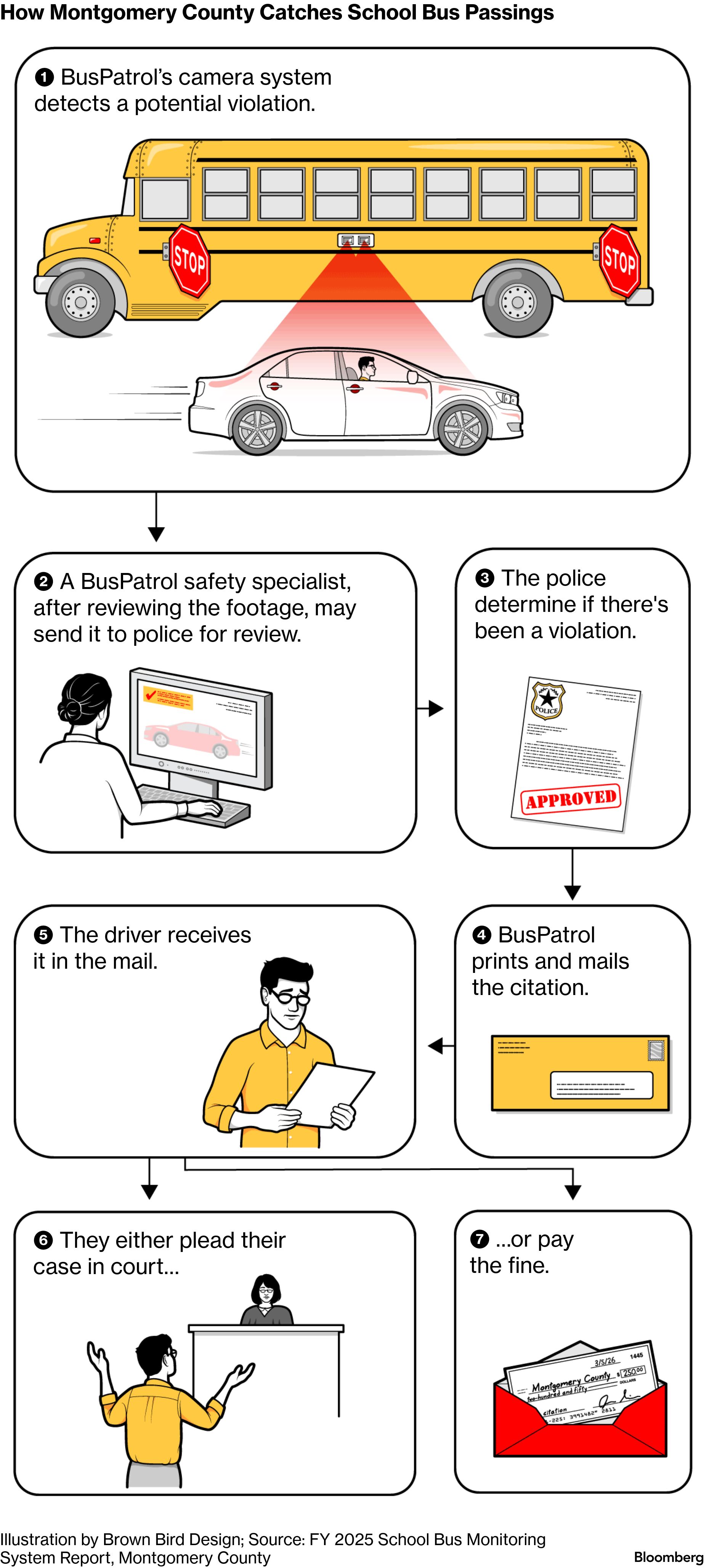
BusPatrol is growing quickly. By early 2024, private equity firm GI Partners had made a significant investment in the company, reportedly acquiring a majority stake in the process; Weatherford Capital also announced a strategic investment later that year. BusPatrol said in a blog post that it made more than 250 new hires and added school districts in Florida, Michigan, Texas and Virginia to its client base in 2025. The expansion is driven in part by America’s epidemic of pedestrian deaths. BusPatrol promises local officials it can solve a problem at no cost to the government, an appealing combination for leaders faced with shrinking budgets and public pressure to address safety concerns. Instead, “it’s a tax with no payoff,” says Tim Curry, policy and research director at the Fines & Fees Justice Center, which advocates for financial penalty reform in the US criminal justice system. “It allows communities to say, ‘Look, we take safety seriously’ without actually taking safety seriously, and the private company profits hand over fist.” For David Moon, a member of the Maryland House of Delegates who’s spent years trying to reform the program in Montgomery County with little success, the situation emphasizes the importance of preventing profit motives from overtaking the public interest. “The minute you ask a question about stop-arm safety enforcement, you’re immediately going to get tagged as trying to harm the children, or not caring about the children’s safety,” he says. “All hell broke loose when you tried to touch the money.”
Keep reading
On the PodcastA Molotov cocktail hurled at Sam Altman’s home. Bullets fired at a city councilman who approved the building of a data center. The cultural mood around artificial intelligence has shifted, and this week on the Everybody’s Business podcast from Bloomberg Businessweek, we’re trying to make sense of it. Bloomberg News tech reporter Sarah Frier joins hosts Max Chafkin and Stacey Vanek Smith to break down what’s driving the new wave of AI backlash. Plus: The job market is rough for everyone, but especially if you’re just starting out. Businessweek senior editor Julia Rubin joins the show to talk about what Gen Z is actually up against. Listen and subscribe on Apple, Spotify, iHeart and the Bloomberg Terminal. More Bw Reads
 
Watch: OpenTable’s Strategy Shift
From the May Issue: First Jobs 
Mercor co-founders Adarsh Hiremath and Brendan Foody in San Francisco.
Photographer: Damien Maloney for Bloomberg Businessweek

Play Alphadots!Our daily word puzzle with a plot twist. 
Today’s clue: Blockbuster in gaming? More From BloombergLike Businessweek Daily? Check out these newsletters:
Explore all Bloomberg newsletters. We’re improving your newsletter experience and we’d love your feedback. If something looks off, help us fine-tune your experience by reporting it here. Follow Us
You received this message because you are subscribed to Bloomberg’s Businessweek Daily newsletter. If a friend forwarded you this message, sign up here to get it in your inbox.
|





Humanoid robots race past humans in Beijing half-marathon, showing rapid advances
This year's race showed a big advancement over last year's, which was riddled with mishaps. ...