| Read in browser | ||||||||||||||
I’m Cécile Daurat, a senior economics editor in Washington. Today we’re looking at the five things to watch this week at this week’s IMF gathering. Send us feedback and tips to [email protected]. To readers of the Balance of Power, Supply Lines, Washington Edition and Brussels Edition newsletters: We thought you’d enjoy this special edition of Economics Daily. To continue receiving this newsletter, sign up here. The global economy is being tested again. War in the Middle East poses a new challenge, adding to ongoing shifts in geopolitics, trade, and technology. At the 2026 IMF-World Bank Spring Meetings, policymakers will discuss how economies are managing this shock and the policies needed to strengthen growth and resilience. Join the Conversation! Top Stories
Five Key Things to WatchFor the fourth time in six years, the IMF-World Bank Spring Meetings take place at a moment fraught with global uncertainty: The Covid pandemic in 2020, the war in Ukraine in 2022, Trump’s tariffs in 2025 and now an oil shock triggered by a conflict in the Middle East. Before the US and Israel attacked Iran on Feb. 28, the IMF was planning to upgrade its growth forecasts. Not anymore, Managing Director Kristalina Georgieva said last week. Under the most optimistic scenario, growth will be slower than expected just a few weeks ago. The damage to energy infrastructure and supply chains is done. The impact of the war on economic activity and inflation will be top of mind at the gathering that starts today, but key issues that would have been a priority before the conflict — the ballooning global debt, say — remain important topics. 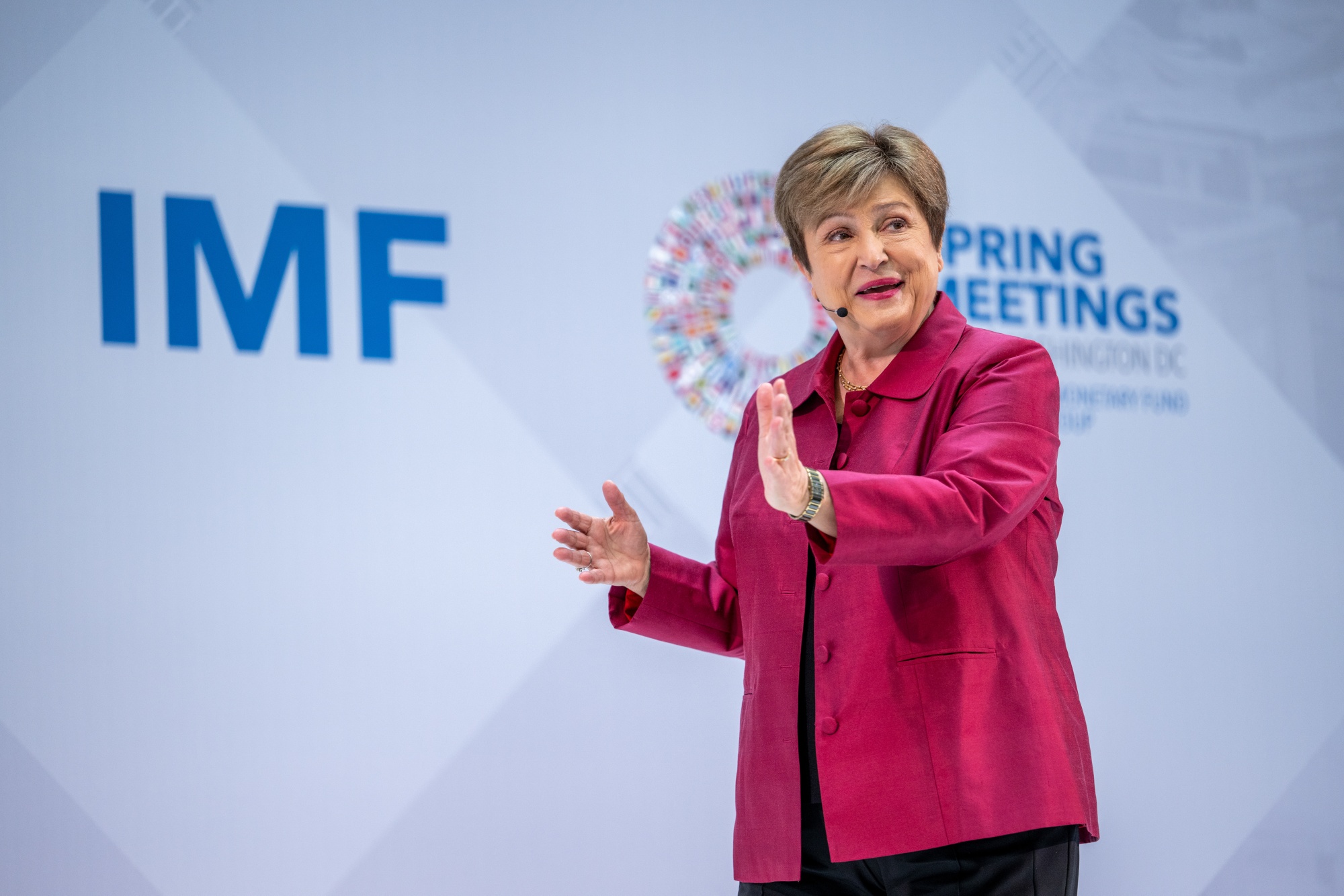
IMF Managing Director Kristalina Georgieva in Washington, DC, on April 9.
Photographer: Daniel Heuer/Bloomberg
Here are five things to watch:
AI and tariffs, prominent in October’s discussions, may be overshadowed by geopolitics this time. The Best of Bloomberg Economics
Need-to-Know ResearchBy now it’s conventional wisdom that the global economy’s 2026 performance will come down to a single variable: What the price of oil will average over the course of the year. Bloomberg Economics has calculated the difference between the upside and downside cases. In a negative scenario with oil at $170 a barrel, global GDP would expand just 2.2% this year, compared with 3.4% in 2025, Tom Orlik and Jamie Rush wrote in a note last week. But in a positive scenario, with oil back at $65, the world could achieve a 3.1% expansion. In monetary terms that amounts to just over $1 trillion – the equivalent of a little more than Switzerland’s economy, or somewhat less than Saudi Arabia’s. 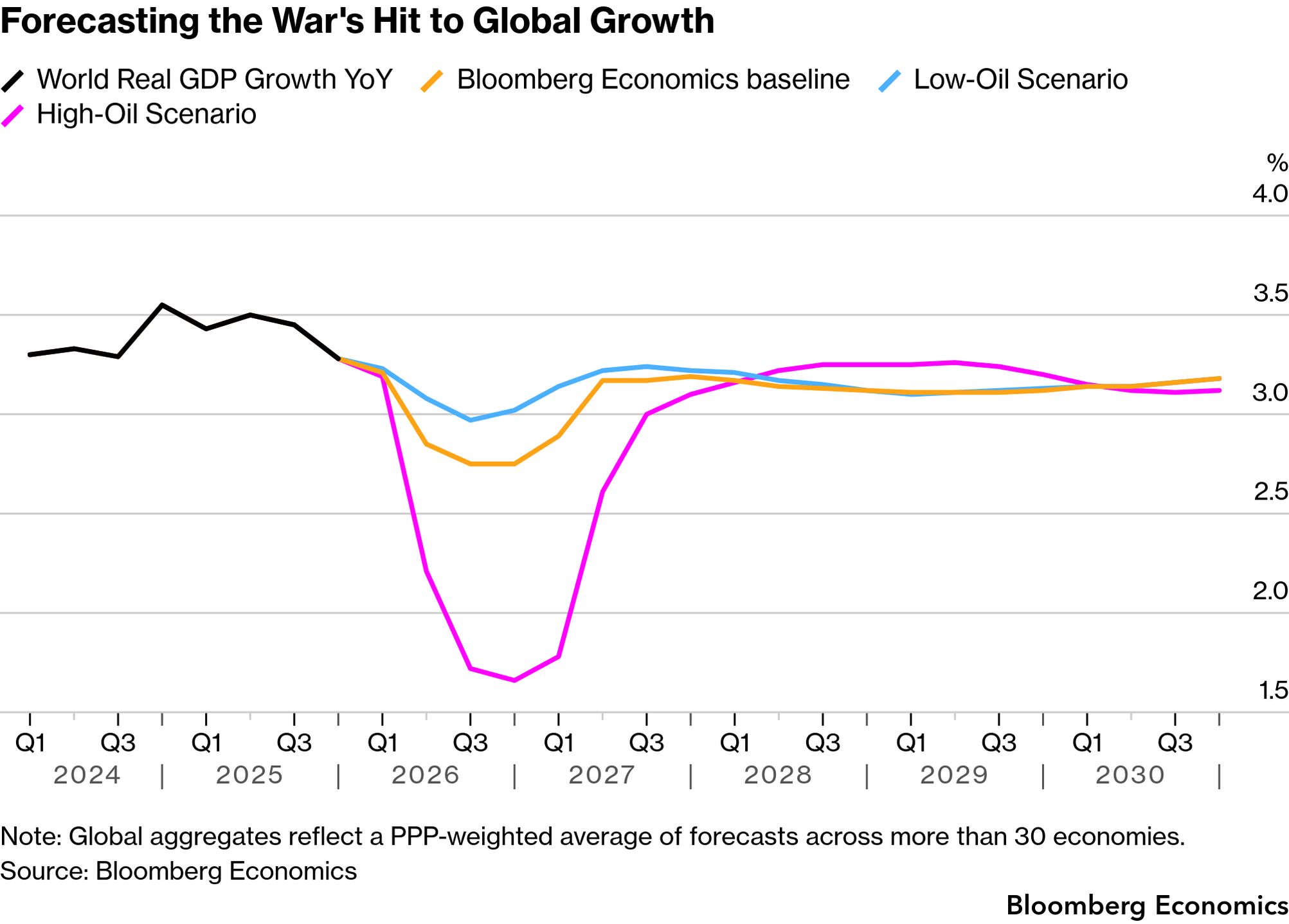
With oil prices hovering something under $100 a barrel, the team’s base case sees 2.9% global growth this year, which would be the weakest since 2020. Under that middle scenario, world inflation is seen at 4.2% for the fourth quarter, versus 3.1% at the end of 2025. In the escalation scenario, world CPI climbs 5.4%. The positive case is 3.7%.
More from BloombergEnjoy Economics Daily?
Plus, here are some newsletters we think you might like
We’re improving your newsletter experience and we’d love your feedback. If something looks off, help us fine-tune your experience by reporting it here. Follow us
You received this message because you are subscribed to Bloomberg’s Economics Daily newsletter. If a friend forwarded you this message, sign up here to get it in your inbox.
|




Blockade in Hormuz
Bloomberg Morning Briefing Americas ...