| Read in browser | ||||||||||||||

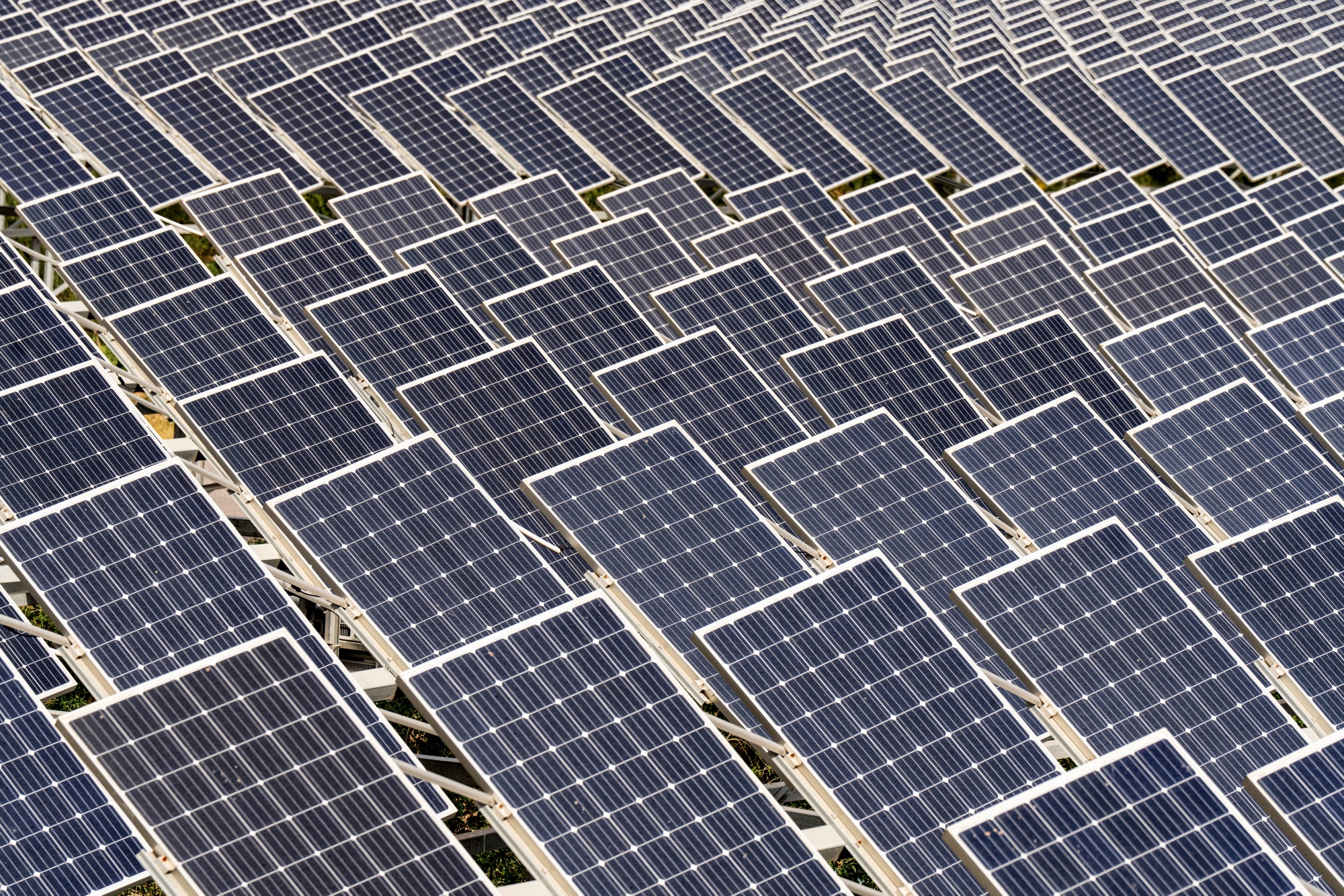
Batteries are everywhere. Cars? Yes. Stoves? There, too. The grid? Oh yeah, lots of batteries. That includes on Bloomberg Green, which is doing a week of coverage focused on energy storage. Today’s newsletter explores why falling costs and a glut of production in China have flooded the world with energy storage. The Iran War could turbocharge demand as countries look to reduce their dependence on fossil fuels with increasingly volatile prices. Plus, BloombergNEF has selected the year’s most exciting climate tech companies in three key global challenges. Want to get all our coverage of batteries this week and beyond? Subscribe to Bloomberg News. Batteries are so hotBy Keira Wright, Mark Chediak, and Petra Sorge Around the world, a wave of mega installations batteries are lining up to be connected to the grid this year — from solar hubs in Texas to grasslands in Inner Mongolia and the site of a former coal plant north of Sydney. Falling costs and soaring energy demand from data centers had already set the stage for rapid growth. The war in the Middle East has helped accelerate the trend by lifting demand for alternatives to expensive fossil fuels, setting 2026 up to be the year batteries become influential in the global energy system. BloombergNEF analysts had already expected installations to jump by about a third this year, led by expansion in Europe, the Middle East, Africa and Latin America. That momentum could build further if fuel disruptions persist. 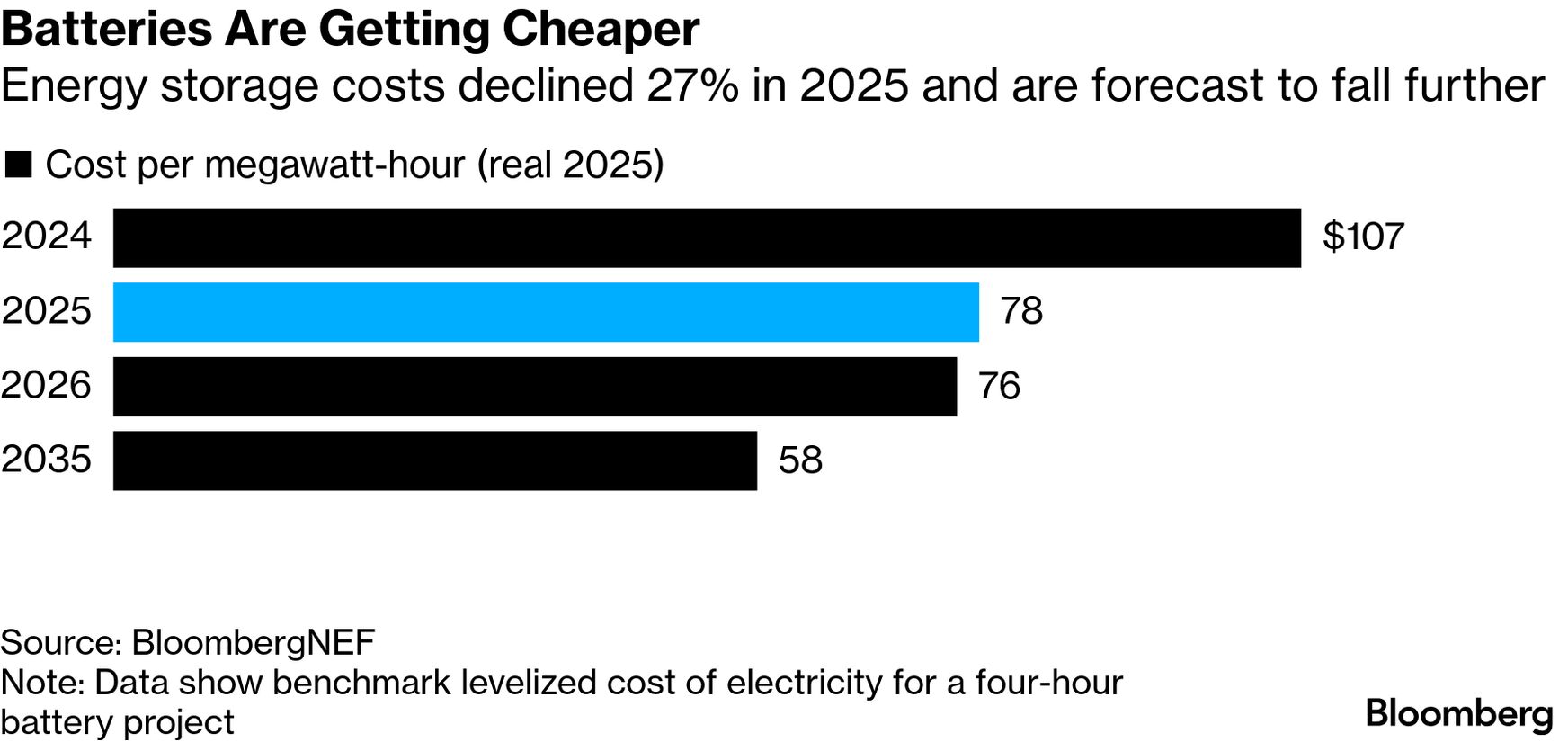
Signs of the ramp up are already emerging. A Chinese battery manufacturer has forecast a sharp rise in first quarter profit as global demand picks up. In Vietnam, a developer is seeking approval to replace a planned LNG-to-power project with renewables paired with storage, citing the surge in fuel costs linked to the war. “We’ve now crossed into a point where anytime anyone is looking at investing in the power system, batteries are one of the most attractive options,” said Brent Wanner, head of the power sector unit at the International Energy Agency. “Battery storage systems will continue to grow for the foreseeable future.” 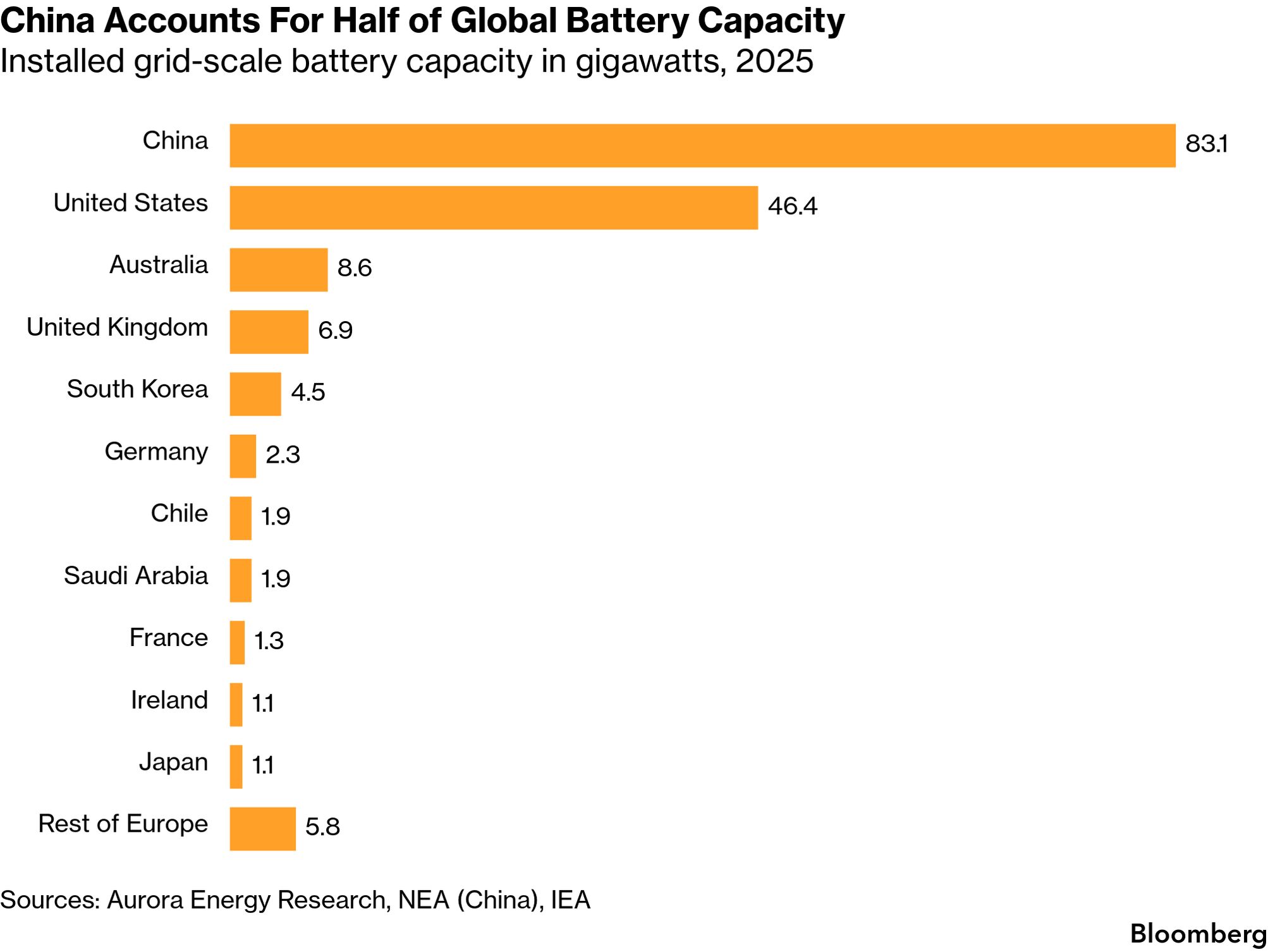
In markets flooded with solar and wind — technologies that have been built out significantly since the last energy crisis in 2022 — battery operators can buy electricity when it’s cheap and sell it when demand peaks. Where grids once relied on coal and gas when renewable output dipped, storage technology is now becoming cheap and fast enough to make a difference in how the grid functions. Average costs have dropped by around 75% from 2018 to 2025, according to BNEF, and are expected to tumble another 25% through 2035. Battery projects are also increasingly being built in fleets big enough to make a real difference in how the grid operates. In Inner Mongolia, three massive sites were recently switched on with a combined capacity of 7.4 gigawatt-hours, enough to rival several large power plants for short periods. In Scotland, two huge neighboring battery farms at the site of a former coal mine will start up this year. Australia — the world’s largest battery market on a per capita basis — offers a glimpse of how the boom is reshaping energy systems. Shortly after a massive project known as the Waratah Super Battery was partially switched on in New South Wales last year, batteries discharged more power onto the main grid during the evening peak than gas-fired plants. The site is expected to become fully operational in 2026. Storage is also helping delay an expected gas crunch as domestic fields deplete, underscoring its role in the nation’s energy security. 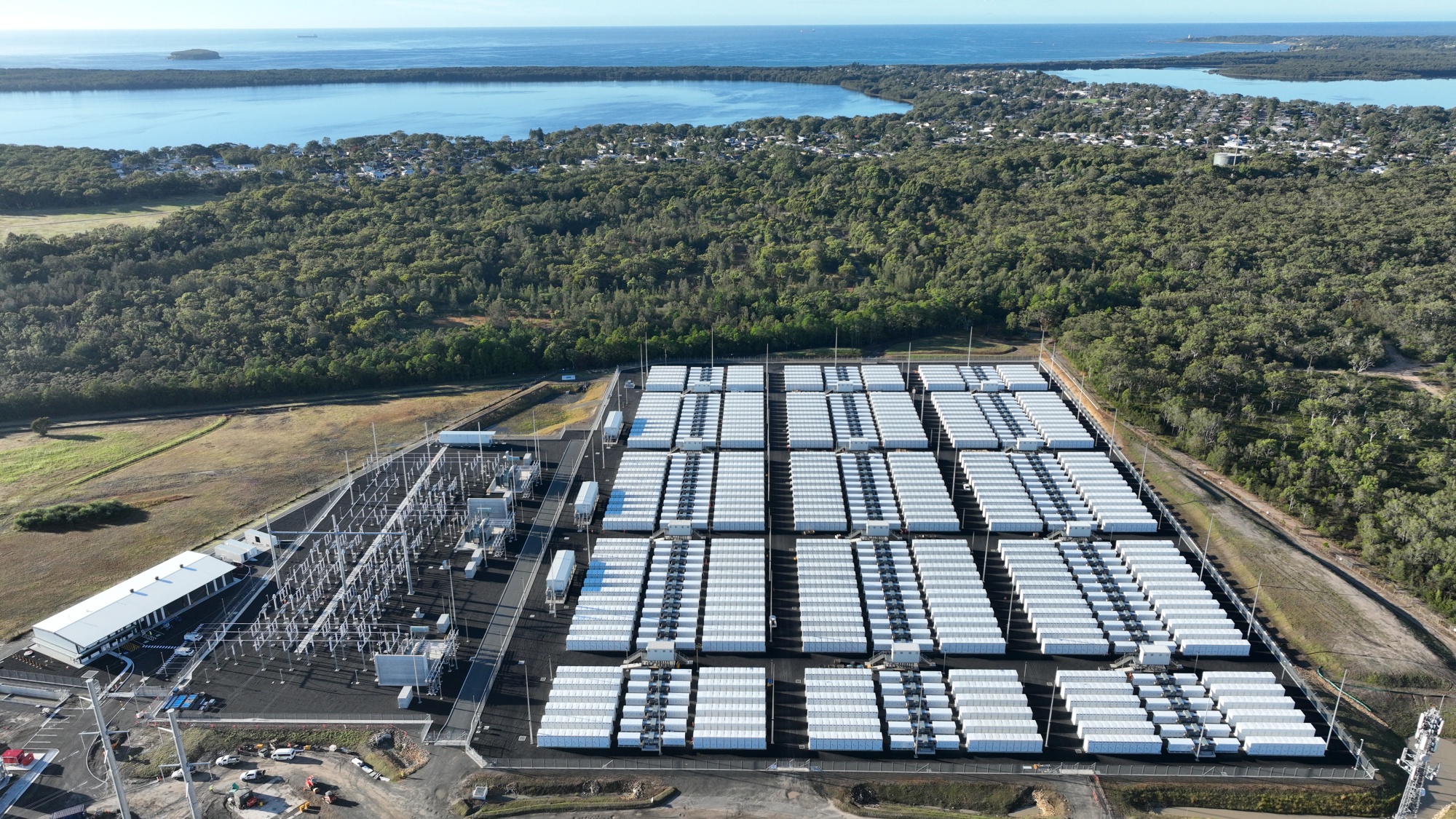
The Waratah Super Battery
Energy Corporation of NSW (EnergyCo)
For investors, one big reason that projects have become more appealing is the rapid decline in costs. Waratah, for instance, would cost about 20% less to build now than when it began construction four years ago, according to Nick Carter, chief executive officer of Waratah’s owner Akaysha Energy Pty Ltd. “If you had the same project today, the economics would be materially better,” he said, even as Waratah’s strong returns have left him with “no regrets.” Developers are continuing to push into new markets, from Europe to Texas, betting that the same forces reshaping Australia will play out elsewhere. Carter, who cut his teeth in oil and gas before making the jump to renewables, sees the current momentum extending well beyond this decade. “Power demand is going up, data centers are coming online, more renewables are getting built, coal is exiting,” he said. “So when you combine all those things, the need for storage is going up.”
Read more
On its own100% How much of US battery needs the country can meet with domestic production capacity, according to the US Energy Storage Coalition. Still, Chinese equipment remains cheaper than American-made components. Staying the course“Blindly chasing geopolitical changes would essentially cripple our operations.” Yuqun “Robin” Zeng Founder, CATL The Chinese battery making behemoth is forging ahead to develop better batteries and new ways for customers to use them despite risks of being perceived as too big a threat. Pioneering climate techBy Brian Kahn and Coco Liu International climate ambition has faltered since the start of President Donald Trump’s second term. Yet funding for the global energy transition climbed to a record $2.3 trillion in 2025. The same tailwinds that support the battery boom — war, energy insecurity and the rise of data centers — are also fueling other parts of the climate tech ecosystem. This year’s BloombergNEF Pioneers awards have identified 12 climate tech startups flourishing amidst this chaotic backdrop. 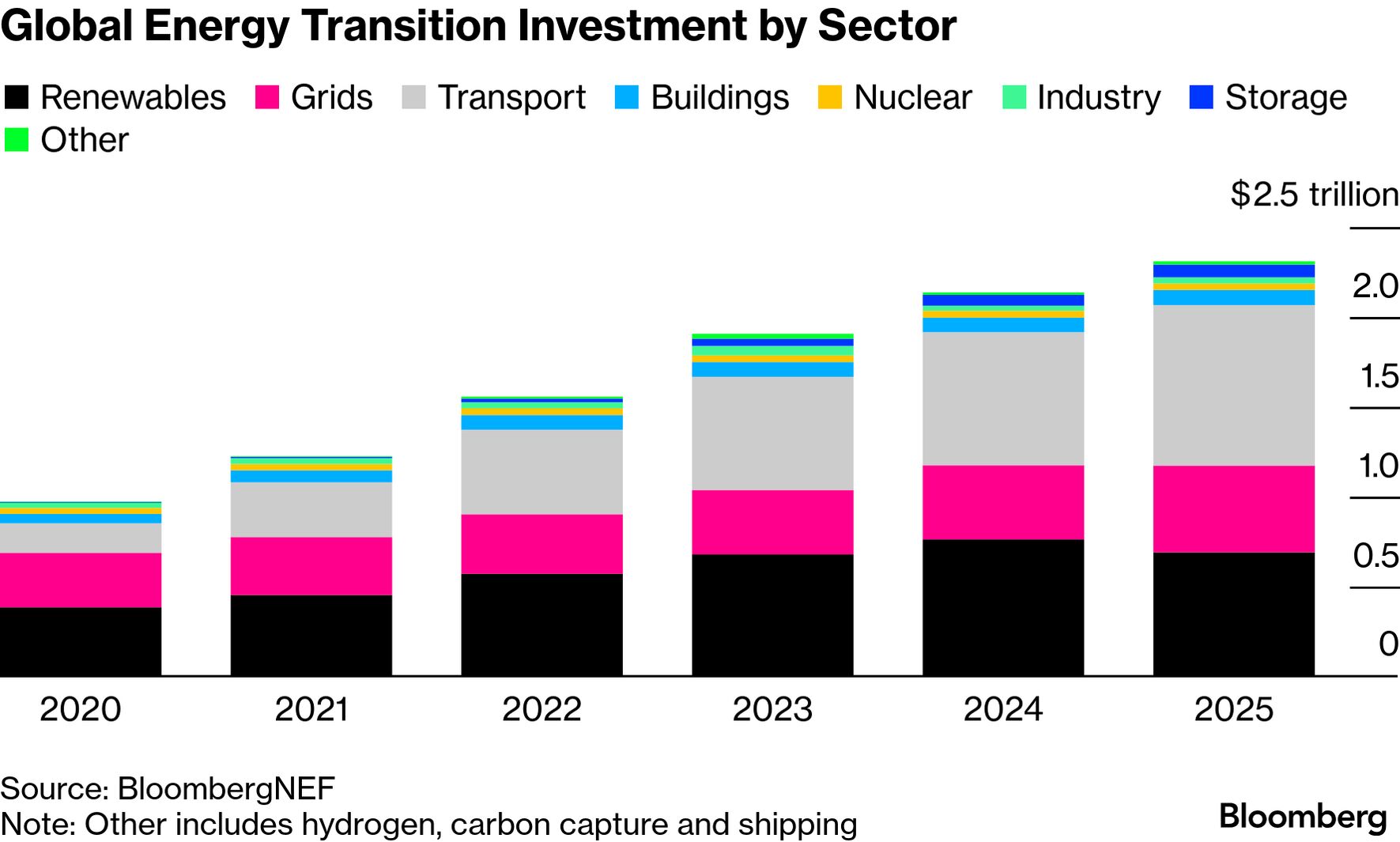
BNEF chose three challenges: powering data centers, balancing energy supply and demand and cleaning up heavy-duty transport. The winning companies are forging solutions in these areas. Taken together, they show that the world increasingly runs on electrons, and there’s a strong business case to keep funding the energy transition. As Claire Curry, the global head of technology, industry and innovation put it, the words “net zero” are becoming less common in countries’ and companies’ climate plans. But their actions show that energy security can be just as potent a driver of emissions cuts. That’s not to say there isn’t work to be done. Big tech companies have funded billions in clean energy projects, but their emissions keep rising. And countries have agreed to a global carbon tax on shipping, only for it to be held up by pressure from the Trump administration. But this year’s BNEF Pioneers award winners show where progress can be made.
Read more
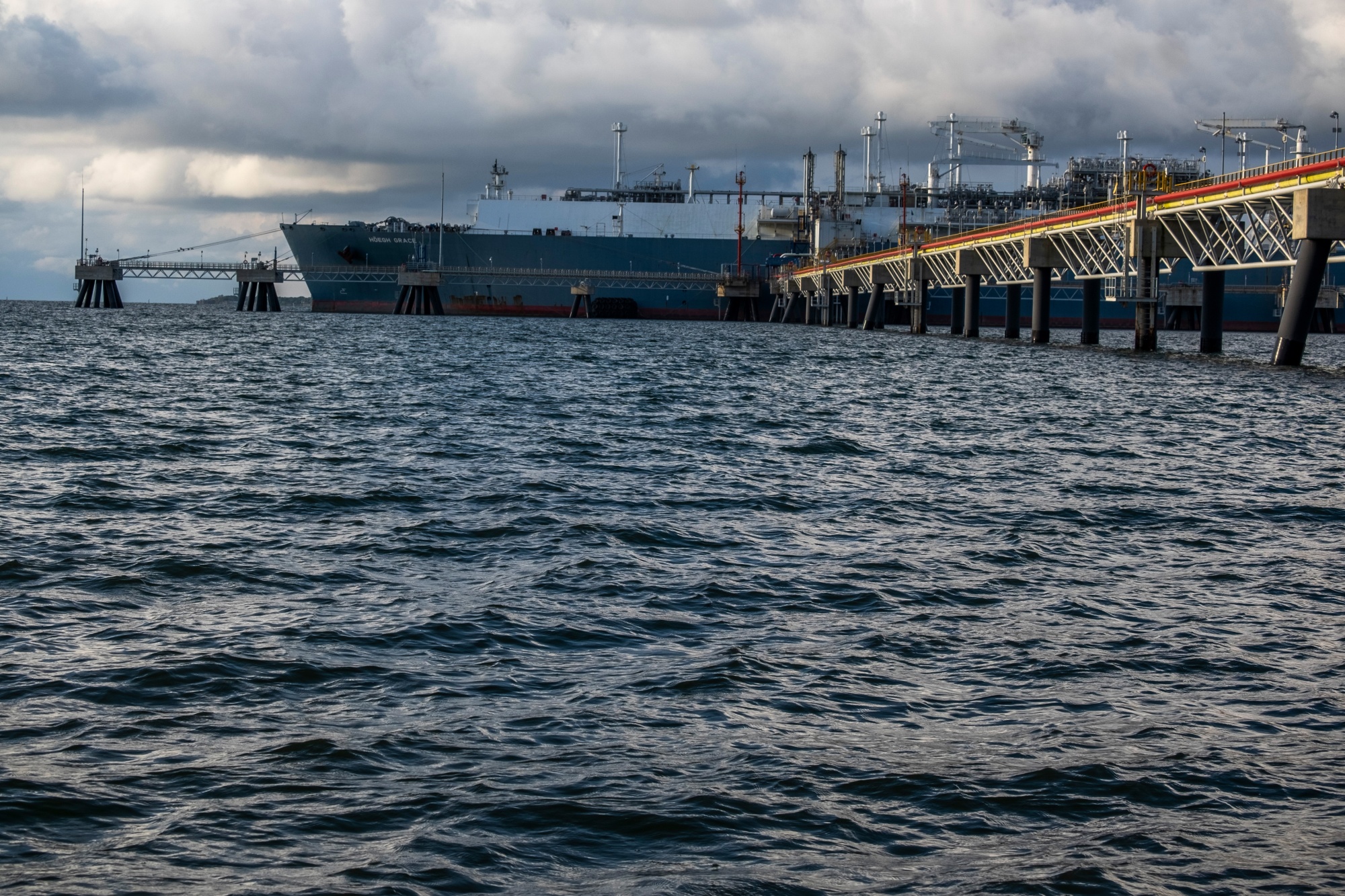
Wartime exportsChina’s exports of clean technology climbed in March, reinforcing signs that manufacturers are benefiting from rising global demand for alternative energy sources as traditional supplies are roiled by the Iran war. The most notable growth came in shipments of lithium-ion batteries and electric vehicles, with an annual increase of 34% and 53%, according to data released by China’s General Administration of Customs on Saturday. Solar cells also saw 80% growth last month. All three exports rose from February levels as well. The data give the first comprehensive picture of China’s clean tech exports since the US and Israel launched attacks against Iran seven weeks ago, effectively shutting the Strait of Hormuz and sparking a global energy crisis. The disruptions caused by the conflict have heightened the issue of energy security for countries reliant on fuel imports and sent consumers and industries hunting for alternatives. 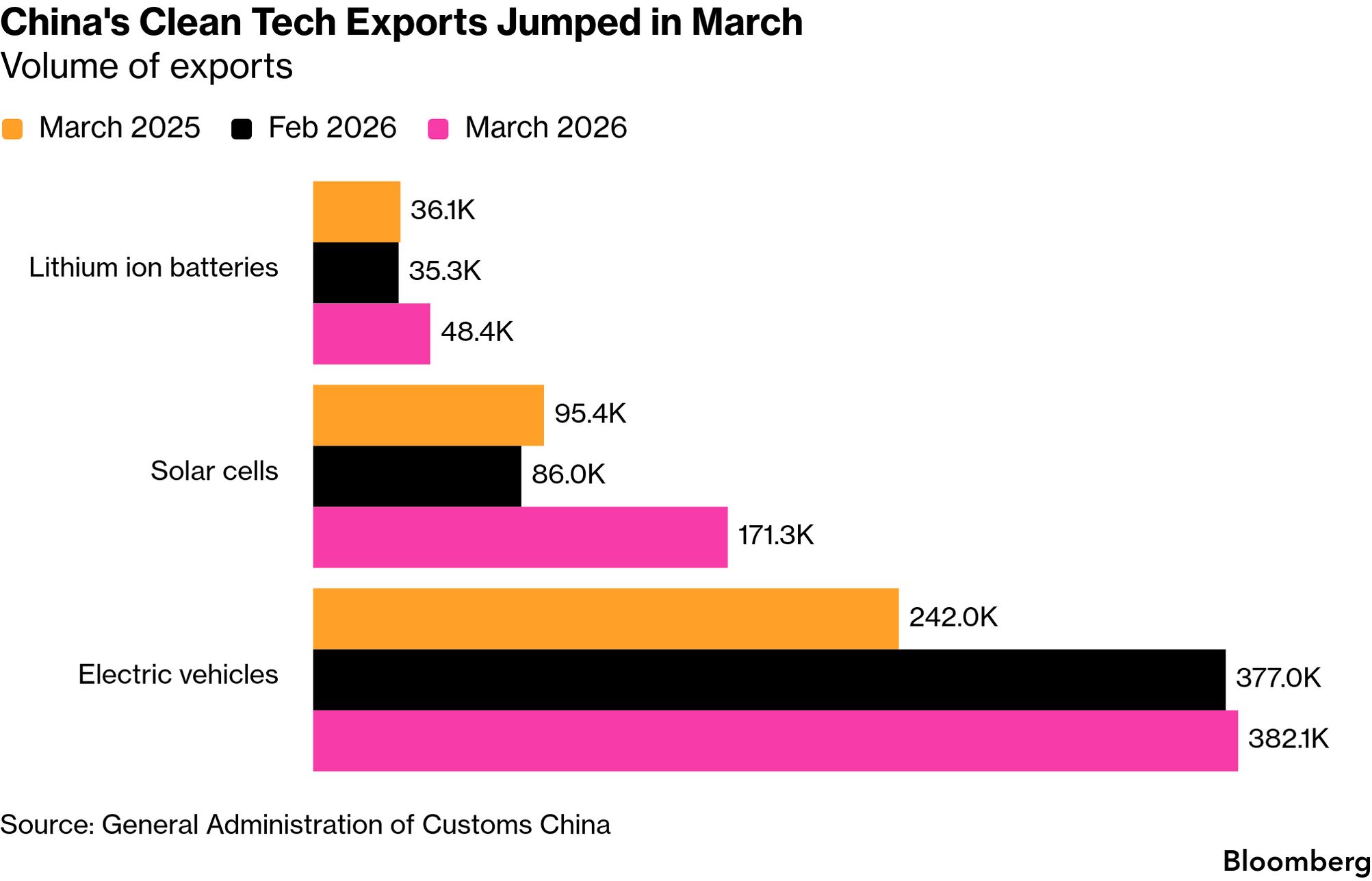
Read more
More from GreenBad Bunny had a problem. Days before the Puerto Rican mega-star was set to perform in Colombia earlier this year, the possibility of heavy rains threatened to turn three sold-out shows in Medellin into multimillion-dollar losses. 
Bad Bunny performs at the Atanasio Girardot stadium in Medellin, Colombia, on Jan. 23.
Photographer: Fredy Builes/Getty Images via Getty Images South America
Solutions were few. Traditional event cancellation insurance is rarely available so close to a performance date. Even if a policy could be secured, geography posed another challenge. The nearest official weather sensor sat a mile from the open-air venue — too far, in a tropical city with steep terrain and complex microclimates, to serve as a reliable trigger for a payout. So a transatlantic team of brokers, underwriters and meteorologists devised a workaround to save Bad Bunny from losses: They installed a temporary weather station inside the stadium, linked to a bespoke policy that would pay out if rainfall exceeded a set threshold.
Read more
More from Bloomberg
Explore all Bloomberg newsletters. We’re improving your newsletter experience and we’d love your feedback. If something looks off, help us fine-tune your experience by reporting it here. Follow Us
You received this message because you are subscribed to Bloomberg’s Green Daily newsletter. If a friend forwarded you this message, sign up here to get it in your inbox.
|




Asia regulators monitor Anthropic's Mythos for potential banking risks
Some Asian regulators said on Monday they were monitoring the development and possible implications of Anthropic's frontier AI model Mythos, which has triggered concerns in the U.S. and Europe over its potential use to destabilise banking systems. ...