| Read in browser | ||||||||||||||

Medical sterilizers rely on ethylene oxide, a carcinogenic gas. Regulations were about to go in place to reduce emissions across the US when the Trump administration stepped in. Today’s newsletter shares what happened and the risks posed by dozens of plants across the US. Plus, a look at how India’s biggest companies are struggling to break Beijing’s grip on production of batteries, EVs and critical minerals. Someone forward you this email? You can subscribe to the Green Daily for exclusive like these six days a week. Not so sterile airBy Leslie Kaufman and Zahra Hirji After teacher Janet Rau learned that a carcinogenic gas was being released from an industrial plant near her school in 2019, she started a campaign for more oversight. Five years later, the Environmental Protection Agency issued rules requiring facilities that use the gas to better monitor and cut their emissions of it. Those rules were set to take effect starting this month. But the Trump administration has granted dozens of temporary exemptions, including to the Atlanta-area facility near Rau. Now, as part of a sweeping deregulatory push, the EPA wants to ease the new regulations for the gas — ethylene oxide — permanently. The push to get tighter rules was maddeningly slow, says Rau, but “this is worse. The things that we’ve done have essentially been erased.” 
The Sterigenics plant in Atlanta, Georgia.
Photographer: Kendrick Brinson/Bloomberg
Back in 2016, the EPA determined that ethylene oxide, which is used to sterilize medical devices, was 30 to 60 times more carcinogenic than previously thought. Two years later, it identified areas near sterilizing facilities with elevated health risks. One was on the northwest edge of Atlanta, around a plant operated by the company Sterigenics, which is just downriver from the private Lovett School where Rau teaches fourth grade. As Rau and others learned about the pollution and pushed for answers, the EPA embarked on the years-long rulemaking process. In 2024 it finalized regulations requiring commercial sterilizers to cut their ethylene oxide emissions by 90%; carry out continuous monitoring of levels of the gas; and report the results in a way that communities could be confident gas wasn’t leaking into the air. Activists in Cobb County and an hour away in Covington, Georgia, where Becton, Dickinson and Co. operates a sterilization plant, considered it a victory. Then came the Trump administration. Last year, it offered waivers to a range of industries from having to comply with Biden-era standards for toxic air pollutants. More than three dozen of the country’s roughly 90 medical sterilizing facilities, including the Cobb County and Covington plants, got two-year exemptions from the new ethylene-oxide rules, according to the White House. This March, the EPA proposed to loosen the 2024 rules permanently. It will make its decision after a public comment period that ends May 1. If it makes the rollback final, legal challenges are almost sure to follow. Brigit Hirsch, a spokesperson for the EPA, said the standards are too burdensome to meet for an industry that’s critical for the country. “The 2024 rule posed a real threat to one of America’s only options for a secure domestic supply chain of essential medical equipment,” Hirsch wrote in a statement. She added that there was “no viable alternative” to ethylene oxide on the market. Community and environmental groups from around the country are now plaintiffs in a lawsuit challenging the administration’s authority to issue the exemptions. The US District Court for the District of Columbia has consolidated the case with others contesting Trump’s waivers, and will hear arguments on whether they should proceed together. As of mid-April, the EPA had already received more than 6,000 comments from the public on the proposed rollback. Of the roughly two dozen posted online, which are mostly opposed, one reads in part, “I grew up in east Texas and was exposed to ethylene oxide most of my childhood. I was 30 years old when I found my breast cancer and now 11 years later I’m dying.”
Read the story
Deregulation race40 The number of deregulatory actions the Trump EPA had taken as of February since the start of his second term. The EPA took 60 such actions across his entire first term. Mission critical“Air pollution rules exist to protect human health and the environment. That is the entire mission of the EPA.” Lena Moffitt Executive director, Evergreen Action New on ZeroIn the past month, we’ve seen two major plans from two of the world’s biggest polluters. In March, China approved its 15th five-year plan, which gave us a clearer sense of how the government makes progress on its climate goals. A few weeks after that, India published its climate plan for 2035. This week on Zero, Bloomberg Green’s Lili Pike and Akshat Rathi discuss those climate plans, and whether they’re ambitious enough for the current moment. Listen now, and subscribe on Apple, Spotify or YouTube to get new episodes of Zero every Thursday. India’s China threatLate last year, hundreds of executives and engineers from Reliance Industries Ltd., India’s biggest company, fanned out across Wuxi and other cities in China. The goal: getting up to $1.1 billion worth of equipment exported to kit out Reliance’s planned battery plant — the country’s most significant attempt to manufacture the advanced lithium-ion cells that power electric vehicles and renewable energy storage systems. Yet as senior company executives pushed suppliers and regulators to get the machines manufactured and past customs, Beijing dropped a diktat tightening controls on key battery-making technology and equipment. Reliance’s deal with its Chinese partner to help build the battery plant had hit a new roadblock. Despite the expensive machinery now sitting in Jamnagar in Gujarat state, where Reliance’s gigafactory is located, commercial production cannot begin anytime soon without further access to Chinese technology. Reliance did not respond to a request for comment. The episode encapsulates the bind hampering Mukesh Ambani’s company and others, as China’s grip on high-tech manufacturing hinders India’s ambitions to jump-start local industries and ultimately become an export manufacturing alternative. Interviews with over a dozen insiders across India’s battery, EV and electronics manufacturing ecosystem — who asked not to be identified discussing sensitive information — highlight how critical up-and-coming sectors are even more dependent on China now, despite billions of dollars in investment under the Make in India initiative. 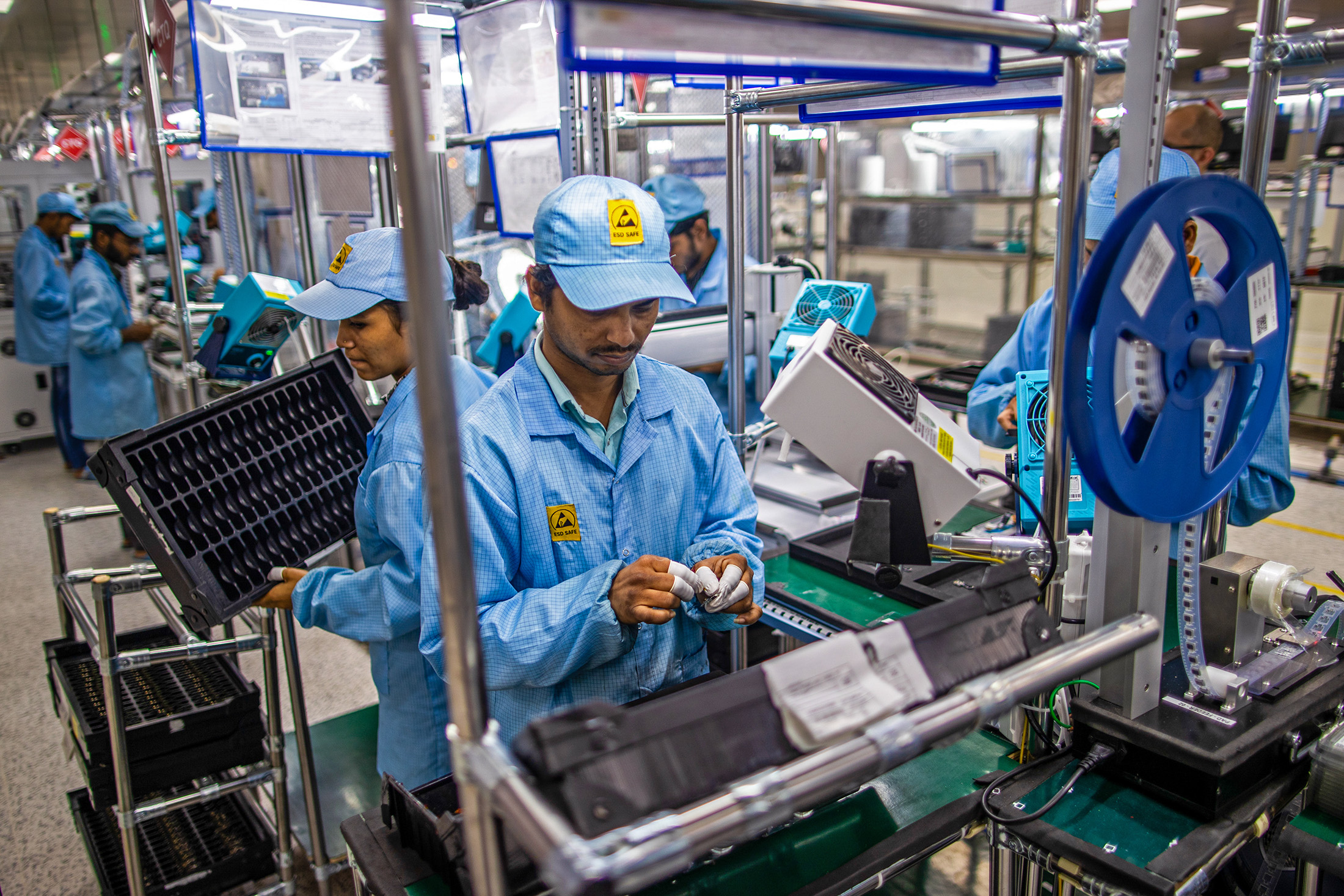
An assembly line at a subsidiary of Dixon Technologies, an Indian contract manufacturer of electronics.
Photographer: Prashanth Vishwanathan/Bloomberg
The war in Iran has also amplified India’s need to build out clean energy supply chains and work towards energy self-sufficiency. India’s “multitude of reforms in recent years have certainly positioned the country well to take advantage of global shifts in trade and financial flows,” said Eswar Prasad, an economist and professor of trade at Cornell University, in emailed comments. But China’s determination to ring-fence its prowess in new-technology industries “could leave India grasping for crumbs” at the lower end of the manufacturing spectrum, he said. Prime Minister Narendra Modi wants manufacturing to rise to 25% of GDP, but World Bank data shows the segment’s contribution has in fact shrunk from 17% in 2010 to just 13% in 2024. That could worsen under China’s new restrictions. Exacerbating that is the fact that India’s mission to boost manufacturing comes at a time of great geopolitical ruptures that are upending global trade. “Unlike in the previous two decades, the global economic, trade and geopolitical landscapes have turned into a hostile rather than conducive environment for countries seeking to follow the traditional development path built around manufacturing-intensive, export-led growth,” said Prasad.
Read more
More from GreenMore from Bloomberg
Explore all Bloomberg newsletters. We’re improving your newsletter experience and we’d love your feedback. If something looks off, help us fine-tune your experience by reporting it here. Follow Us
You received this message because you are subscribed to Bloomberg’s Green Daily newsletter. If a friend forwarded you this message, sign up here to get it in your inbox.
|






Strong ASML, TSMC forecasts signal AI spending boom is intact
Strong forecasts from ASML and TSMC this week point to another quarter of hefty spending by American cloud-computing giants as they race to secure advanced chips needed for their artificial intelligence build-outs. ...