| Read in browser | ||||||||||||||
 If Donald Trump intended his speech about the Iran war last night to have a reassuring effect on oil markets, Thursday's numbers reflected a distinct lack of success on that front. The 79-year-old president on Wednesday (and again today) reiterated his whipsaw social media strategy of threatening continued bombing of Iran—including targeting civilian infrastructure—while saying the war will soon be over. (And like the US military strikes on civilian boats in the Caribbean, attacks on civilian installations could constitute a war crime.) Trump did not, however, articulate a clear endgame to a conflict that's triggered the biggest energy crisis in 50 years. After another week of fighting and confused messaging from the White House, oil markets became more decisive: The most important price for real-world oil barrels surged above $140. 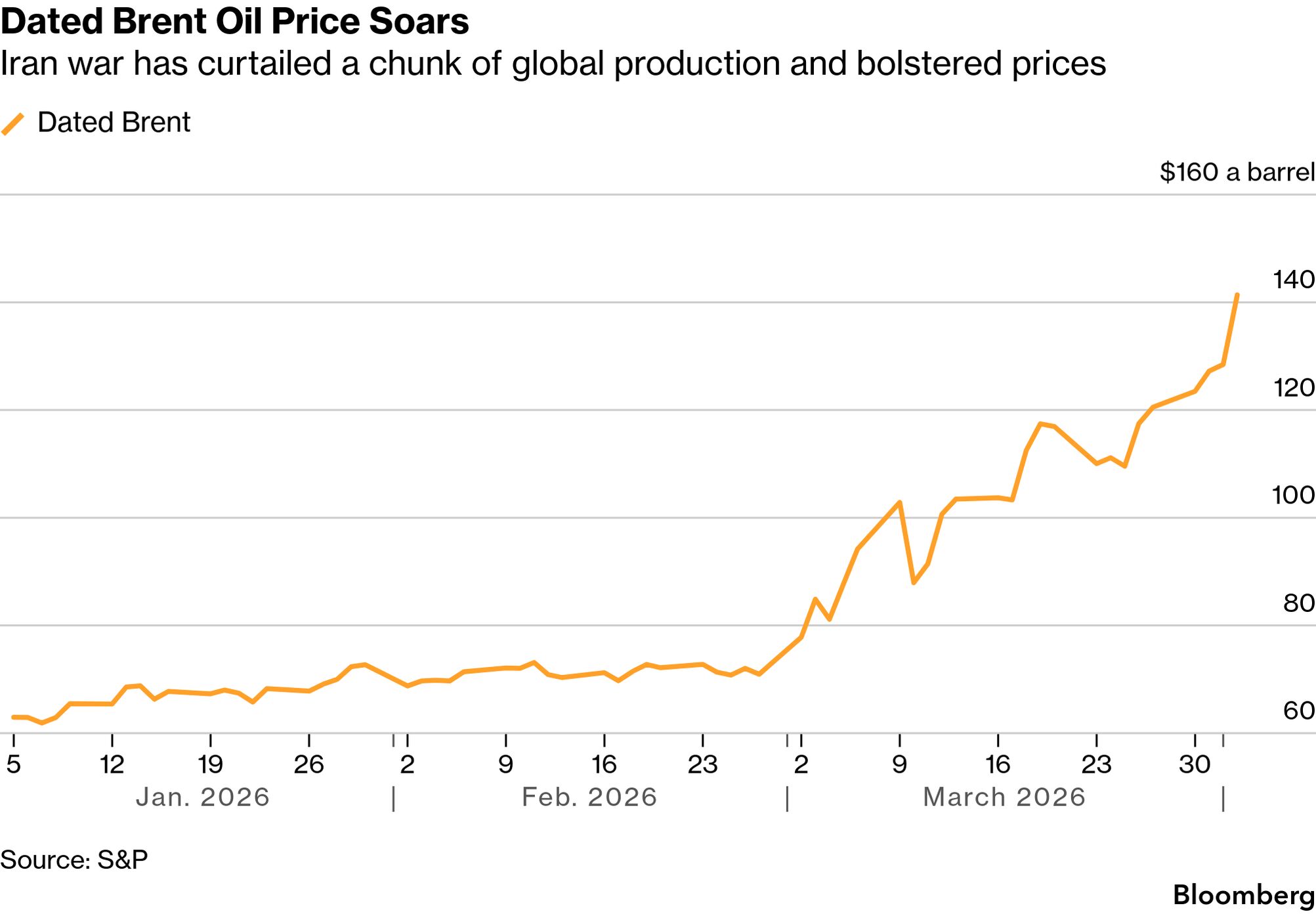 Dated Brent, the price of shipments bought and sold in the North Sea, reached $141.37. Previous measures of Iran war-driven oil spikes cited by comparison fallout from the full-scale Russian invasion of Ukraine in 2022. Today's prices are more in the neighborhood of the 2008 global financial crisis. Dated Brent underpins a significant number of transactions where actual cargoes are bought and sold—and a large volume of supply has been lost to the war. The futures market, on the other hand, is weighted largely to financial trading in so-called paper barrels. —David E. Rovella What You Need to Know TodayThe troubled private credit market experienced fresh pain Thursday. Blue Owl Capital will limit redemptions from two of its private credit funds after facing a surge in withdrawal requests—unprecedented among major firms in the opaque $1.8 trillion market. Wall Street was not amused. Investors in its $36 billion Blue Owl Credit Income Corp. fund, one of the industry's largest, asked to pull 21.9% of shares in the three months ended March 31, according to an investor letter, up from 5.2% in the prior period. The smaller Blue Owl Technology Income Corp. saw shareholders ask for 40.7% back, compared with 15.4% three months earlier, according to a separate letter. For the bigger fund, that amounts to $988 million of redemptions honored and about $3.2 billion remaining in the fund, while for the other it means redeeming $179 million and keeping roughly $1 billion of investors' cash. Fear has been growing among Investors after high-profile collapses and concerns over artificial intelligence disrupting—or simply laying waste to—the software industry, particularly those companies that have relied heavily on direct lenders. Blue Owl has found itself in a harsh spotlight in that regard. While Elon Musk can perhaps look forward to the prospect of being (on paper anyway) a trillionaire thanks to SpaceX going public, that fact that the company that made him is hitting increasingly bumpy roads may yield a twinge. Tesla posted one of its worst sales quarters in years, missing Wall Street's expectations, as the carmaker struggles to turn around its core business and navigate an increasingly challenged electric-vehicle market. 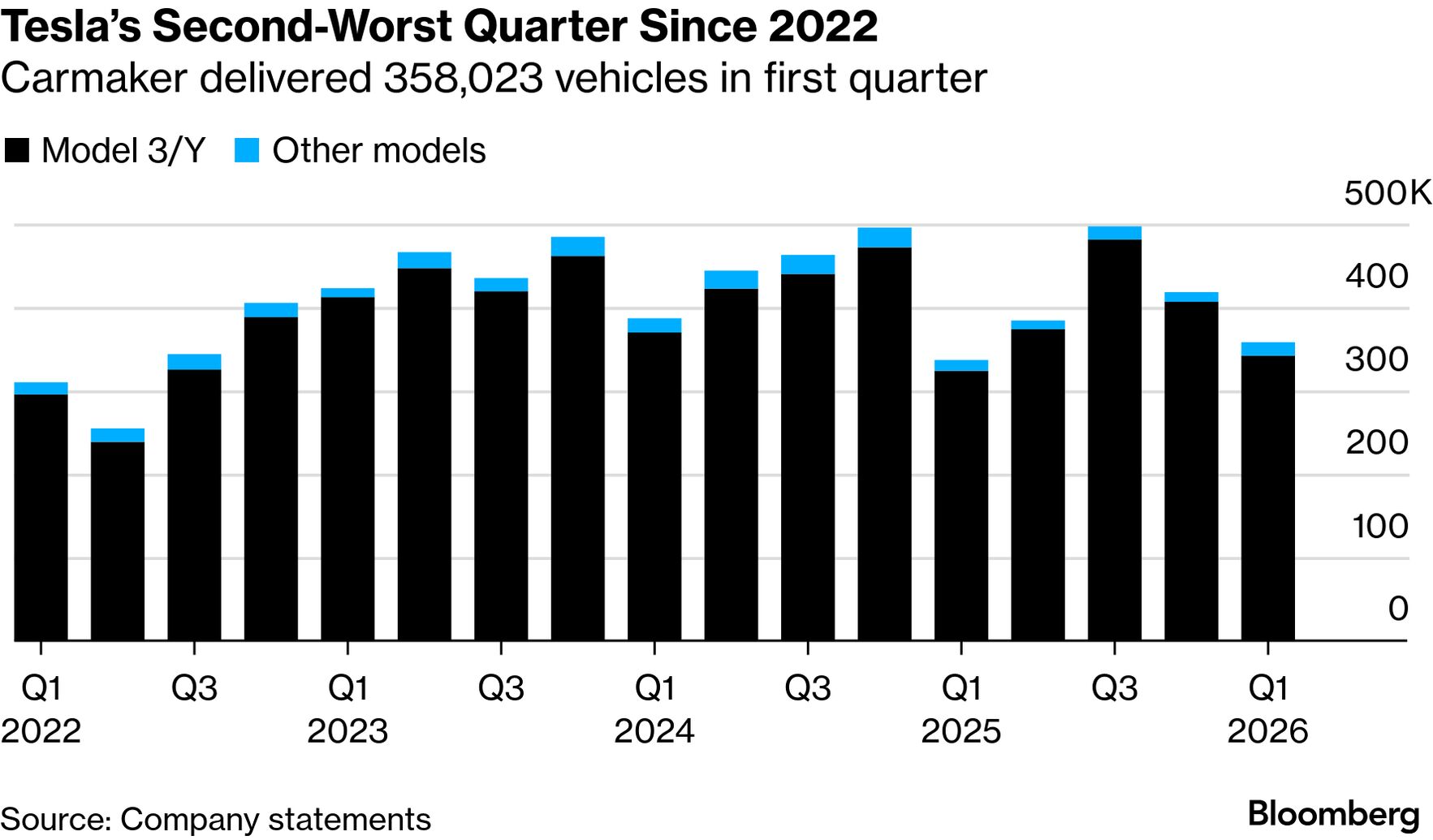 Canadian officials are considering unusual measures to protect domestic producers of vegetables and wood products from low-priced imports. The move threatens to complicate Prime Minister Mark Carney's efforts to fight US tariffs and strengthen trade relationships with other countries while tackling cost-of-living challenges. Finance Minister Francois-Philippe Champagne ordered an investigation last month into imports of frozen and canned vegetables to ensure Canadian industries "are not jeopardized by harmful trade diversion resulting from a rapidly changing trade environment." He also said he'd received an "urgent" request for trade protection from makers of wood furniture, cabinets and flooring. The potential for new trade barriers comes as Canada has positioned itself as a vocal opponent of Trump's global trade war. Canada has called some of those import taxes illegal and challenged them at the World Trade Organization. The government said restrictions imposed by other WTO members appear to have pushed significant volumes of vegetables into Canada. The private equity firm that acquired Walgreens as part of a $10 billion deal is said to plan a doubling of the pharmacy chain's profitability over the next several years to $4 billion. That's up from about $2 billion that the US drugstore company earned in 2024. Walgreens, one of the most recognizable drugstores in the US, was taken private last year after its stock fell steadily over a decade, in part due to increasing competition from online retailers and big-box stores. The company, once valued above $90 billion, also floundered as insurance companies tightened reimbursements for prescription drugs. What You'll Need to Know TomorrowFor Your CommuteBloomberg's Evening Briefing Americas will return on Monday, April 6. More from BloombergEnjoying Evening Briefing Americas? Get more news and analysis with our regional editions for Asia and Europe. Check out these newsletters, too:
Explore all newsletters at Bloomberg.com. We're improving your newsletter experience and we'd love your feedback. If something looks off, help us fine-tune your experience by reporting it here. Follow us
You received this message because you are subscribed to Bloomberg's Evening Briefing Americas newsletter. If a friend forwarded you this message, sign up here to get it in your inbox.
|