| Read in browser | ||||||||||||||


I’m Nancy Cook, Bloomberg’s senior national political correspondent, and each weekday I’ll be coming to you with inside-the-room reporting and insights that reveal what’s really happening in Washington — and how it impacts you. Email me with feedback and comments here. If this newsletter was forwarded to you, sign up here. Long-Term ImpactIt may be one of the most consequential decisions of President Donald Trump’s time in office. I’m talking about today’s Supreme Court ruling in a case from Louisiana that dealt a significant blow to what remains of the 1965 Voting Rights Act, one that will let states dismantle majority-Black and Hispanic congressional districts that have generally favored Democrats. The emerging consensus is that the ruling will have a limited impact on the November midterms since a handful of states have already held primaries and the candidate filing deadlines have passed in most others. But the consequences will be felt for years to come. 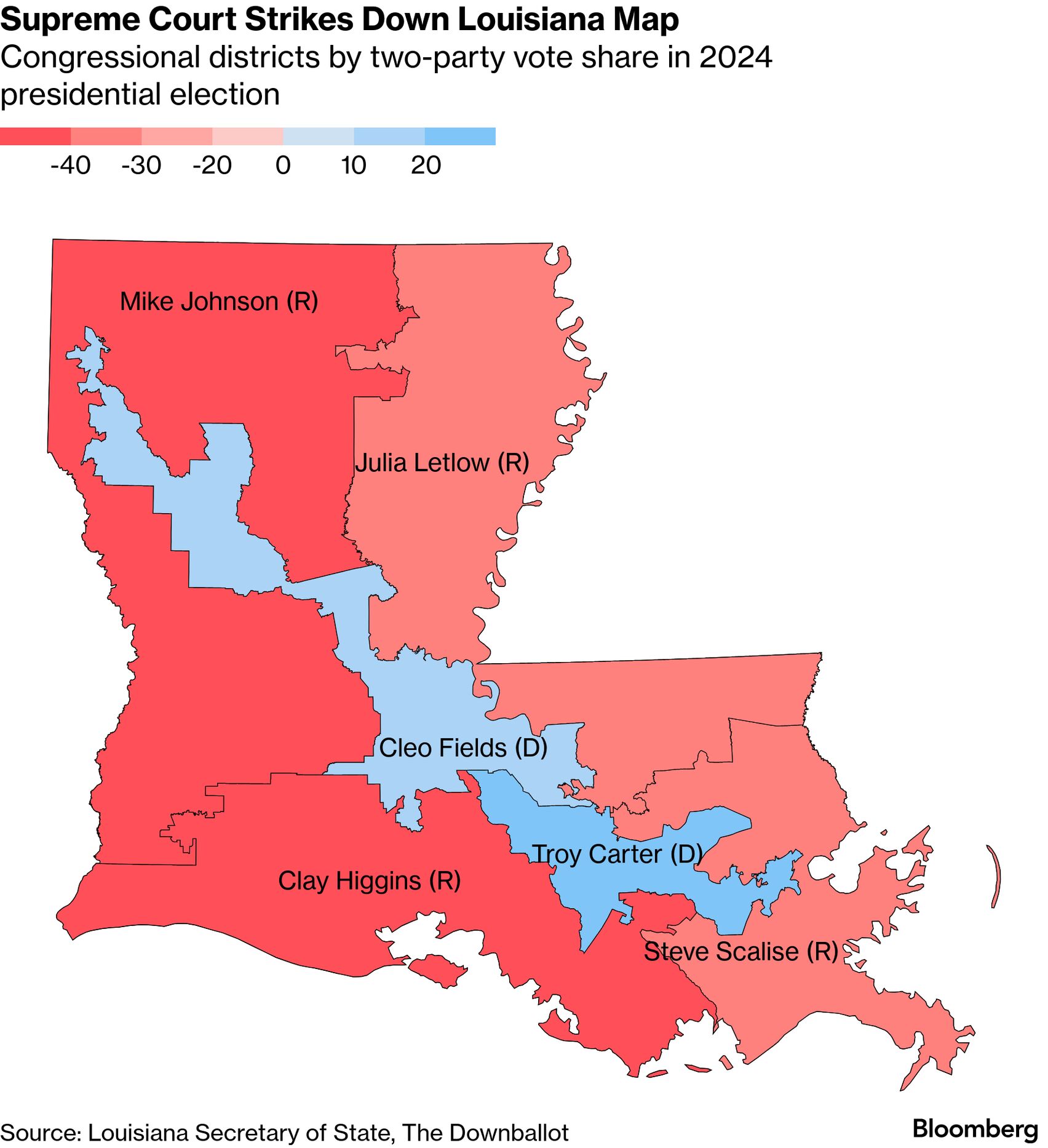
Democrats are united on the argument that it ultimately will strip minority voters of their political power and their ability to vote for people who represent their interests. Republicans “know they can’t win a free and fair election in November so they are doing everything they can to rig it,” House Democratic leader Hakeem Jeffries told Bloomberg’s Erik Wasson. Democrats are widely expected to reclaim the House majority in November and have put the Senate in play. Republicans contend the ruling will remove race and ethnicity bias from the political map — similar to the way Trump has tried to subtract race from college admissions — despite the nation’s long history of race-based voter suppression. House Speaker Mike Johnson, who represents a Louisiana district, called the decision “obviously the right result.” Senator Marsha Blackburn, who is running for governor in Tennessee, urged the state legislature to use ruling to draw another Republican seat in Memphis, a majority-Black city. The court’s 6-3 decision adds fuel to a redistricting battle that Republicans started this year in Texas as part of their larger strategy to cement power. It came the same day Florida lawmakers approved Governor Ron DeSantis’ map that would net Republicans as many as four more House seats. Read More:
While the court ruling may only net Republicans a few seats in the 2026 mid-terms, it could really boost Republicans in the long run. One Republican official recently told me that he expected the redistricting fights to last through at least the next two presidential election cycles. My colleague Greg Stohr, who covers the Supreme Court, wrote that, “Although the court didn’t strike down the law or explicitly overrule any precedents, the majority set up a demanding new test for those seeking to create heavily minority districts.” Democrats in districts with large populations of Black or Hispanic voters are trying to sort out their fates. Democratic Representative Terri Sewell told Wasson that she expects the Alabama legislature to try to redraw her Black-majority district this year to oust her. “I think this is an open invitation to every Republican state to try to redraw their maps before this election towards partisan ends.” One interesting footnote: All six conservative justices — three of them appointed by Trump — attended the White House state dinner last night to honor King Charles III, but the three liberal dissenters on today’s ruling did not. War With IranTrump told Axios he won’t lift a naval blockade of Iran’s ports until he secures a deal with Tehran to address the country’s nuclear program, extending a standoff over the Strait of Hormuz that has caused a global energy crisis. Oil surged to the highest since June 2022, with no end in sight to the US-Iran conflict or choked-off energy flows through the Strait of Hormuz, heightening concerns over a rapidly shrinking global supply cushion. 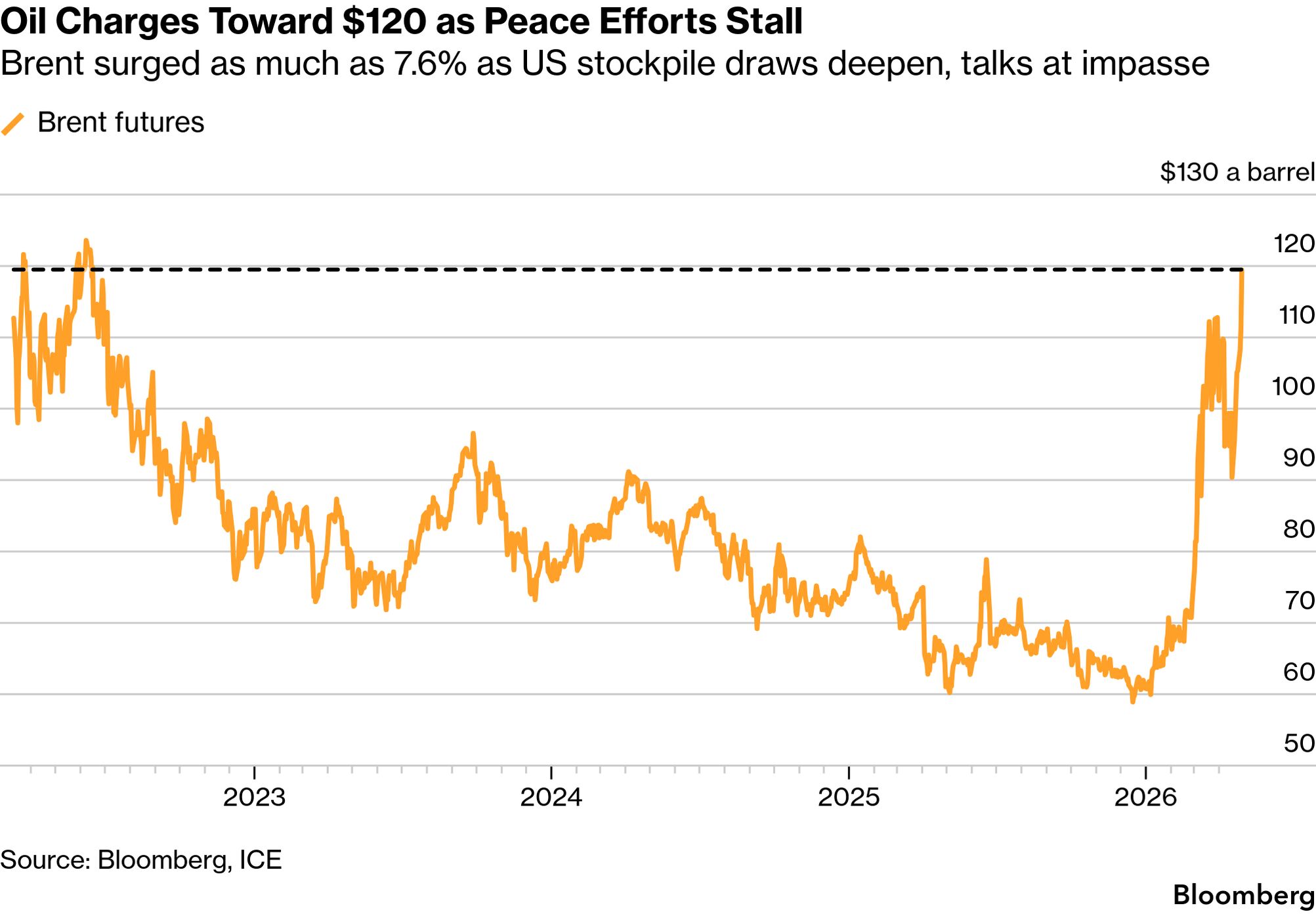
The US has spent an estimated $25 billion on the Iran war, the Pentagon’s budget chief told lawmakers today, in the administration’s most complete public estimate of the conflict’s cost so far. Today’s Top NewsFederal Reserve officials left interest rates unchanged, but revealed a deepening division over the outlook for policy amid increased uncertainty caused by the conflict in the Middle East. Fed Chair Jerome Powell said he’ll remain at the central bank as a governor after his term as chair ends on May 15 “for a period of time to be determined.” His seat on the Board of Governors doesn’t expire until 2028. Kevin Warsh, Trump’s nominee to replace Powell, won the backing of the Senate Banking Committee on a 13-11 party-line vote, putting him on track to be confirmed before Powell leaves as chair. Trump said he encouraged Vladimir Putin to conclude his war in Ukraine and rebuffed an offer from his Russian counterpart to help secure Iran’s nuclear material. The governor of the Mexican state of Sinaloa and other current and former officials were accused by US prosecutors of conspiring with cartel leaders to import drugs into the US in exchange for political support and bribes. Orders for business equipment in the US increased in March by the most since mid-2020, extending a yearlong stretch of solid capital investment fueled by spending on artificial intelligence. 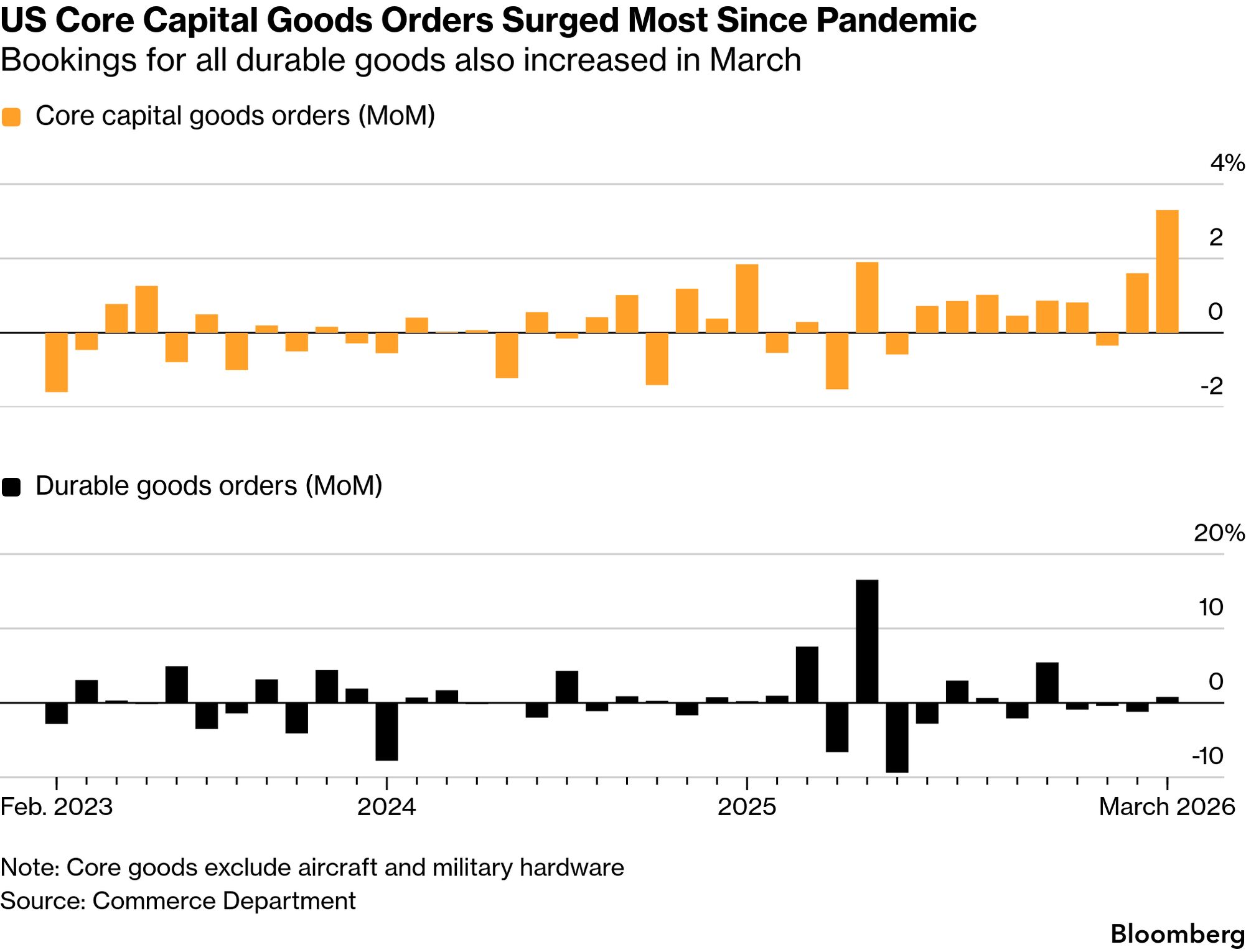
New residential construction in the US rose in March to the highest level in more than a year as homebuilders boosted production despite ongoing affordability concerns. A bid by influential Republican lawmakers to answer voters’ concerns about the cost of living by lowering taxes on capital gains is dividing the GOP ahead of November elections. Former FBI Director James Comey surrendered to authorities Wednesday in response to federal criminal charges for allegedly threatening Trump’s life in a social media post. The Trump administration told a divided Supreme Court that past remarks by the president disparaging Haiti and immigrants weren’t racist and shouldn’t get in the way of the government stripping temporary protections for migrants. The man charged with attempting to assassinate Trump at a Washington hotel on Saturday followed the president’s movements in real-time using a website and live video feeds just before a shootout with security at the venue. Texas Democrat James Talarico holds leads in a new poll over both Republicans vying for a US Senate seat, reflecting voters’ concerns about the cost of living and dimming views of Trump’s handling of the economy. The Trump administration said the first tariff refund payment is set to go out around May 11, even as thousands of US importers encounter issues with an online portal designed to handle claims. Must Reads From Bloomberg GovernmentLobbying shops with close ties to the White House are commanding eye-popping sums for influence work for foreign clients—some of whom were facing federal charges—according to disclosures filed last week. The House adopted a procedural measure allowing GOP leaders to move forward on three mammoth legislative priorities, notching a major win for Speaker Mike Johnson after days of Republican infighting and delays. Watch & ListenToday on Bloomberg Television’s Balance of Power early edition at 1 p.m., host Joe Mathieu interviewed Republican Senator Shelley Moore Capito about renewing a key government intelligence law, the war and energy prices. 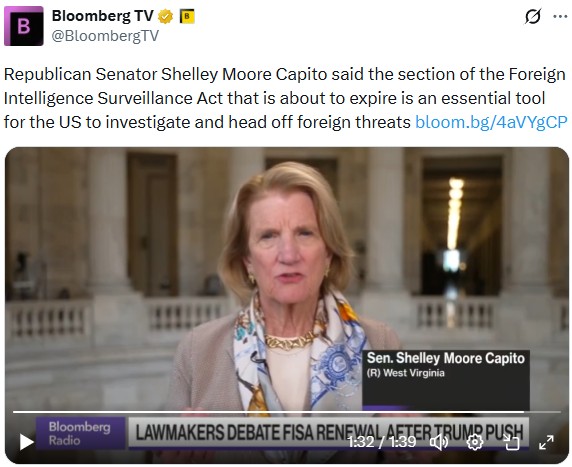
On the program at 5 p.m., he talks with Senators Elissa Slotkin, a Democrat, and Bernie Moreno, a Republican, about their legislation targeting Chinese technology in cars and trucks on US roads. On the Big Take Asia podcast, host K. Oanh Ha speaks with Bloomberg’s Jon Herskovitz about North Korea’s aggressive nuclear buildup and the strain that puts on US defenses. Listen on iHeart, Apple Podcasts and Spotify. Chart of the Day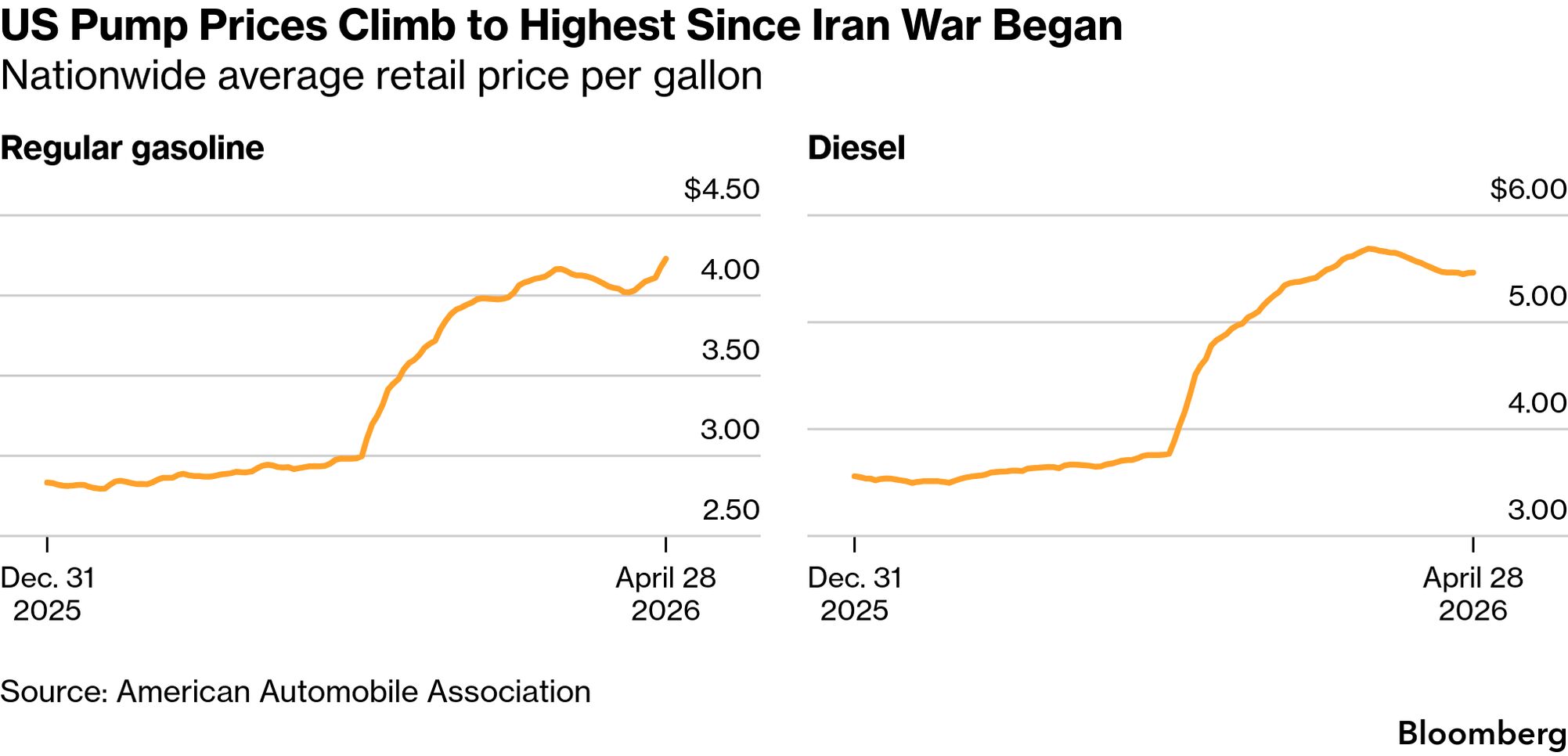
After falling back slightly when an Iran ceasefire was agreed earlier this month, US gasoline prices resumed their advance this week, hitting the highest levels since the war began — in fact, the highest since the post-Covid demand surge of 2022. Diesel, an important inflation risk because it’s so widely used in areas like agriculture and freight, has pared gains this month but remains some 45% higher than it was pre-war. These fuel prices are seen as key to the domestic political costs of the war for Trump. And with the president now threatening to keep the global energy squeeze going through an extended Iran blockade, they’re likely headed higher. — Ben Holland What’s NextThe March personal consumption expenditures index, the Fed’s preferred inflation gauge, will be published tomorrow. Gross domestic product for the first quarter will be reported tomorrow. The 152nd running of the Kentucky Derby is on Saturday. Factory orders in March will be reported next Monday. Durable goods orders for March also will be reported next Monday. Trade data for March is due out on next Tuesday. Job openings and layoff in March will be released next Tuesday. Primaries will be held next Tuesday in Indiana and Ohio. The April jobs report will be published May 8. The University of Michigan’s preliminary reading of consumer sentiment in May will be released May 8. More From BloombergLike Washington Edition? Check out these newsletters:
Explore all newsletters at Bloomberg.com. We’re improving your newsletter experience and we’d love your feedback. If something looks off, help us fine-tune your experience by reporting it here. Follow Us
You received this message because you are subscribed to Bloomberg’s Washington Edition newsletter. If a friend forwarded you this message, sign up here to get it in your inbox.
|





Highlights from Bloomberg CityLab 2026 in Madrid
The conference kicked off with remarks from the mayors of Madrid, London and more. ...