| Read in browser | ||||||||||||||

Each week we bring you insights into one of Asia’s most dynamic economies. If you haven’t yet, please sign up here. This week, Karthikeyan Sundaram examines how a terse decree from Beijing unwound a $2 billion deal and dealt a blow to hopes that Singapore can be a sanctuary for Chinese AI; Niki Koswanage and Tom Redmond trace the events behind Malaysia’s change of guard at its anti-corruption agency; and Srinidhi Ragavendran visits — or tries to — a Little India institution that has gone dark. Pulling the PlugSingapore has become something of a sanctuary for Chinese AI ambition in recent years. Manus, the autonomous AI agent startup whose Chinese founders relocated here to tap global capital, looked like the clearest proof yet that the strategy worked. A $2 billion acquisition by Meta Platforms, a Benchmark Capital-backed valuation, a global product launch — it was the template every founder with China roots and international dreams quietly studied. This week, Beijing tore up the template. China’s National Development and Reform Commission issued a terse, 54-character directive ordering the unwinding of Meta’s takeover of Manus, citing laws prohibiting foreign investment in the startup. No elaboration. No appeal process mentioned. Just a one-line notice from one of the country’s most powerful state planners — and a deal that had largely been completed suddenly seemed dead. The ruling lands at an awkward moment, weeks before a scheduled summit between Presidents Donald Trump and Xi Jinping, and its implications stretch well beyond Manus itself. 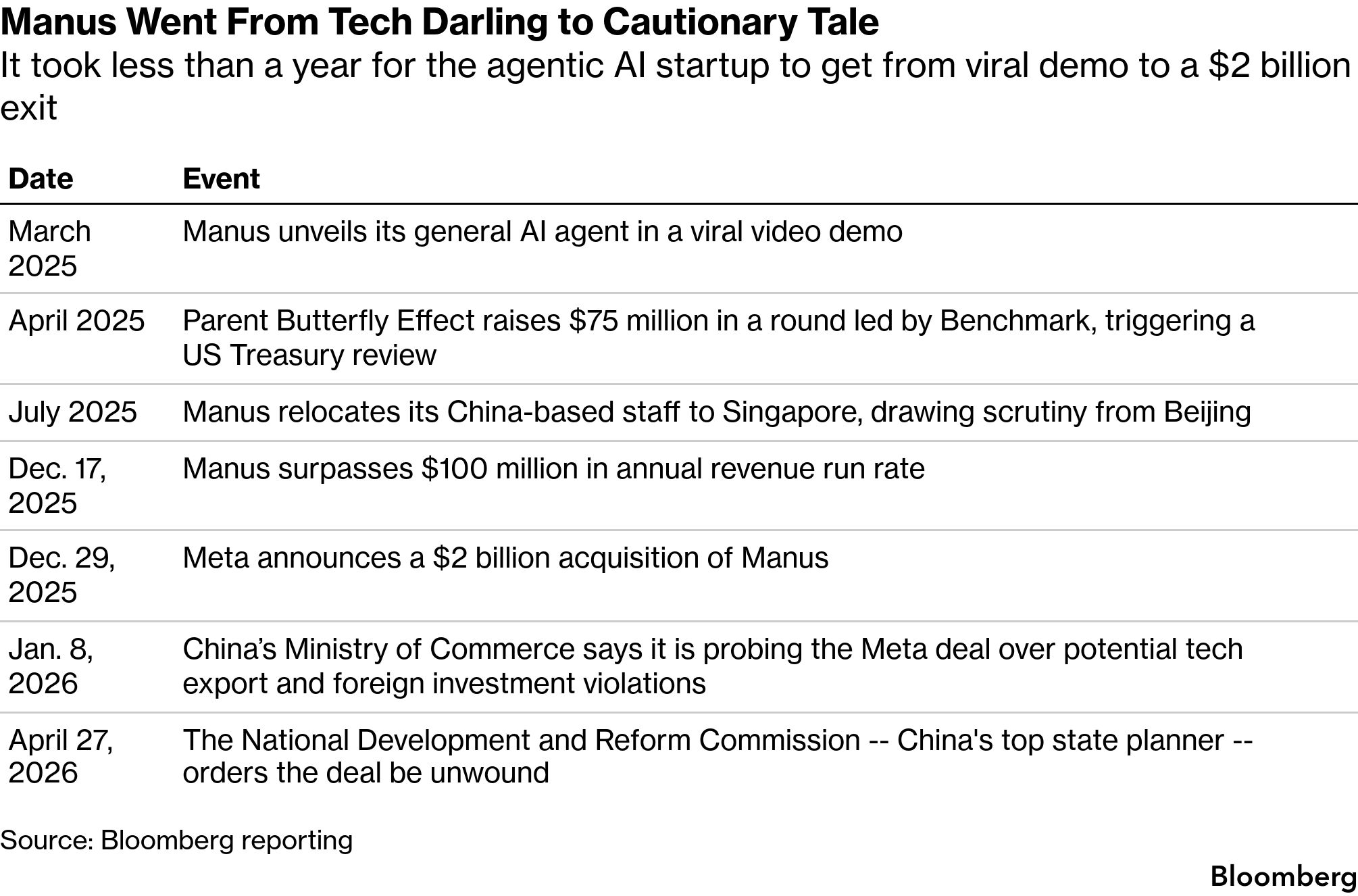
Beijing has simultaneously moved to restrict major tech firms — ByteDance and Moonshot AI among them — from accepting American capital without explicit approval, and tightened scrutiny of offshore Chinese companies seeking Hong Kong listings. Taken together, the moves signal that China’s patience with the so-called “Manus Model” — relocate to a neutral hub, raise global capital, stay out of Beijing’s immediate line of sight — has run out. For Singapore, the fallout is pointed. The city-state has positioned itself as precisely the kind of neutral, well-regulated jurisdiction that has proven attractive for companies caught between Washington and Beijing as they seek breathing room. Manus’s move here, its global hiring spree and its backing by Silicon Valley’s Benchmark were all, in a sense, a validation of that proposition. The NDRC’s ruling suggests China sees Singapore’s neutrality rather differently — less as benign geography, more as a conduit for technology transfer to a geopolitical rival, at least in the Manus case.  
WATCH: Why is China blocking Meta’s acquisition of Manus?
What happens next to Manus’s Singapore operations remains unclear. It could take a tremendous effort for Meta to fully disentangle Manus from its network. This is not just a matter of engineers working on Meta’s behalf for months, but also of code and data that may already have been integrated into Meta’s systems. The company has not commented. But for the founders, investors and startups watching closely — and there are many — the message is stark. The regulatory firewalls are going up. Business structures are being overhauled. The era of threading the needle between Chinese origins and American capital, with a Singapore address as the bridge, has become considerably more treacherous. As Dermot McGrath, a Shanghai-based adviser to tech startups, put it: “As of today, ‘the Manus Model’ is officially dead.” Singapore, which has bet heavily on becoming Asia’s AI hub, now has to reckon with what that means for its broader ambitions — as will the next Manus waiting in the wings.—Karthikeyan Sundaram Weekend Catch-UpA selection of the best of Bloomberg storytelling, from podcasts and video to explainers and feature stories. Read
Watch 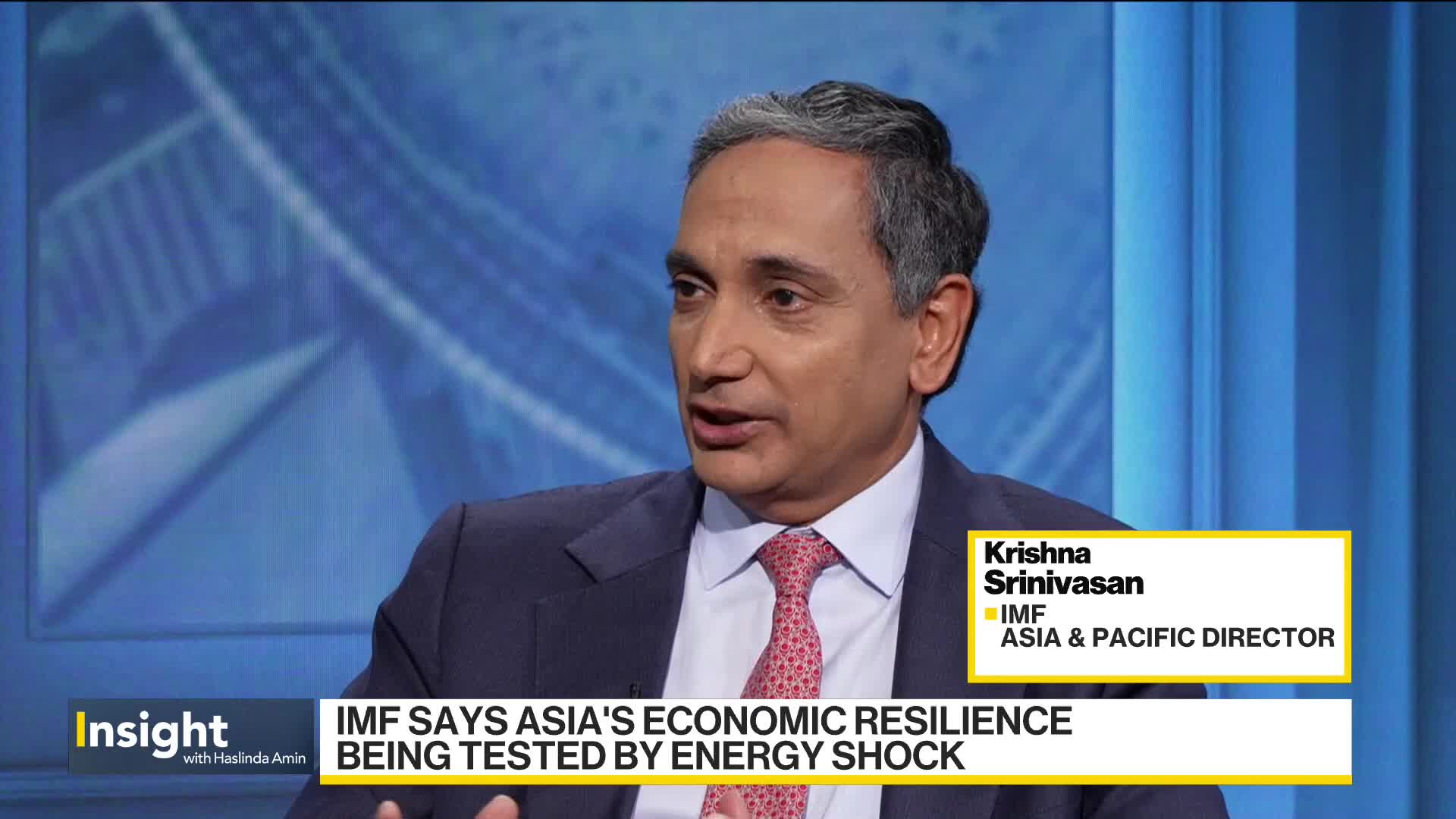
WATCH Bloomberg Insight: IMF Asia and the Pacific Director Krishna Srinivasan discusses the impact of the Iran war and economic risks with Haslinda Amin.
Listen
MORE: Explore live streaming news and interviews, documentaries, reporter analysis and more, all in one place. Check out Bloomberg.com/videos. Malaysia’s Change of GuardIt began with a social‑media decree from Malaysia’s king. In posts on Instagram and Facebook, Sultan Ibrahim Iskandar said he would determine the next head of the Malaysian Anti‑Corruption Commission. It was the first official confirmation that current chief Azam Baki’s contract wouldn’t be renewed. The next day, Prime Minister Anwar Ibrahim met the monarch in Johor, the southern state bordering Singapore. It was a working visit, the king said on social media. Anwar later told reporters he had submitted a list of candidates for anti-graft chief. Asked how many names were on it, he cracked a joke. “There were 120,” Anwar said. The light moment masked a deepening political scandal. Protesters were preparing to march through Kuala Lumpur on Saturday last week, demanding Azam’s arrest and reforms to Malaysia’s most powerful enforcement agency. A veteran graftbuster and a key figure in Anwar’s anti‑corruption drive, Azam came under scrutiny after Bloomberg reported in February that his shareholdings in a financial‑services firm far exceeded the allowed limit for public officials, citing documents from Malaysia’s corporate register. Azam said he did nothing wrong and that the shareholdings were properly declared. 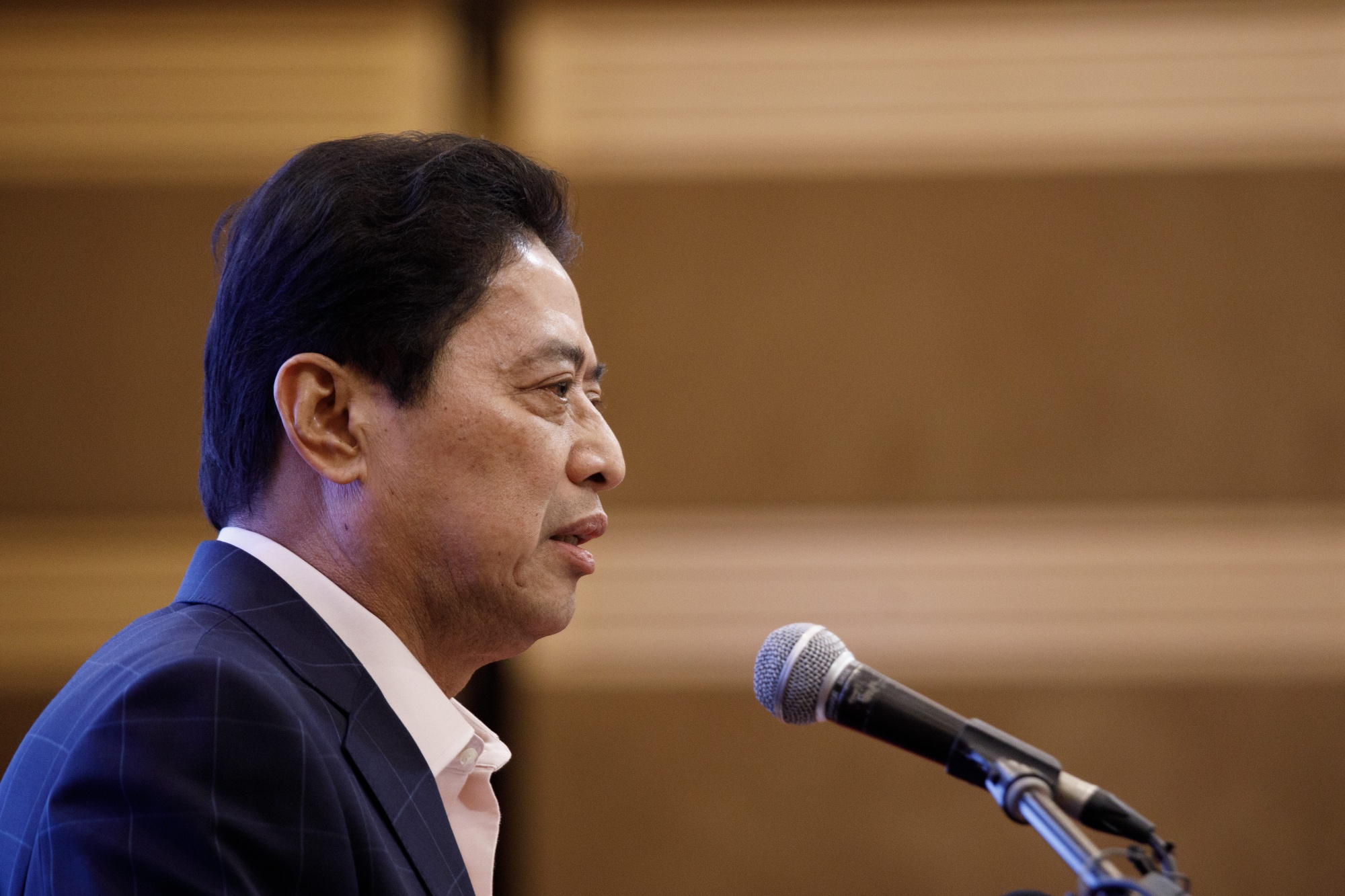
Azam Baki, outgoing chief commissioner of the Malaysian Anti-Corruption Commission
Photographer: Samsul Said/Bloomberg
MACC and Azam then denied allegations in a separate Bloomberg report, based on documents and people familiar with the matter, that business executives colluded with agency officials to intimidate and oust company founders. Hours before the protest was due to start, Anwar’s government made its move, announcing the appointment of a new MACC head. The choice was Abdul Halim Aman, a former High Court judge and agency outsider. “This will not stop us,” said Faisal Abdul Aziz, chairman of the Coalition for Clean and Fair Elections, one of the protest organizers. “What we want is reform of the MACC leadership structure and a Royal Commission of Inquiry into the alleged wrongdoing and abuse of power.” More than 1,500 protesters turned up on a rainy Saturday. The situation briefly turned tense when firecrackers were set off but it quickly calmed. Politicians from both government and opposition camps joined the crowd, alongside youth groups, a rare show of broad‑based concern. Critics say the agency’s chief should be appointed by a parliamentary committee, an election campaign promise that Anwar’s ruling coalition has yet to make good on. The government hasn’t yet released the findings of its investigation into Azam’s shareholdings. It has asked law enforcement agencies including the MACC to probe the allegations of collusion with the so-called corporate mafia. So far, police and Azam say they have found no evidence of MACC involvement. Azam’s six‑year tenure ends on May 12, his birthday. Asked about it all recently, Azam said he had no plans to enter politics and would spend time jogging and cycling. He also laid out one thing he wouldn’t be doing. “Rest assured, I will not be gathering at Sogo,” Azam said. He was referring to the department store that often serves as an assembly point for political protests in KL. —Niki Koswanage and Tom Redmond The Review: Komala VilasFrom the best spots for a business lunch to drinks with the boss, we sample the city’s eateries, bars and new experiences. In the heart of Singapore’s Little India, Komala Vilas remains shuttered since Jan. 19. A sign on the door cites renovation. Months on, there’s no reopening date. No visible work inside. Founded in 1947 by Murugiah Rajoo in post-war Singapore, Komala Vilas grew into one of the city’s most recognizable South Indian vegetarian restaurants, known for its long queues, no-frills setting, crisp thosai served on plates lined with banana leaf, and filter coffee in steel tumblers. It had its moment of global recognition too. In 2015, then Prime Minister Lee Hsien Loong brought his Indian counterpart Narendra Modi here for thosai — a gesture that briefly turned a Serangoon Road institution into an international dateline. Someone even called it Dosa diplomacy. The place holds the SG Heritage Business designation from the National Heritage Board, awarded to businesses considered the backbone of Singapore’s cultural landscape. I caught up with Rajoo Thanasekaran, the founder’s son, at his own restaurant a 10-minute walk away on Race Course Road. Known to customers simply as Sekar, he grew up in Komala Vilas alongside his elder brother, Rajoo Gunasekaran, who later ran the restaurant until his death in 2020. Today, Komala Vilas is helmed by Gunasekaran’s son. In 1995, Thanasekaran struck out on his own to start Komala’s, a South Indian vegetarian chain that now has five outlets across Singapore. He said he does not have visibility on how long the renovations will last in Komala Vilas or what plans are in place. As we spoke over thosai, a long-time patron approached to ask Thanasekaran about Komala Vilas. She had first come to Singapore as a newly married bride in the 90s, and shared that the restaurant had especially been a place of comfort in those early years. Komala Vilas was an institution in its own right. We hope to be writing a different review soon — one with a reopening date, a queue out the door, and a filter coffee worth the wait.—Srinidhi Ragavendran Have a place you’d like us to review or feedback to share? Get in touch at [email protected]. Thanks for reading our newsletter! Subscribe here if you haven’t already. More from Bloomberg
We’re improving your newsletter experience and we’d love your feedback. If something looks off, help us fine-tune your experience by reporting it here. Follow Us
You received this message because you are subscribed to Bloomberg’s Singapore Edition newsletter. If a friend forwarded you this message, sign up here to get it in your inbox.
|