| Read in browser | ||||||||||||||

Renewables and batteries go hand in hand. But for US data center operators, batteries are increasingly a tool to pair with natural gas. Today’s newsletter looks at how energy storage is being used to deploy more fossil fuel in service of the AI boom. Plus, China’s local officials are under pressure to make sure the country meets its climate goals. Someone forward you this email? You can subscribe to the Green Daily for free news about the twists and turns of the energy transition. Charging with gasBy Mark Chediak and Michelle Ma The scramble to find enough power for artificial intelligence has data center operators looking for any solution. An unexpected one taking root pairs batteries — long seen as a key to adding more renewables — with fossil fuels. BloombergNEF has tracked 4.9 gigawatts of energy storage announcements that are co-located with on-site fossil fuel generation at data centers. That’s about 32% of announced global on-site data center battery capacity. The sites include some of the largest AI data center complexes under development, such as Elon Musk’s Colossus supercomputer in Memphis, Tennessee, and the combo has become so popular that companies such as Caterpillar Inc. and GE Vernova Inc. have announced products or partnerships pairing energy storage with gas generation. 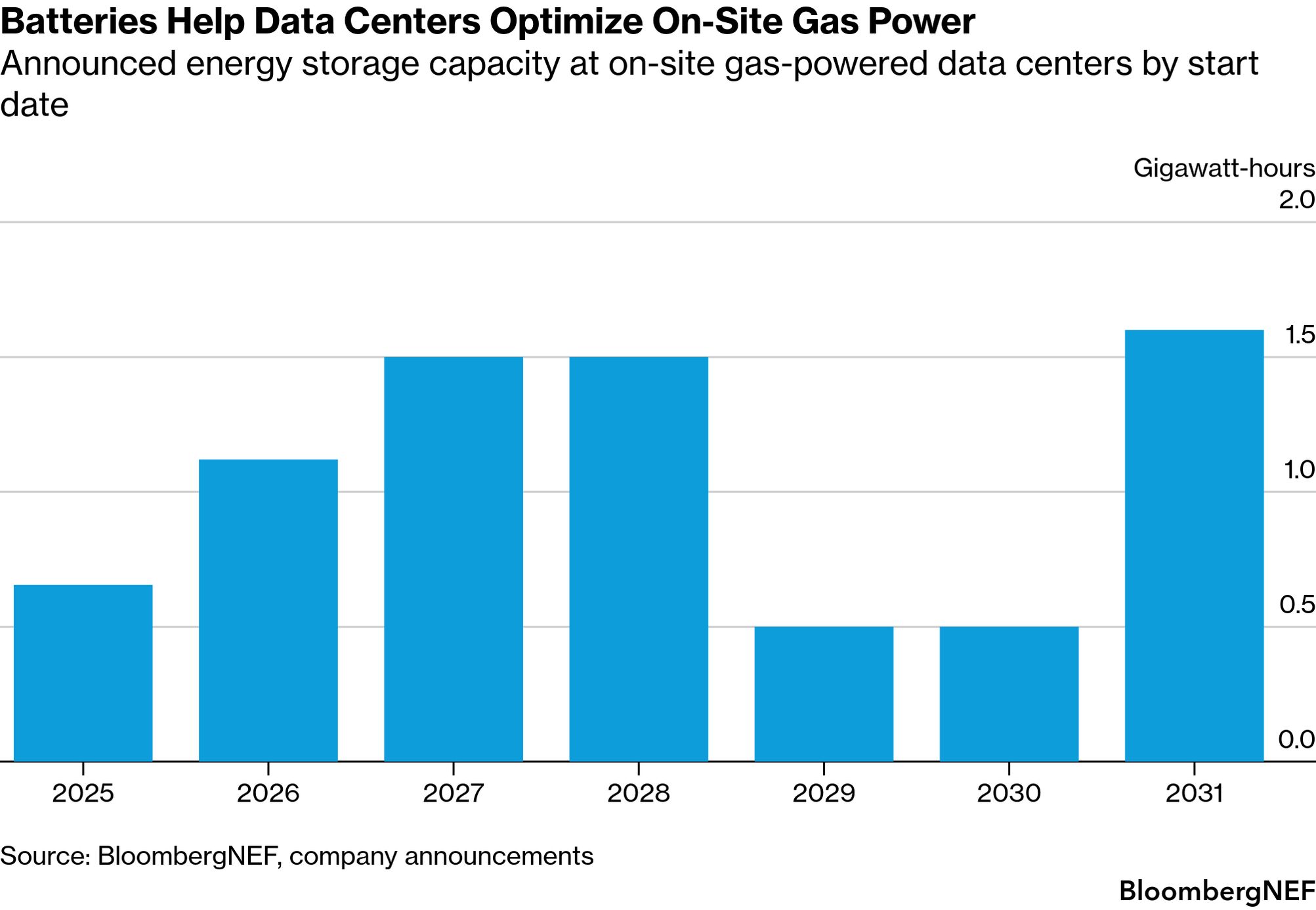
Batteries are a linchpin for unlocking solar and wind energy’s full potential by soaking up excess green energy and then discharging it when the wind isn’t blowing or the sun isn’t shining. However, the steep drop in battery costs is now allowing energy-storage technology to be deployed in conjunction with natural gas to provide more reliable power for data centers. While gas can provide round-the-clock power, not all plants work 24/7. For many behind-the-meter facilities, data centers are choosing gas turbines that run for shorter periods and don’t ramp up quickly enough to meet computing needs. That has hyperscalers turning to batteries, which can rapidly discharge power, to fill these gaps. The batteries also help prevent damage to gas turbines that aren’t designed to be used for frequent ramping cycles. “I assumed batteries would be a tool for decarbonization,” said Michael Thomas, founder of clean energy research firm Cleanview who has also been tracking the rise of energy storage paired with gas. “What we are learning in this new AI era is that they can also be used as a tool for fossil fuel power because their technological advantages make it possible to build and operate an off-grid power plant.” While data centers now face an average of four years to get power from the grid, they are turning to gas generators paired with energy storage as a bridge source of energy, said Allison Weis, Wood Mackenzie’s global head of energy storage. As long interconnection queues delay requests for utility-connected power, data center developers are finding it faster to bring their own generation. 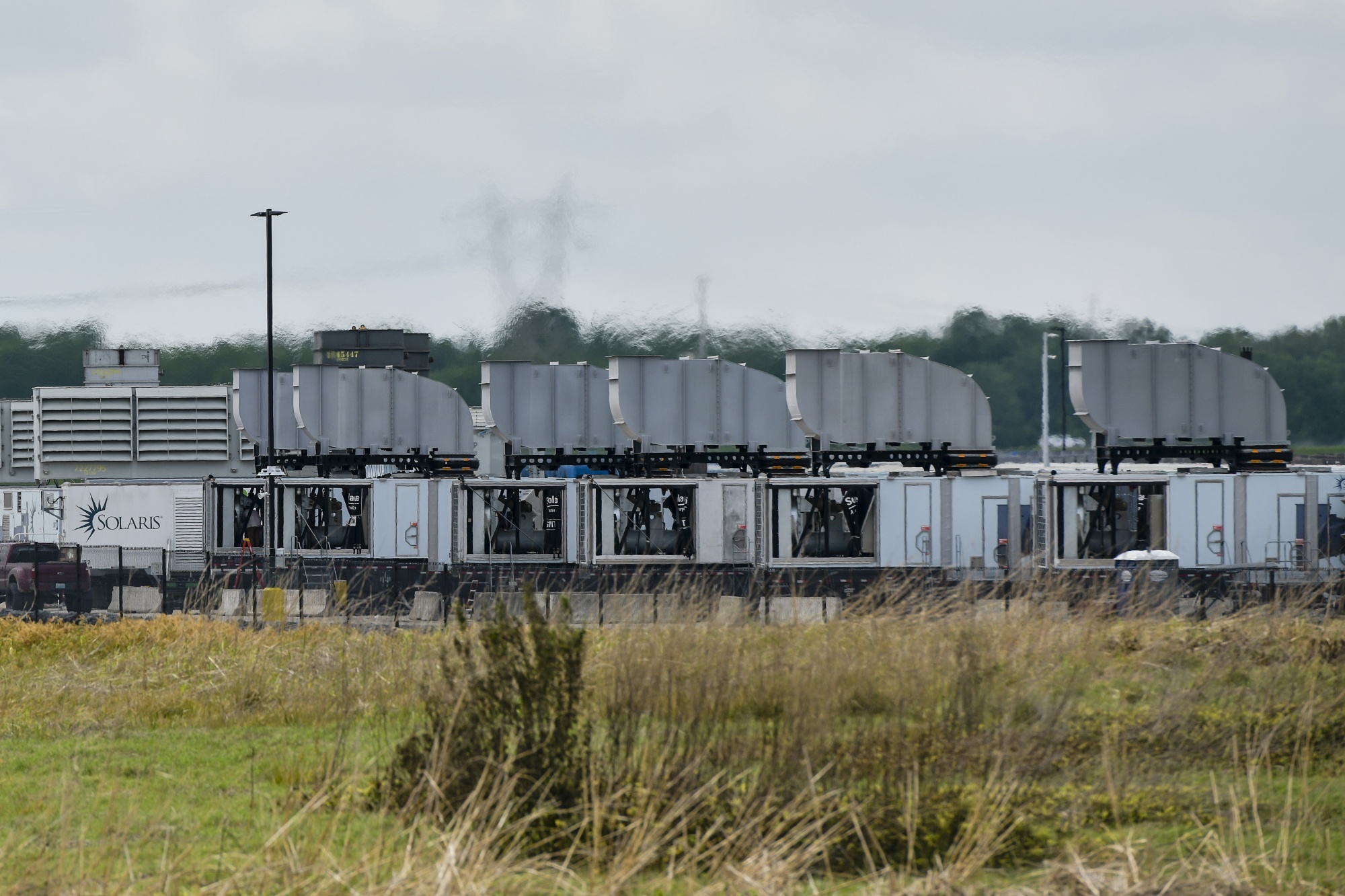
Gas turbines at an xAI data center in Memphis.
Photographer: Brandon Dill/The Washington Post/Getty Images
Data centers also have sharp demand spikes driven by computing-intensive tasks, such as training models. Batteries paired with gas can help provide power rapidly enough to ensure smooth operations. Some of the largest US data center projects are deploying batteries alongside gas generators. At xAI’s Colossus facility, rows of Tesla Inc. Megapacks are being installed next to gas turbines as part of a 1.2 gigawatt off-grid power plant that will supply the massive data center. In West Texas, Pacifico Energy’s GW Ranch off-grid data center will have 1.8 gigawatts of battery storage installed next to 7.65 gigawatts of gas-fired power generation. Williams Cos., a natural gas pipeline operator, plans to install Tesla batteries along with natural gas-fueled power plants its building for several data center projects. “Batteries really help support the turbines and give us the 99.999% reliability,” said Executive Vice President Rob Wingo at the S&P Global Power Markets Conference in Las Vegas last week. Fluence Energy Inc., a global energy storage provider, is in talks with large natural gas companies to supply batteries that can help get data centers up and running before turbines arrive, said Chief Customer Officer Jeff Monday. “We are seeing massive demand coming out of the hyperscalers and data center operators,” Monday said, noting that projects pairing batteries with gas generation are part of the fastest-growing part of the company’s energy storage pipeline. Coupling batteries with natural gas also promises to extend the life and usefulness of fossil fuel plants. That is setting batteries up for a dual role as an enabler to putting more green energy on the grid and delaying the phase-out of fossil fuels. “There is nothing about batteries that are inherently clean,” said Thomas. “Batteries are just a technology.”
Read more
Cost cuts75% How much the price of batteries fell from 2018 to 2025. People power“Solar is a very good example of how private citizens themselves found a solution for high energy prices.” Syed Raza Mohsin Founder, VLEKTRA Electric Motorcycles Mohsin, who sells electric motorcycles in Pakistan, expects battery-powered two-wheelers to account for 10% to 15% of the market in 2026, up from less than 1% two years ago. China’s climate pushBy Lili Pike China will begin a major campaign aimed at accelerating climate action by local authorities, warning regional officials that they will be held accountable for failing to make progress toward President Xi Jinping’s green targets. Starting this year, provinces will be graded on efforts to ensure China’s carbon dioxide emissions peak before 2030, and on objectives to lift clean energy consumption and to limit the use of coal and oil, according to an official document published Thursday by the Xinhua News Agency. 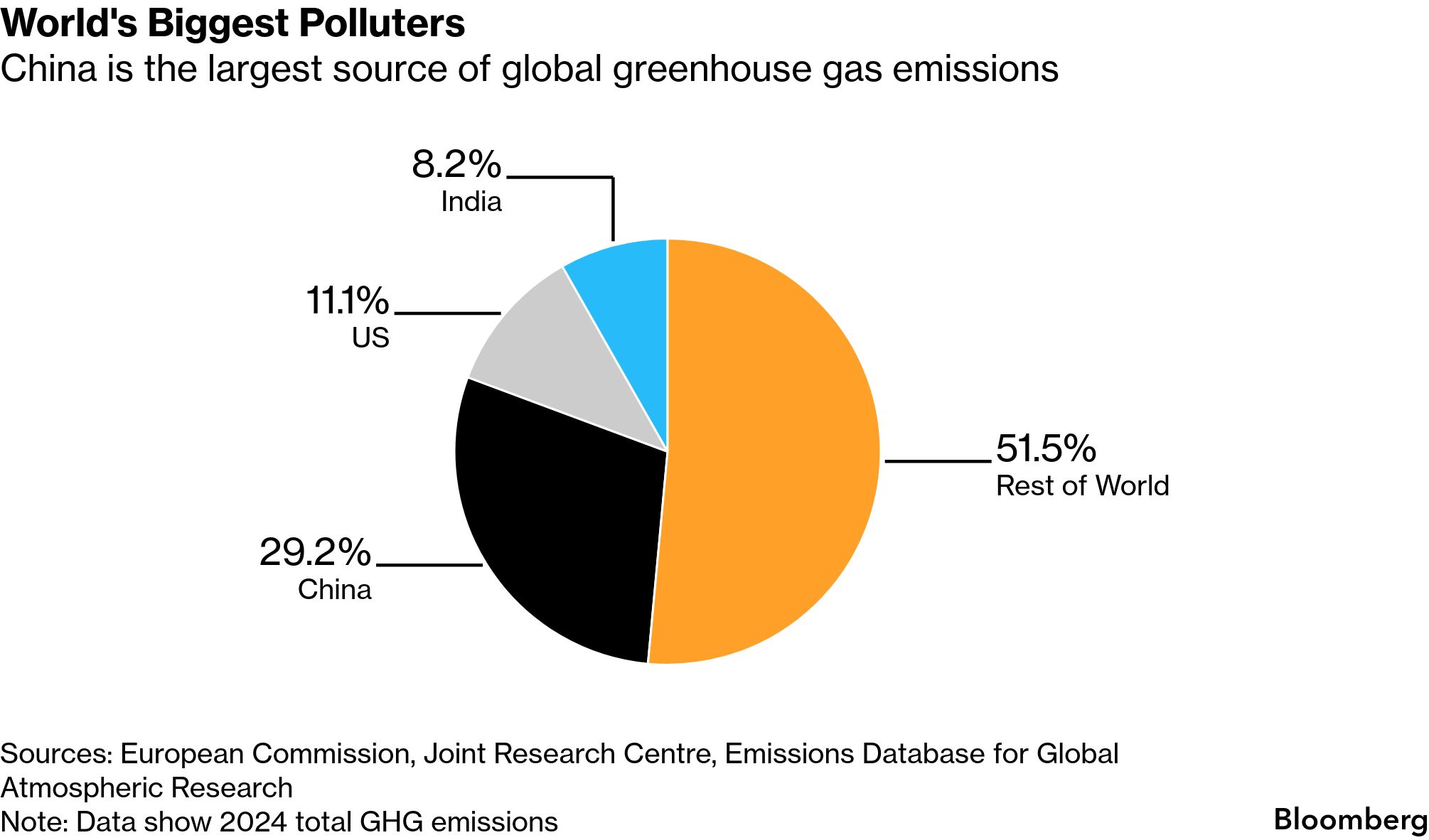
Authorities ranked as making unsatisfactory progress during annual assessments will have 30 working days to set out remedies and could be subject to disciplinary processes if issues aren’t rectified, according to the notice by the State Council and the central committee of the Chinese Communist Party. Individual officials also face potential punishments or rewards dependent on a region’s success. Clean energy companies in China advanced following the release of the new rules. Huadian Energy Co. jumped as much as 10% in Friday trading, while Jinko Power Technology Co. rose as much as 9.6%. Officials in China, the world’s top polluter, have recently stressed the importance of meeting Xi’s goals to peak emissions this decade and to hit net zero by 2060, emphasizing potential benefits from modernizing the country’s heavy industry and further improving energy security. Though recent medium-term climate plans have underwhelmed global advocates of faster decarbonization, Xi in September pledged the nation would be “striving to do better” than those targets. Putting pressure on local-level officials to deliver national policy goals is a familiar strategy for China’s government, with those leaders often evaluated in the past on their region’s contribution to economic growth, air quality improvements or poverty alleviation. The results of the evaluation will serve “as an important reference for the comprehensive assessment, selection and promotion, supervision and management” of provincial leaders and relevant leading cadres, the notice said. Outstanding performers may be rewarded.
Read more
This week’s ZeroSadiq Khan is about to complete 10 years as London’s mayor. He’s seen the city affected by Brexit, the pandemic and two energy crises. That hasn’t deterred him from deploying some of the strongest air-quality regulations in any city. But he hasn’t yet succeeded in getting enough homes built and struggled to keep improving the train network. As cities keep growing, Khan talks to Akshat Rathi about lessons from London’s successes and failures. As a prominent member of the UK’s Labour Party, Khan also shares his thoughts about the future of the party. The interview was recorded on April 16. Listen now, and subscribe on Apple, Spotify or YouTube to get new episodes of Zero every Thursday. More from GreenMore from Bloomberg
Explore all Bloomberg newsletters. We’re improving your newsletter experience and we’d love your feedback. If something looks off, help us fine-tune your experience by reporting it here. Follow Us
You received this message because you are subscribed to Bloomberg’s Green Daily newsletter. If a friend forwarded you this message, sign up here to get it in your inbox.
|






Batteries light up the Amazon
Isolated communities are ditching diesel ...