| Read in browser | ||||||||||||||


I’m Jonathan Tamari, senior Washington reporter for Bloomberg Government, and each weekday I’ll be coming to you with inside-the-room reporting and insights that reveal what’s really happening in Washington—and how it impacts you. Email me with feedback and comments here. If this newsletter was forwarded to you sign up here. Today, The push against “debanking,” tackling DHS morale, and some states reconsider climate laws. Attacking DebankingJohn Ghazvinian is an Oxford-trained academic, but even he was at a loss when his parents’ bank suddenly locked them out of their checking account. It took nearly six months to restore access to their $100,000 and learn the bank had closed the account. Their saga is at the heart of Tom Schoenberg’s must-read dive on “debanking.” The issue directly affected Donald Trump after Jan. 6, 2021. “Debanking,” Tom explains, is when banks close or freeze accounts for people they suspect are up to no good like fraud, elder abuse, or illicit dealings. They often, however, cite vague concerns, leaving clients with little understanding of what they’re suspected of, or how to alleviate it. “Once a bank puts a red flag on a customer, it can be very tough to remove,” Tom writes. The process has drawn outrage on both sides of the Atlantic, he adds, and is now being targeted by the Trump administration as conservatives say they’ve been unjustly affected. 
Capital One signage in front of a bank branch in New York
Photographer: John Taggart/Bloomberg
Trump sued Capital One and JP Morgan accusing them of unfairly closing accounts related to him and his business after the riot at the Capitol. (A judge dismissed the Capital One suit, but gave Trump a chance to refile). Trump has also suggested potential investigations into banks that eject clients who pose certain types of “reputation risk,” one of the more frequently invoked reasons for debanking. It’s a common way banks distance themselves from people or businesses they suspect of illegal activity, but who haven’t been convicted. Trump is focusing on cases of account holders being rejected because of political or religious views, or business activity that’s legal. The effort to crack down on debanking, however, raises concerns that banks might now err on the side of keeping potentially shady clients. “As Trump’s regulators rewrite some of the policies that can trigger debanking, they risk making it harder for firms to expel clients suspected of criminal activity, or more reticent to explain the reasons for turning them away,” Tom writes. Banks, for example, could have turned away Jeffrey Epstein after his 2008 conviction by citing reputational risk, he adds. Instead, he maintained access to the financial system that allowed for his lifestyle. Trump often approaches policy decisions in personal terms, not through an analytical lens of weighing competing interests. This debate has both factors. Top NewsUS allies are reportedly pressing for a last-minute deal with Iran, as Trump extended his deadline for Tehran to reopen the Strait of Hormuz to Tuesday night. Axios reported that Pakistan, Egypt, and Turkey are pushing to secure a potential ceasefire — lasting about 45 days. Over the weekend, US forces rescued a second airman after Iran shot down his jet. Of all the things Donald Trump has done to disrupt global commerce, few would be as consequential as withdrawing from the Persian Gulf and leaving the Strait of Hormuz jammed by Iran. The move would represent a break with decades of US policy on sea lanes carrying four-fifths of the global goods trade. Even the threat of reducing security for the strait risks shaking confidence in a pillar of the global economy, write Gerry Doyle, Peter Martin, and Weilun Soon. Tens of thousands of American citizens, most of them children, could lose public housing benefits under a Trump administration plan targeting immigrants without lawful status, Andrew Kreighbaum writes. The proposal would upend more than three decades of housing policy allowing families to receive rental vouchers or public housing based on the number of eligible members in their household. Even some liberal states are re-considering climate laws as gas prices spike. The push includes efforts in California, New York, and Massachusetts, Todd Woody reports. It shows how, for public officials, affordability now trumps everything. Ships are in, electric vehicles are out, and space technology is useful — if it puts astronauts on the moon — according to Trump’s new budget. Andrew Ramonas and Aaron Gregg break down the winners and losers from the administration’s proposed spending priorities. Watch This 
Former Greenhill CEO Scott Bok tells Odd Lots’ Joe Weisenthal and Tracy Alloway what it is that investment bankers do (and why AI won’t fully replace them)
Go Deeper With BGOVFirst-half fiscal year procurement spending spikes within the Department of Homeland Security led to a 190% increase for the agency, compared with the first half of fiscal 2025, BGOV contracting analyst Maika Ito writes. 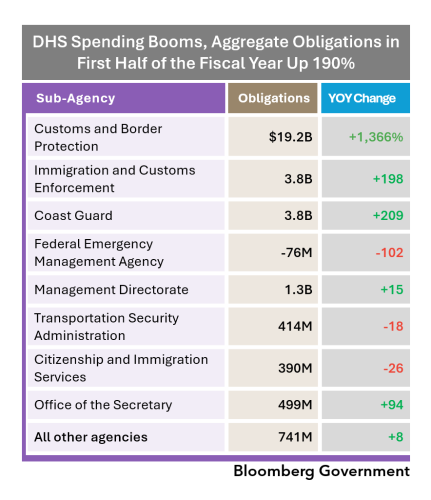
What’s Coming TodayTrump hosts a news conference at the White House at 1 p.m. House and Senate hold pro forma sessions Institute for Supply Management services index gives us an indication of how that part of the economy is holding up The White House holds its annual Easter Egg Roll More From BloombergLike Washington Edition? Check out these newsletters:
Explore all newsletters at Bloomberg.com. We’re improving your newsletter experience and we’d love your feedback. If something looks off, help us fine-tune your experience by reporting it here. Follow us
You received this message because you are subscribed to Bloomberg’s Washington Edition newsletter. If a friend forwarded you this message, sign up here to get it in your inbox.
|




Trump’s Iran ultimatum
Bloomberg Morning Briefing Americas ...