| Read in browser | ||||||||||||||
 This is Washington Edition, the newsletter about money, power and politics in the nation's capital. Today, senior domestic policy reporter Ted Mann looks at how the president is handling two issues defining his term. Sign up here. Email our editors here. Making a StatementFor a president notoriously bothered by rejection, Donald Trump put a lot on the line in an all-day public offensive on two issues that will help define his legacy. In a historic first, Trump personally attended oral arguments at the Supreme Court on his attempt to restrict birthright citizenship, a maneuver that would undo more than a century of legal precedent and alter the makeup of the country. He departed from his front-row seat about half-way through, after hearing the justices' deeply skeptical questioning of the administration's position, as reported by my colleague Greg Stohr. Trump then blasted away at birthright citizenship in a fact-challenged online post. 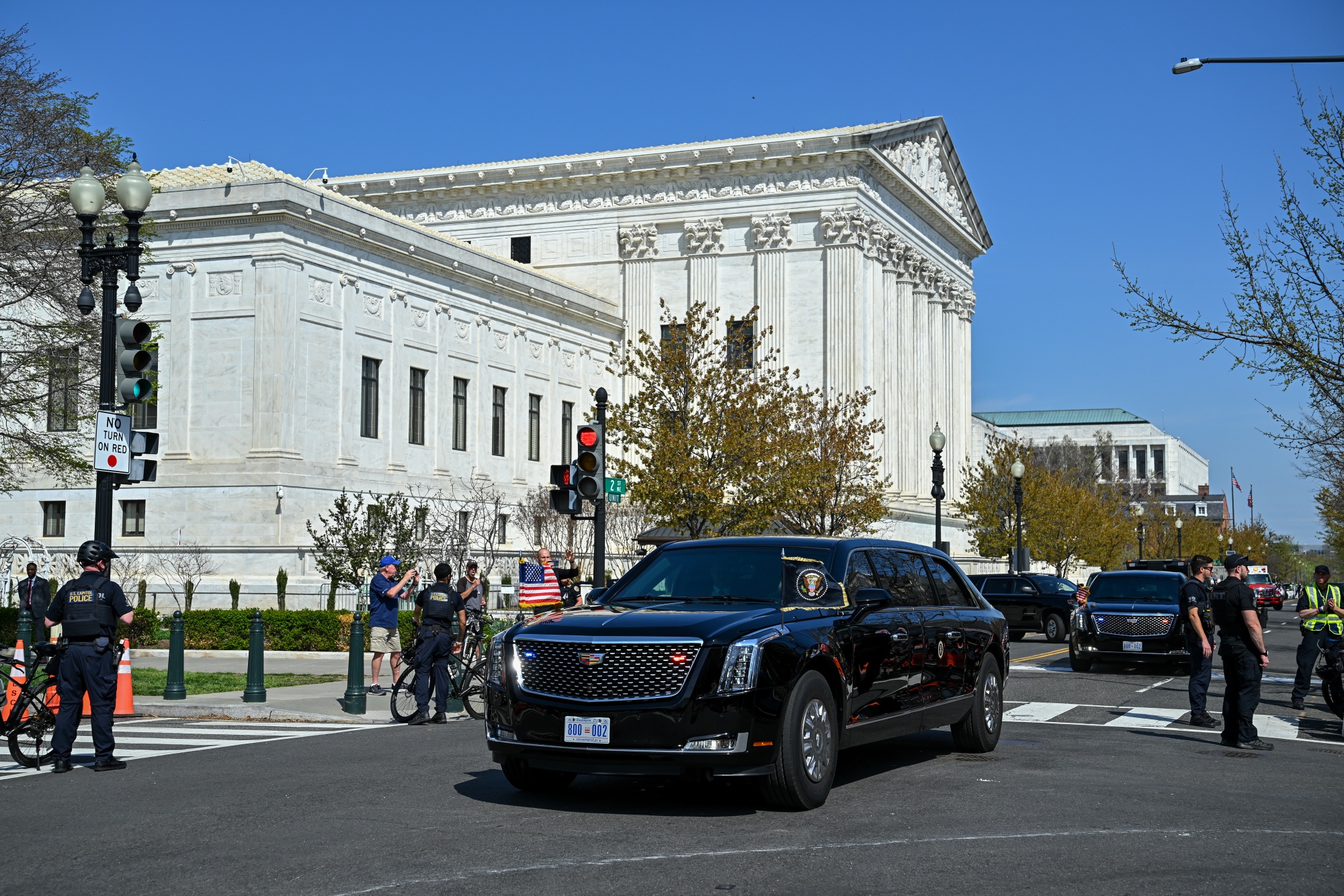 President Donald Trump's motorcade departs the Supreme Court . Photographer: Graeme Sloan/Bloomberg An even bigger moment comes tonight. The president will do something he hasn't done in five weeks since the US and Israel launched a war with Iran: try to provide a coherent explanation of the conflict in an address to the American public. Trump's past statements on the Iran campaign, doled out on social media and off-the-cuff pronouncements, show what a challenge that might be. He's offered a blizzard of differing and sometimes contradictory rationale and objectives for the war, which has upended oil markets, shaken economic forecasts and bitterly divided the US from its NATO allies. Read More: Trump Seeks War Off-Ramp, Floats More Attacks to Press Iran Trump regularly says the US attack was aimed at deterring Iran's nuclear weapons program, even though he had deemed it "obliterated" by airstrikes last June. He has variously suggested that the US might seize Iran's oil reserves (an act of plunder that could violate international law) and vacillated on whether his intent was regime change – a goal he now claims to have achieved. The president has also said he would accept nothing less than unconditional surrender from Iran and then touted productive negotiations (which Tehran has denied). He's set deadlines and extended them. He told Reuters in an interview he doesn't care about Iran's enriched urnanium because it's buried "so far underground." Tonight, Trump will lay out a two- to three-week timeline for ending the war, a White House official told my Bloomberg News colleague Hadriana Lowenkron, and will say that the US military is achieving all of the goals it set before the start of the war on Feb. 28. It's not clear how he'll address the Strait of Hormuz, a choke point for about one-fifth of the world's oil supply. Just yesterday, Trump suggested it would be up to other nations to resolve opening the strait for tanker traffic. This morning brought a different tone. Trump said Iran had offered a ceasefire but that the US will consider it once the Strait of Hormuz is "open, free, and clear." "Until then," the president wrote on Truth Social, "we are blasting Iran into oblivion or, as they say, back to the Stone Ages!!!" — Ted Mann Today's Top NewsTrump's threat to exit NATO as retaliation for the bloc's failure to help reopen the Strait of Hormuz faces a major obstacle — one that comes from his very own secretary of State, Marco Rubio. The Justice Department is appealing a federal judge's order earlier this year that required immigration authorities to release a 5-year-old boy whose photo became a symbol of the Trump administration's hardline policies. Companies in the US added more jobs than expected last month, led by the education, health services and construction sectors, suggesting the labor market may be stabilizing. 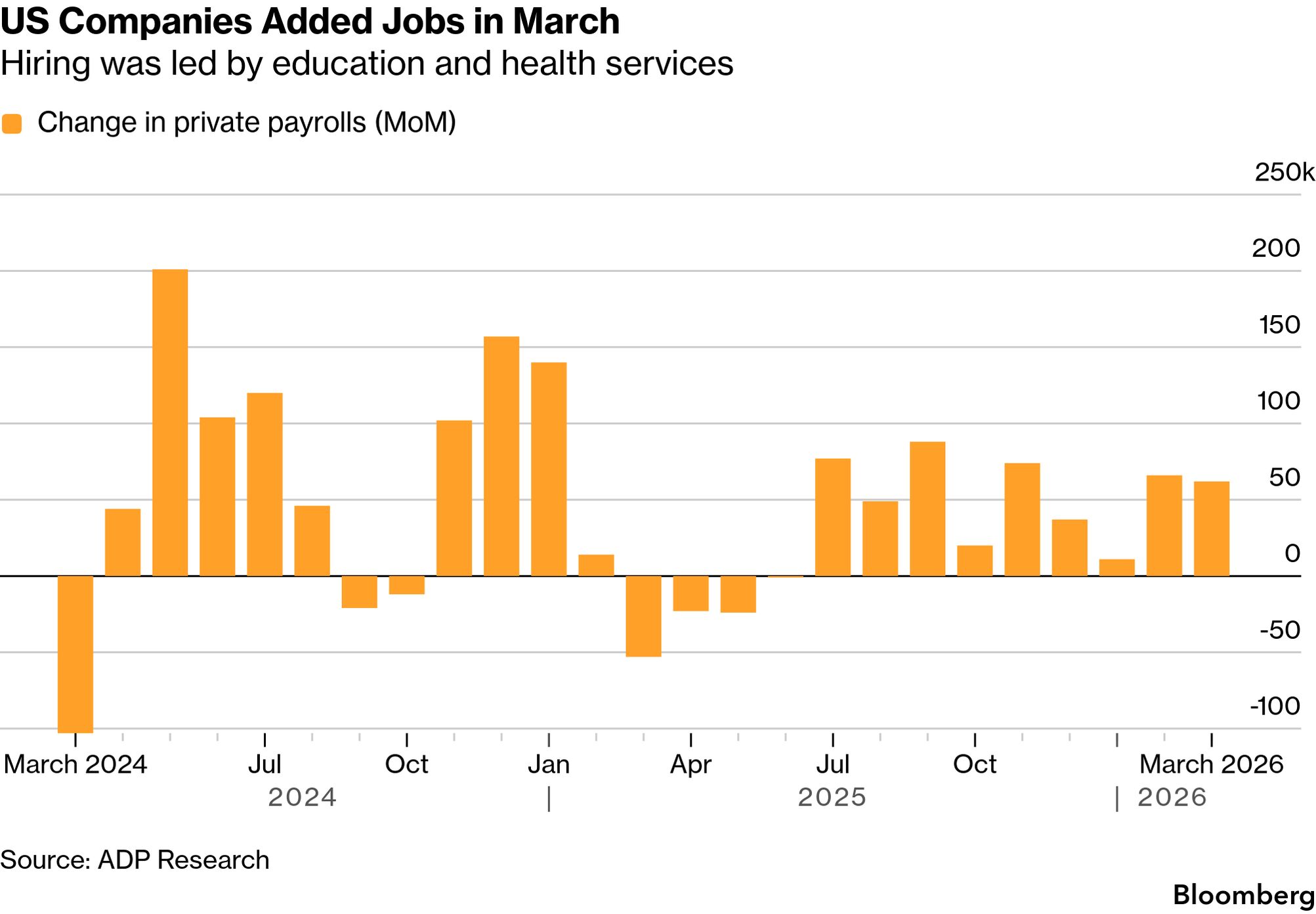 In another bit of good news for the US economy, retail sales rebounded by more than forecast in February in a broad advance as consumers stepped up spending after a slow start to the year. Mortgage rates climbed for a fourth straight week, to 6.57% for the typical 30-year loan, bringing them to the highest since August and denting refinancing and home purchase activity. US manufacturing activity expanded in March by the most since 2022, though prices for inputs continued to surge amid the war with Iran, which may put pressure on firms to raise prices. Trump's long reticence to direct the Republican-controlled Congress on how to clear a standoff on Department of Homeland Security funding has triggered tumult within his party and imperiled GOP unity. The Commodity Futures Trading Commission's enforcement chief said the agency will use its powers to root out insider trading in prediction markets, as concerns about suspicious activity on the exchanges grow. Powerus, a drone company backed by Trump's eldest sons, has met with officials in Abu Dhabi to discuss selling weapons to the United Arab Emirates as the country looks to shore up its defense systems against attacks from Iran. Must Reads From Bloomberg GovernmentGOP leaders agreed to fund the Department of Homeland Security using a two-track path after Trump called on Congress to send a party-line bill to fund immigration and border agents to his desk no later than June 1. A group of House Democrats is seeking to use Congress' appropriations process to block a federal government initiative that they say could be used to deny coverage for those enrolled in traditional Medicare. Watch & ListenToday on Bloomberg Television's Balance of Power early edition at 1 p.m., hosts Joe Mathieu and Kailey Leinz interviewed former Vice President Mike Pence about the war with Iran, the US relationship with NATO and the president's appearance at the Supreme Court. 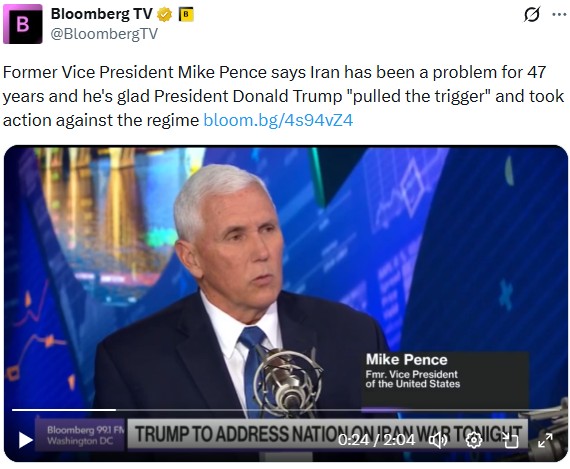 On the program at 5 p.m., they talk with Julianne Smith, who was US ambassador to NATO during the Biden administration, about the war and the future of the alliance. On the Big Take podcast, host Sarah Holder talks to Bloomberg defense policy and intelligence reporter Peter Martin about the Middle East's reliance on desalination for water, the potential humanitarian crisis that targeting the plants could spark and how that action could fly in the face of international law. Listen on iHeart, Apple Podcasts and Spotify.  Chart of the Day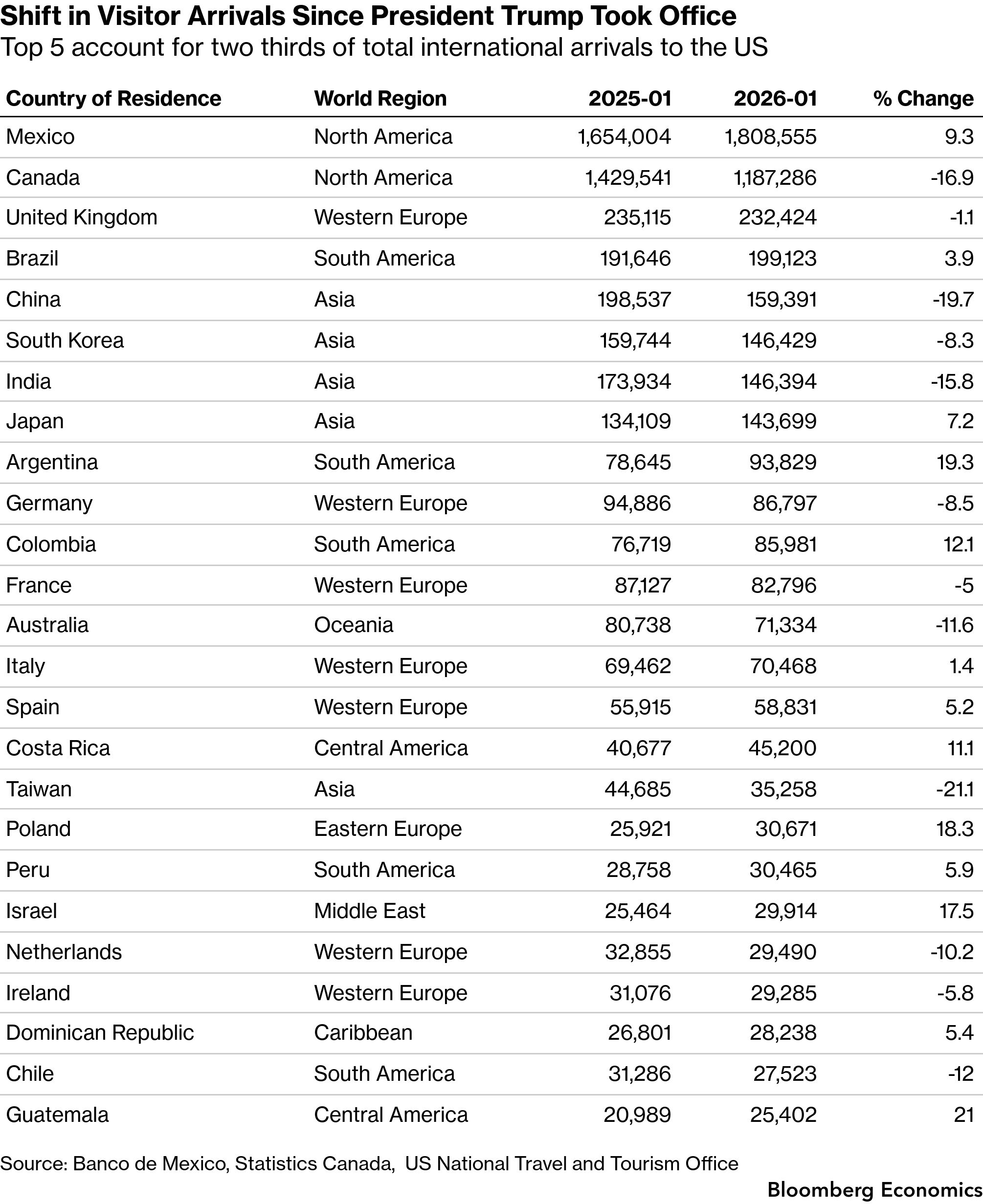 The number of international visitors arriving in the US declined 3.5% overall during Trump's first year in office. In January of this year, Mexico was the biggest source of international arrivals with 1,808,555, an increase from the same time last year. Canada was second with 1,187,286, but that marked a significant decline. After that came the United Kingdom (232,424), Brazil (199,123), and China (159,391). The top five combined accounted for 66.3% of all international arrivals. There has been a drop off of at least a 10% in visitors from Taiwan, China, Canada, India, Chile, Australia, and the Netherlands. Meanwhile, gains of at least 10% were seen from Costa Rica, Colombia, Israel, Poland, Argentina, and Guatemala. During the same one year period, outbound international travel by US citizens increased 5.8%. — Alex Tanzi What's NextThe nation's trade deficit in February will be reported tomorrow. The jobs report for March will be released Friday. The White House is set to release its budget request for fiscal 2027 on Friday. US stock and bond markets will be closed for Good Friday. Durable goods order in February will be reported on Tuesday. The Federal Reserve's preferred gauge of inflation for February will be reported April 9. The consumer price index for March will be released April 10. More From BloombergLike Washington Edition? Check out these newsletters:
Explore all newsletters at Bloomberg.com. We're improving your newsletter experience and we'd love your feedback. If something looks off, help us fine-tune your experience by reporting it here. Follow us
You received this message because you are subscribed to Bloomberg's Washington Edition newsletter. If a friend forwarded you this message, sign up here to get it in your inbox.
|




Waiting for a sign
The future of the Iran war remains in doubt. Read in browser International organizations, government leaders and Wall Street are attempting to divine the endgame of the US-Israel war with Iran amid increasingly chaotic and contradictory statements by President Donald Trump as his administration struggles to find a way out of the month-old conflict . The war has pushed US pump prices above $4 a gallon, threatening political pain for Republicans in a midterm election year. Trump, 79, is said t...