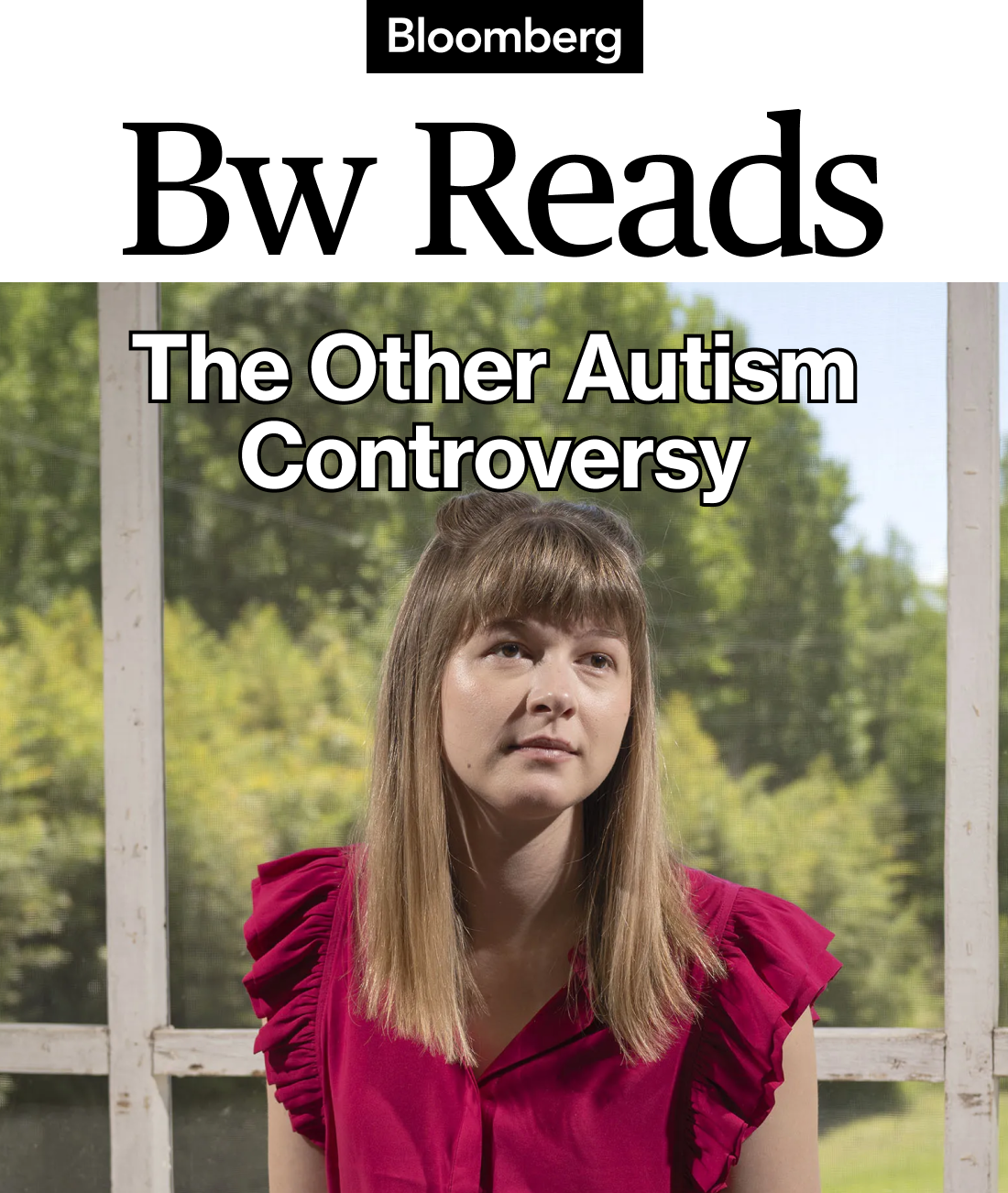
Welcome to Bw Reads, our weekend newsletter featuring one great magazine story from Bloomberg Businessweek. Today, Amanda Cantrell and Christopher Beam write about America’s go-to autism therapy, known as ABA. Some parents and patients swear by it. Critics call it harmful. And no matter your view, it’s a big business. You can find the whole story online (free!) here. If you like what you see, tell your friends! Sign up here. Kaelynn Partlow doesn’t seem like she’d have haters. The friendly, energetic 29-year-old is best known for appearing on Love on the Spectrum, the Netflix reality show about the joy and agony of dating as an autistic person. These days, she lives in Greenville, South Carolina, and works with autistic kids. She also gives talks around the country and has developed a huge following on social media, where she posts videos debunking misconceptions about autism and offering advice for interacting with autistic people. Yet Partlow has a tendency to make people mad online. There was the time she posted a video in which a colleague purposely mispronounced Zohran Mamdani’s name, drawing accusations of racism. Or when she used the phrase “human meat puppet” to refer to the practice of helping autistic people use certain types of assisted communication. Or when she suggested that highly articulate autistic people like herself aren’t given as much grace as those with low verbal skills. She deleted or apologized after each of these missteps, all of which could be chalked up to the classic autistic difficulty with reading a room. But to some of her detractors, those gaffes aren’t the worst of it. Critics consistently object to her earnest endorsement of a form of autism therapy called applied behavior analysis, or ABA. Partlow was hyperactive and distracted as a child, and she struggled with dyslexia and dyscalculia. “I failed the third grade, which you wouldn’t think you could do, but I did,” she says. After that, she was diagnosed with autism. She tried a few different kinds of therapy over the years—occupational therapy, speech language therapy—but eventually embraced ABA. Like other kinds of behavioral therapy, ABA is about shaping actions through reinforcement. When a patient does something good, they get a reward. When they do something bad, they get punished—or, more likely nowadays, have rewards withheld. Partlow’s instructors would take her out for ice cream if she achieved her goals; if she misbehaved, for instance by being rude, they would dump books on the floor and tell her to pick them up. “I don’t think they would operate in that way now,” she says. “But it was effective.” She later became a certified ABA practitioner herself, and she promotes the treatment online as scientific and productive. “It gets downright NASTY every time, from both sides” Partlow has written that whenever she posts about ABA, “It gets downright NASTY every time, from both sides.” Some of her critics have compared ABA to dog training or conversion therapy. One TikToker posted a video about her that described it as usually “abusive.” A Redditor called Partlow a “trojan horse” to make the treatment look more appealing. More constructive criticisms challenge Partlow’s characterization of ABA as a “science” or suggest that it isn’t appropriate for everyone. Many of her critics cast it as favoring conformity over embracing differences. The polarization partly reflects ABA’s ubiquity. Touted by supporters as the “gold standard” and backed by endorsements from the US surgeon general, the American Psychological Association and the American Academy of Pediatrics, it’s the go-to treatment recommendation for many children newly diagnosed with autism. Kids are regularly prescribed regimens of as many as 40 hours per week, compared with only a few hours for, say, speech or occupational therapy, and all 50 states require insurance companies to cover it. Many parents say ABA has helped their children adapt to a society that’s not designed for them. But with its spread has come the pushback—from therapists, social scientists and autistic adults, who argue it’s ineffective at best and traumatizing at worst. One recent study found that children who’d received ABA were 30% more likely to be hospitalized for mental health issues than a control group. ABA’s rise in the US isn’t a simple tale of good guys and bad guys. Rather, it’s the result of well-intentioned but imperfect research combining with intensive lobbying, profit motives and a community desperate for answers and support. It’s also a distinctly American response to a distinctly American set of factors; ABA is less dominant in European countries, which by and large don’t legally recognize or regulate it, let alone require insurance to cover it. Autism has moved to the center of the public discourse in recent years, thanks to the climbing diagnosis rates and the attention of Health and Human Services Secretary Robert F. Kennedy Jr. Rather than focusing on treatment and accommodation, though, the discussion has largely been about causes and prevention, including Kennedy’s dubious claims about links with vaccines and with Tylenol taken during pregnancy. While the antivaccine circus generates headlines, the ABA debate is the one autistic people and their families live with day to day. Sure, let research scientists try to figure out what causes autism. In the meantime, what should everyone else be doing to manage it?
Keep reading
On the PodcastThis week the Everybody’s Business podcast by Bloomberg Businessweek looks at two legal battles reshaping the worlds of tech and public health. First, OpenAI is in the middle of a court fight with Elon Musk over whether it betrayed its altruistic mission in pursuit of profit. The company in the meantime is pivoting to hardware. Bloomberg News editor Mark Gurman breaks down whether that’s what consumers actually want or whether that’s just a convenient distraction. Then, the Make America Healthy Again movement went to the Supreme Court this week to fight Bayer, maker of herbicide Roundup. Businessweek columnist Deena Shanker, who was at the protest, joins the show to explain what the case means for the food industry and a movement at odds with the administration it helped elect. Listen and subscribe on Apple, Spotify, iHeart and the Bloomberg Terminal. More Bw Reads
Illustration: Erik Carter for Bloomberg Businessweek; Getty Images
 
Weekly Doc: How a Secretive Trading Empire Is Taking Over Wall Street
Play Alphadots!Our daily word puzzle with a plot twist. 
Today’s clue: Black and green rock? More From BloombergLike Businessweek Daily? Check out these newsletters:
Explore all Bloomberg newsletters. We’re improving your newsletter experience, and we’d love your feedback. If something looks off, help us fine-tune your experience by reporting it here. Follow Us
You received this message because you are subscribed to Bloomberg’s Businessweek Daily newsletter. If a friend forwarded you this message, sign up here to get it in your inbox.
|





Singapore Edition: Beijing upends the Manus Model
A one-line decree from Beijing just scuttled a bet on Singapore becoming a sanctuary for Chinese AI. ...