| Read in browser | ||||||||||||||

Have you recently found yourself stumped on what to wear because the weather is so changeable? Today’s newsletter looks at the ups and downs of spring temperatures. These swings are a feature of the season, but they’re getting wilder because of climate change. Plus, why the Bank of Montreal is betting on AI for earthquake prediction and wildfire response. Subscribe to Bloomberg for unlimited access to all our stories. From sweaters to T-shirts and back againBy Eric Roston and Emma Court Dramatic temperature jumps marked this March and April in the US Northeast, making it hard to know what to dress for: chilly or sweltering conditions? Researchers have concluded that wild temperature swings are becoming more common as the world heats up. That’s changing how we experience spring, with plants blooming sooner and consumers rushing to buy more warm-weather goods earlier in the year. 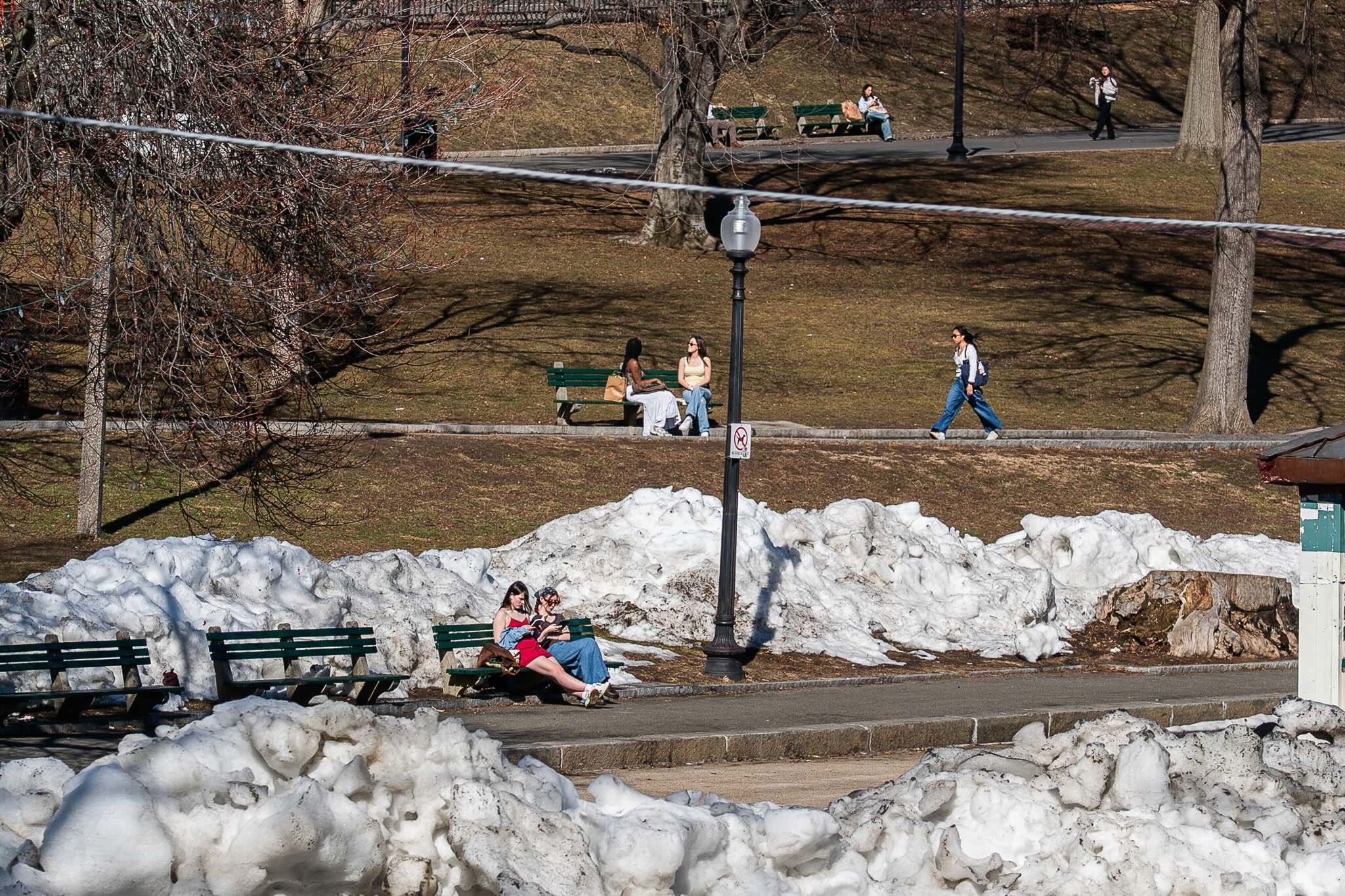
Snow piles linger on a warm spring day at the Boston Common, on March 9, 2026.
Photographer: Boston Globe
Andra Garner, a meteorologist and climate scientist at Rowan University in New Jersey, was struck by the ups and downs of spring weather a few years ago. Finding herself switching back and forth between heating and air conditioning, she went on to research the matter. From 1950 to 2019, New Jersey saw increasing variation in daily high and low temperatures in late winter and spring, Garner found in a 2024 study. She and her co-author, environmental scientist Dan Duran, also of Rowan, defined swings as changes from above 60F (16C) to below 32F (0C). Consider this April 23, when the temperature in New York City hit 73F shortly before 4 p.m. — a full 28 degrees higher than it had been 12 hours earlier. On April 13, the high was 79 — 30 degrees above the overnight low — while on April 4 the temperature fell to 42 from 73. Those jumps are bigger than the month’s average daily fluctuation of 17 degrees at Central Park’s weather station. Fluctuations over multiple days are also growing larger. 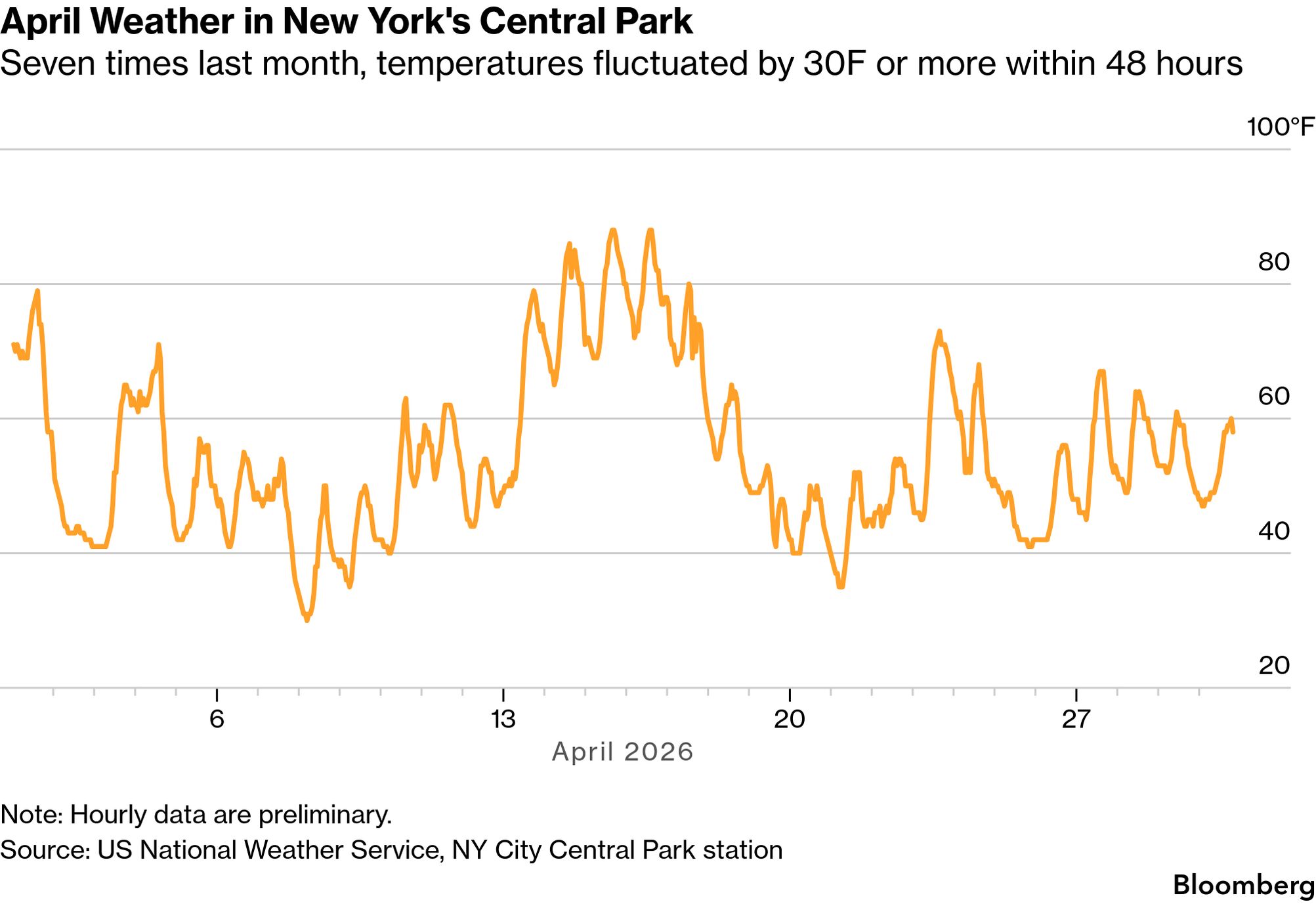
Springtime weather is naturally wild. But the size of recent temperature shifts points to the influence of climate change, experts say. “It’s not unusual to have such variability in the spring, but the extremes are a little more extreme,” said Marshall Shepherd, director of the University of Georgia’s atmospheric sciences program. “That’s always been a hallmark of what we expected in climate change.” Greenhouse gas pollution, as well as kick-starting spring sooner in the year, may be adding spikiness to daily highs and lows. Temperatures are rising earlier across the Earth’s temperate band; a hotter Gulf of Mexico is pushing warm air north; a wobblier jet stream lets more cold Arctic air travel south. In other words, the ingredients are ripe for surprises. More than 60% of the globe has experienced more common, intense and rapid temperature flips since 1961, a trend that is expected to worsen, according to a 2025 study in the journal Nature Communications. Extreme day-to-day temperature changes “are an independent, but largely ignored, aspect of extreme weather events” that may grow in frequency and intensity this century by 20%, a different team of researchers wrote last year. “Recent studies suggest these whiplash events are increasingly frequent and will become more common in the future,” said Jennifer Francis, senior scientist at the Woodwell Climate Research Center, whose research documents how Arctic warming may be affecting Northern Hemisphere weather. “So in terms of wardrobe-planning, be ready for anything, especially in New England,” Francis said.
Read more
Unseasonal heat90F The temperature recorded in New York’s Central Park on April 15, even higher than forecast and a new record. Spring drought“This certainly ranks up there with some of the worst we’ve seen.” Brad Rippey Meteorologist, US Department of Agriculture An intense drought in the Great Plains is threatening wheat harvests. Banking on disaster predictionBy Miranda Davis and Yizhu Wang Bank of Montreal is betting on artificial intelligence and quantum computing to help predict earthquakes and respond to wildfires as part of the Canadian bank’s expansion in the US. Kristin Milchanowski, the company’s chief AI and quantum officer, said she has created and received a provisional patent for a quantum algorithm that will eventually help BMO and other scientists predict earthquakes. The bank is also using AI to help it mobilize mobile banking units to communities impacted by wildfires like the ones Los Angeles experienced last year. The technological advancements are a key part of BMO’s expansion in the US after it acquired California’s Bank of the West for about $16 billion in 2023. While the quantum algorithm to predict earthquakes still need to be tried and tested, BMO is going to integrate the wildfires technology into its emergency response system.
Read more
This week’s ZeroWe are living in an increasingly divided world. It took two decades to get to the Paris Agreement, and then global cooperation really lasted only for a decade. One key reason for this fragmentation is US President Donald Trump, who has taken an axe to the rules-based international order that America helped build. This week on Zero, Gordon LaForge, senior policy analyst at think tank New America, tells Akshat Rathi what comes next, and how progress can still be made on climate. Listen now, and subscribe on Apple, Spotify or YouTube to get new episodes of Zero every Thursday. More from Bloomberg
Explore all Bloomberg newsletters. We’re improving your newsletter experience and we’d love your feedback. If something looks off, help us fine-tune your experience by reporting it here. Follow Us
You received this message because you are subscribed to Bloomberg’s Green Daily newsletter. If a friend forwarded you this message, sign up here to get it in your inbox.
|




Singapore Edition: Beijing upends the Manus Model
A one-line decree from Beijing just scuttled a bet on Singapore becoming a sanctuary for Chinese AI. ...